



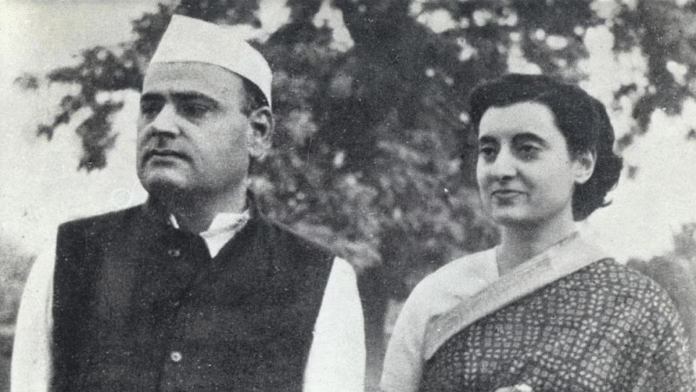

“This is not your House, or my House; it is the House of the people,” Feroze Gandhi had said in the Lok Sabha in March 1956. Nearly 75 years after India became a republic, the line still reads like a compact definition of parliamentary journalism—what is said inside the legislature belongs to those outside it.
Gandhi was speaking while moving a private member’s Bill to protect the publication of reports of Parliament proceedings, state legislatures and their committees. It was not an abstract defence of press freedom. He was responding to a practical problem. Legislators enjoyed parliamentary privilege for what they said inside the House, but newspapers reporting those speeches could face civil or criminal action.
“The law of libel hangs like the sword of Damocles over the head of every editor and correspondent,” he said. It operated, he argued, as a “silent censor”, keeping people from knowing what they have a right to know.
His argument began with the testimony of journalist K. Ramachandran, the Press Trust of India’s special representative covering Parliament, who told the Press Commission that he could not report proceedings truthfully because the Constitution did not protect him.
Feroze Gandhi said he had visited Ramachandran’s office and found a copy of the Indian Penal Code in his drawer. “I think he at times even dreams of it,” he told the House.
He painted an evocative image of the parliamentary reporter surrounded not merely by speeches and notes, but by the law that might punish him for reproducing them.
Gandhi’s Bill became the Parliamentary Proceedings (Protection of Publication) Act, 1956. It was principally for substantial true reports of legislative proceedings, provided they were not malicious and were published for the public good.
For Gandhi, however, the larger issue was simple: Parliament was supposed to be the people’s House. If citizens could not know what their representatives said and did inside it, they could not hold them accountable.
The argument also revealed the unusual quality of his politics. Gandhi was a Congress MP, not an Opposition politician attacking the government from outside. Yet he was arguing that public scrutiny was necessary to keep those in power honest.
His instinct was that of a reporter, to identify the legal obstacle, speak to people who encounter it and put a concrete remedy before the public.
From ‘Ghandy’ to ‘Gandhi’
Feroze Jehangir Ghandy was born in Bombay on 12 September 1912 into a Parsi family. After his father’s death, he moved to Allahabad, which brought him into the orbit of the freedom movement and the Nehru family. At 18, he came to the aid of Kamala Nehru after she fainted during a protest outside his college. The encounter drew him closer to political activism. He eventually left college and joined the freedom struggle.
Around this time, he changed the spelling of his surname from Ghandy to Gandhi, reportedly in honour of MK Gandhi.
He later became close to Indira Nehru. Their relationship developed while they were both studying in England. They returned to India and married at Anand Bhawan in Allahabad on 26 March 1942.
The marriage brought Feroze Gandhi into one of India’s most powerful political families. But his career repeatedly showed that proximity to power did not necessarily translate into deference to it.
The challenge was characteristic. He did not regard the press as a passive observer of Parliament. He saw reporters and news agencies as participants in the democratic process—institutions that could hold power to account, but could also fail through caution and omission.
The Bill eventually passed with safeguards. It was not a licence to print allegations. It protected responsible reporting of parliamentary proceedings.
The reporter becomes an investigator
The same method appeared in Feroze Gandhi’s better-known parliamentary interventions.
In 1955, he raised financial irregularities linked to the Dalmia-Jain group. His intervention drew attention to the misuse of funds and contributed to government action against industrialist Ramkrishna Dalmia.
Three years later, he turned his attention to the Life Insurance Corporation’s investment in six ailing companies associated with businessman Haridas Mundhra.
The LIC had been created as a public institution, and Feroze Gandhi questioned why public money was being used to support a private businessman. His campaign led to the appointment of the Chagla Commission and was followed by the resignation of Finance Minister TT Krishnamachari.
Feroze Gandhi’s scrutiny also moved beyond businessmen to the political system that regulated them. He increasingly saw that questionable transactions could not be understood without examining the officials and institutions involved.
That made his position particularly unusual. He was not merely attacking private capital while defending the government. He was demanding accountability from both.
Also read: Partition child Sunil Dutt fought for Hindu-Muslim unity, from marriage to peace marches
Independence inside the family
Feroze Gandhi’s independence was not confined to Parliament. In 1959, when the Centre dismissed Kerala’s elected Communist government, he criticised the move. According to a later recollection cited by biographer Bertil Falk, the issue came up during breakfast at Teen Murti. Feroze told Indira: “It is just not right. You are bullying people. You are a fascist.”
The anecdote captures something important about Feroze: his opposition to concentrated power was not simply a parliamentary pose. He was willing to challenge it inside the Nehru family as well.
By then, his marriage to Indira had become strained, even as both continued their political lives.
Feroze Gandhi died on 8 September 1960, four days before his 48th birthday.
He entered public life through journalism and carried the journalist’s habits into Parliament: ask who benefits, follow the document, test the official version and speak truth to power.
In the first decade of the Republic, when Congress dominated Parliament and the Opposition was weak, Feroze Gandhi demonstrated that scrutiny did not necessarily have to wait for a change of government.
(Edited by Ratan Priya)