


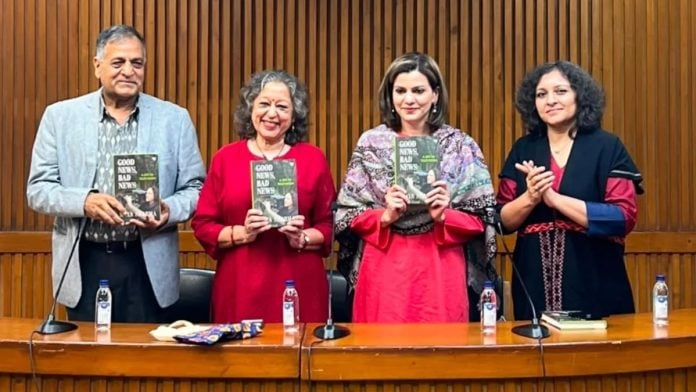
New Delhi: There was a time when politicians would turn up at designated spots to speak to television reporters. During the five to ten minutes allotted for an Outside Broadcast, or OB, politicians sought out journalists and travelled the distance, knowing that a few minutes on television could serve their interests. For journalist Maya Sharma, who has spent 36 years in television news, those times are long gone and getting those in power to answer questions has become a far greater challenge for journalists in India today.
According to Sharma, the change reflects an erosion of the relationship between the press and political power—a theme that runs through her debut book, Good News, Bad News: A Life in Television, published by Westland Books and launched at the India International Centre (IIC) in New Delhi on Thursday.
Sharma worries that younger journalists have grown accustomed to a political culture in which the Prime Minister does not hold open press conferences.
“There’s a whole generation of young journalists who have grown up thinking that it’s fine that a prime minister doesn’t give a press conference,” she said. “That this is how it must be, because they haven’t seen a different time.”
The book traces Sharma’s career from Doordarshan to NDTV under Prannoy and Radhika Roy, and her subsequent brief contractual stint with the Adani Group. But it is also an account of what has happened to television journalism, the institutions that shaped it and the space available to reporters to question those in power.
For Sharma, one of the most painful chapters has been watching the organisation she helped build change overnight after the takeover. While writing the book, she went back to watching the channel to see whether the changes she had observed were continuing.
“Some of the scripts and headlines,” she said, “would never have been allowed on air in the earlier NDTV”.
She cited certain phrases and described them as partisan and markedly different from the effort at balance that had once governed the newsroom.
“When you work for a long time for an organisation with integrity, you try to build up its reputation,” she said.
Senior journalist Nidhi Razdan, who moderated the panel, chimed in: “I wish they had also changed the name of the channel.”
‘Never cared about ratings’
The discussion, attended largely by Sharma’s former NDTV colleagues and admirers, was as much a reunion of a newsroom generation as a book launch.
Former election commissioner Ashok Lavasa, chief guest at the event, recalled in his opening remarks that he had first noticed Sharma’s reporting from Bengaluru in May 2018, before the two had even met. Struck by her composure, he sent her a message through a colleague, describing her as having a “divine indifference to the goings-on”—a quality he considered the hallmark of professionalism.
Having read the manuscript, Lavasa said the book was written in the same manner as her reporting: “Very frank, candid, no complications. Just say what you want to say.”
Sharma’s career began at Doordarshan—branded the “original Godi media” by Lavasa—where government control placed clear limits on what could be reported. She recalls being instructed to cover visits by the prime minister and Union ministers, including inaugurations and ribbon-cutting ceremonies, and had to just report on the ceremony.
“We could never criticise the government,” she said.
She remembers her husband returning from a reporting trip after accompanying a police party into the forest during the search for the infamous bandit Veerappan. The next day, six policemen were killed in an attack. When he called the Doordarshan desk with the story, the response was: “We don’t do crime news.”
The arrival of private television changed that landscape. At NDTV, Sharma found room for stories that state broadcasting would not have touched, as well as the freedom to report beyond the narrow demands of official coverage. She and Razdan recalled India Matters, a long-format programme that sent reporters to rural parts of the country for a week to work on stories ranging from food-grain shortages to rainwater harvesting. Documentaries were broadcast even without the promise of ratings.
“We never cared about ratings back then. It changed much later,” Razdan said.
She recalled an incident when she was rostered for India Matters, and a major news story broke. Her then editor, Rajdeep Sardesai, asked her to get a reaction for the breaking story. Razdan protested that she was supposed to be working on India Matters.
“India does not matter,” she laughed, recalling Sardesai’s reprimand—a joke on the name of the programme. “Go get me the byte.”
Sharma agrees that the space for in-depth reporting has steadily contracted. The race to be first, the pressure to go live, write copy for the website and feed social media have left journalists with less time to investigate. Technology has made reporting faster and more accessible, but speed has often come at the expense of depth.
“I think it’s a loss for TV that we’re not going as deep,” she said.
She also exposed the limits of a newsroom culture centred on Delhi. As NDTV’s Bengaluru bureau chief, Sharma often felt that stories from the capital received greater attention than developments elsewhere.
“The editors taking the call would be more familiar with Connaught Place than with Kempegowda Road,” she said. “It influenced a lot of what was considered newsworthy.”
Sharma is also wary of blaming changing audiences for the decline of long-form journalism. The argument that young people have short attention spans, she said, can become a convenient justification for news organisations unwilling to invest the time and resources required to produce deeper work.
“Maybe let’s not assume that young people only want 20-second bites,” she said.
Also read: Graça Machel receives Indira Gandhi Peace Prize, recalls India-Africa bond at Delhi event
‘Never doubted role of journalism’
Having left NDTV a few years ago, Sharma is now navigating the uncertainty of independent journalism. She worked with Dekoder on the 2024 Lok Sabha elections from Karnataka, the poll analysis platform started by Dr Roy. She describes the transition from a large organisation—which provided assignments, an audience and a sense of security—to having to find her own stories and work without an institution backing her.
She does, however, want younger people to enter the profession despite what it may seem now. When a Class 11 student in the audience asked her about pursuing a career in media, Sharma said the important thing was to follow the good journalists.
Her book may carry “cynicism” about television news, but she insists that it is not an argument for abandoning journalism.
“While I may doubt the role of journalists today, I’ve never doubted the role of journalism,” she said.
And while retirement could have been the easy option, her instinct to report has not gone away.
“You never stop being a journalist,” she said. “I find myself recording and reporting at family events and things like that, just out of instinct.”
(Edited by Saptak Datta)