


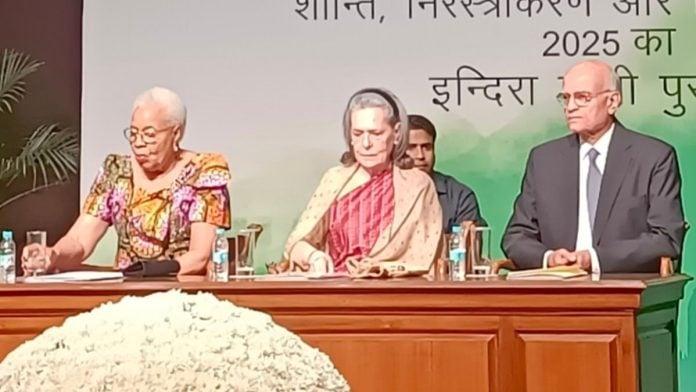
New Delhi: Some friendships are forged in diplomacy. Others are born out of shared struggles, political upheavals and personal loss. At the ceremony for the 2025 Indira Gandhi Prize for Peace, Disarmament and Development, those deeper bonds took centre stage as Mozambican freedom fighter and humanitarian Graça Machel reflected on the ties between India and Africa.
The award carries a cash prize of Rs 10 million, a citation, and a square trophy crafted from banded haematite jasper—the same stone used at Indira Gandhi’s memorial at Shakti Sthal.
Receiving the award Thursday from Sonia Gandhi, chairperson of the Indira Gandhi Memorial Trust, Machel addressed the crowd, including senior Congress leaders such as P Chidambaram, Jairam Ramesh, Ashok Gehlot and Malikarjun Kharge at New Delhi’s Jawahar Bhavan. Former Vice President Hamid Ansari was also present at the event.
Machel talked about the relationship between the two countries which stretched across generations, linking the lives and legacies of Indira Gandhi, Nelson Mandela, Samora Machel and Rajiv Gandhi.
“To receive an award bearing the name of Indira, an outstanding leader I had the privilege of meeting, in a country whose people have shared so much of Africa’s journey toward freedom, is an honour of extraordinary personal significance,” she said.
She also acknowledged her personal bond with Sonia Gandhi, describing their families as connected across generations through public service, friendship and profound personal loss. The occasion, she added, was made even more meaningful by receiving the honour from her.
The ceremony began with a tribute to Machel’s decades-long contribution to education, women’s empowerment and humanitarian work. The prize jury’s choice, the citation noted, recognised her work in education, health, economic empowerment and humanitarian service under difficult circumstances.
The award jury comprised former national security advisor Shivshankar Menon, former RBI governor Raghuram Rajan, former planning commission member Syeda Hameed, former chief information commissioner Wajahat Habibullah, journalist Suman Dubey, social activist Aruna Roy, and economist Kaushik Basu.
‘Peace is indivisible’
Born in rural Mozambique in 1945, Machel returned to her country in 1973 and joined FRELIMO, the liberation movement, as a freedom fighter and teacher. Following Mozambique’s independence in 1975, she became the country’s first minister of education and culture.
During her tenure, school participation rose from 40 per cent to more than 90 per cent among boys and 75 per cent among girls.
In 1996, she produced a landmark United Nations report on the impact of armed conflict on children, drawing global attention to the devastating consequences of war on young lives.
Addressing the gathering, Sonia said Machel’s life and work reflected Indira’s belief.
“Peace, like freedom and progress, is indivisible,” she quoted Indira as saying, underlining the idea that lasting peace cannot exist without justice and meaningful development.
She also highlighted Machel’s work through NGOs like The Elders, Girls Not Brides, the Graça Machel Trust and the Zizile Institute for Child Development, all of which reflect her commitment to vulnerable communities, particularly women and children.
Also read: Clean air, water are not govt’s responsibility alone, says Chandrachud. ‘Easy to criticise’
When Machel met Indira Gandhi
She recalled the historic exchanges of 1982, when her husband, Samora Machel, visited India in April and Indira travelled to Mozambique in August.
Meeting the Indian prime minister as a woman helping lead a newly independent country was particularly significant, she said.
“Indira represented a generation of leaders who understood that the freedom of one people was inseparable from that of others,” Machel said. “To our young nation, her presence conveyed something deeply human. You are not alone. Your freedom matters and your aspirations matter.”
India’s independence in 1947, she said, had inspired liberation movements far beyond its borders. For those still fighting colonial rule in Africa, it demonstrated that even the mightiest systems of oppression could be overcome.
She also recalled India’s support for Africa’s liberation struggles, including through its leadership in the Non-Aligned Movement and the Africa Fund, established in 1986.
“These were not merely diplomatic gestures. They were acts of solidarity among people who practised the principle that freedom cannot be secured while others remain in chains,” she said.
Also read: Troubled kings, distorted faces and vivid shades — Inside Delhi’s UTSAV’26 art exhibition
From political history to personal grief
Machel recalled the assassination of Indira in 1984, followed by the death of her husband, Samora Machel, in a plane crash in October 1986, and the assassination of Rajiv Gandhi in 1991.
“Three monumental leaders. Three lives cut short. Families and nations forever changed,” she said.
Behind every public tragedy, she observed, lies private grief. Yet love, she added, can be transformed into service, grief can deepen compassion, and a legacy survives through the values people choose to uphold.
For Machel, accepting the award was therefore not the culmination of a life’s work but a renewed responsibility.
She turned to what she called the unfinished work of liberation in Africa. Political independence, she argued, had been essential but insufficient. The challenge now was to overcome inequality and ensure access to education, healthcare and economic opportunity.
She also warned against the growing dangers of nuclear weapons and the use of AI in warfare, urging that technology strengthen humanity rather than threaten it.
Referring to conflicts in Sudan, the Democratic Republic of the Congo, northern Mozambique and Palestine, she called for solidarity that went beyond words, demanding accountability and a lasting peace.
Peace, she stressed, must also begin at home. Gender-based violence across Africa and India makes it impossible to speak of development while women and girls continue to live in fear.
“We cannot speak of peace while women and girls live in fear,” she said, calling for accountability and the involvement of men and boys in challenging violence.
Machel argued that the next chapter of the India-Africa relationship must be written not merely through trade and diplomacy but through human possibility.
“Their stories remind us that building a just society is never the task of one leader, one family, or one generation,” she said. “It is a responsibility passed from hand to hand, from heart to heart.”
(Edited by Saptak Datta)