


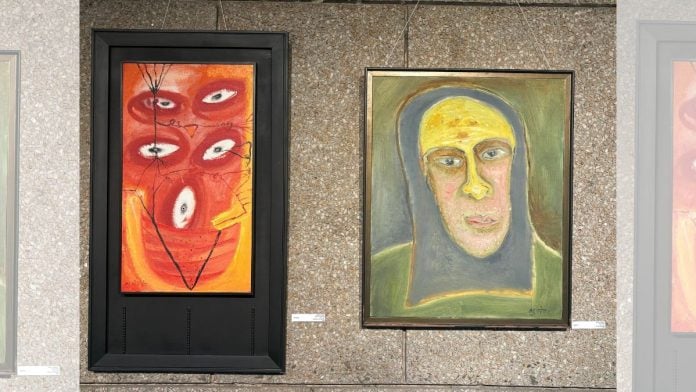
New Delhi: A nude woman reclines across the canvas; her body is painted in broad strokes of pink and red. Her limbs are elongated, and she holds a small mirror close to her face, gazing at her reflection. Through bold brushwork and distorted proportions, artist Jogen Chowdhury moves away from conventional portrayals of the female nude, exploring themes of desire, self-perception, and the human body.
Jogen’s paintings are among the works on display at UTSAV’26 in New Delhi. Titled The Art of Poetry, the six-day exhibition is being held at the Open Palm Court Gallery, India Habitat Centre, from November 14 to 19.
It brings together works by 18 Indian artists, including Arpana Caur, K.G. Subramanyan, Paritosh Sen, Suhas Roy, Sunil Das, Rabin Mondal, Ramananda Bandopadhyay, Lalu Prasad Shaw, Ganesh Haloi, Jogen Chowdhury, Thota Vaikuntam, Ganesh Pyne, Shuvaprasanna, Paresh Maity, Jayashri Burman, Jayashree Chakravarty, Ramesh Gorjala and Debadeep Ghosh.
The exhibition aims to make original art more accessible to a wider audience. Alongside paintings, it displays drawings and sketches by the artists, with works available across different price ranges. With prices starting at Rs 25,000, the collection is intended to attract established collectors as well as first-time buyers.
“We want to make art affordable to all the people, so high-value art is also there, and affordable art is also there,” said Kumar Satyapriya, co-founder of Nostalgia Colours, which has been organising the annual exhibition since 2009.
For visitors unable to afford an original painting by an established artist, drawings and sketches offer a less expensive entry point. The organisers hope this will encourage more people to start buying original art.
“Art should not feel distant or inaccessible. It is something that everyone should have the opportunity to experience, appreciate and, if they wish, make a part of their everyday lives,” said Swati Roy, co-owner of Nostalgia Colours.
Rabin Mondal’s troubled kings and queens
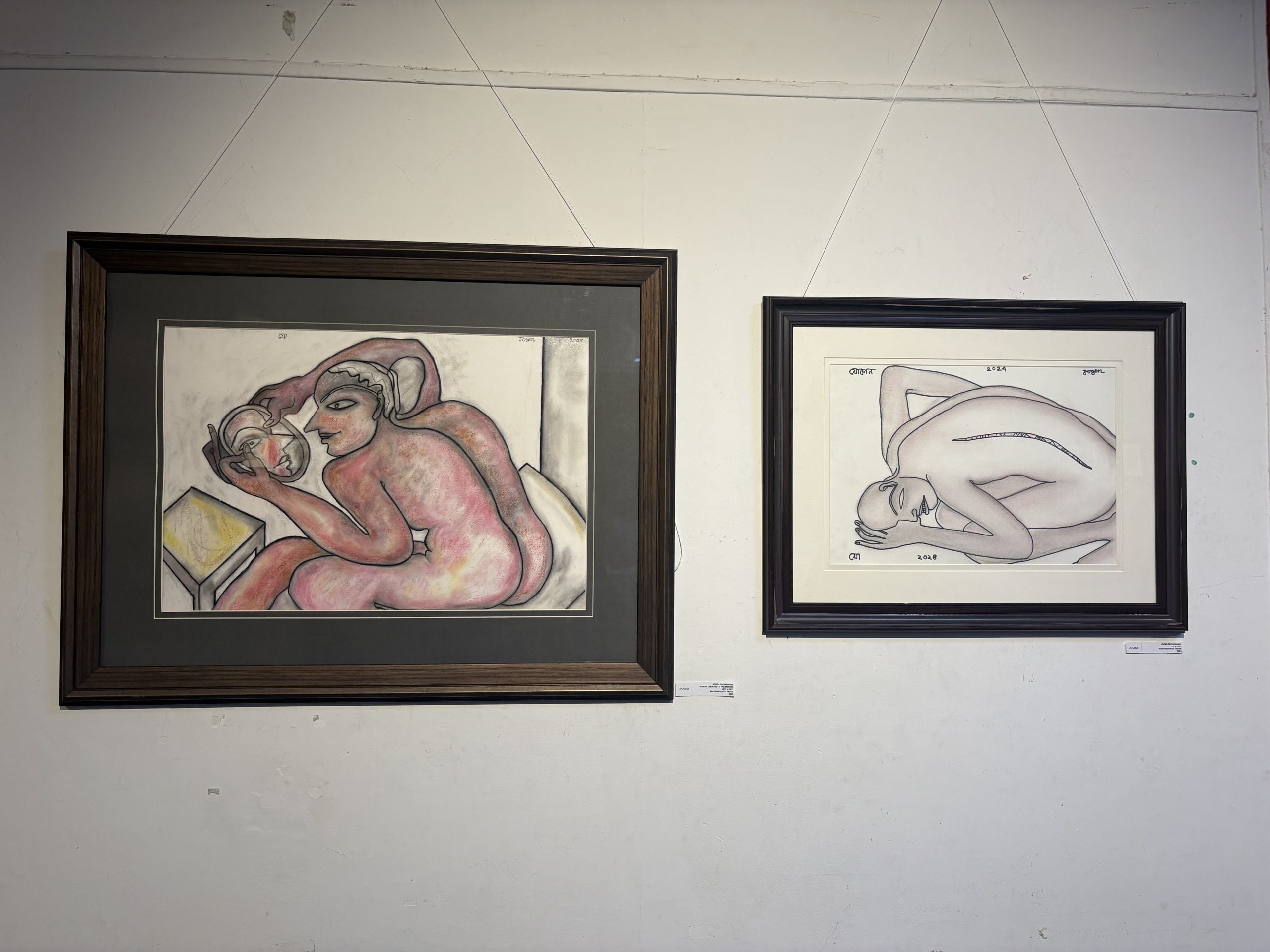
Two crowned men look out from their frames. In one, a bearded man wears a crown and a red garment against a blue background. The other shows a crowned figure against a bright red backdrop. Both have heavily outlined features and intense expressions.
The paintings are by Rabin Mondal, whose kings and queens were rarely celebrations of royalty. Instead, his figures often carried the anxieties, vulnerabilities, and contradictions of those who held power. Their crowns and elaborate clothing sit uneasily with their strained expressions, making the seemingly triumphant rulers appear deeply troubled.
Born in Howrah in 1929, Mondal grew up in a city marked by poverty and industrialisation. The Bengal famine of 1943 and the communal violence of 1946 had a lasting impact on him and influenced his paintings, which often explored human suffering, social inequality and power. In 1964, he became one of the founding members of the Calcutta Painters group.
Mondal died in 2019 at the age of 90.
Also read: Delhi exhibition brings together embroidery traditions from Kashmir, Bengal, Palestine
Manu Parekh’s vivid, distorted faces
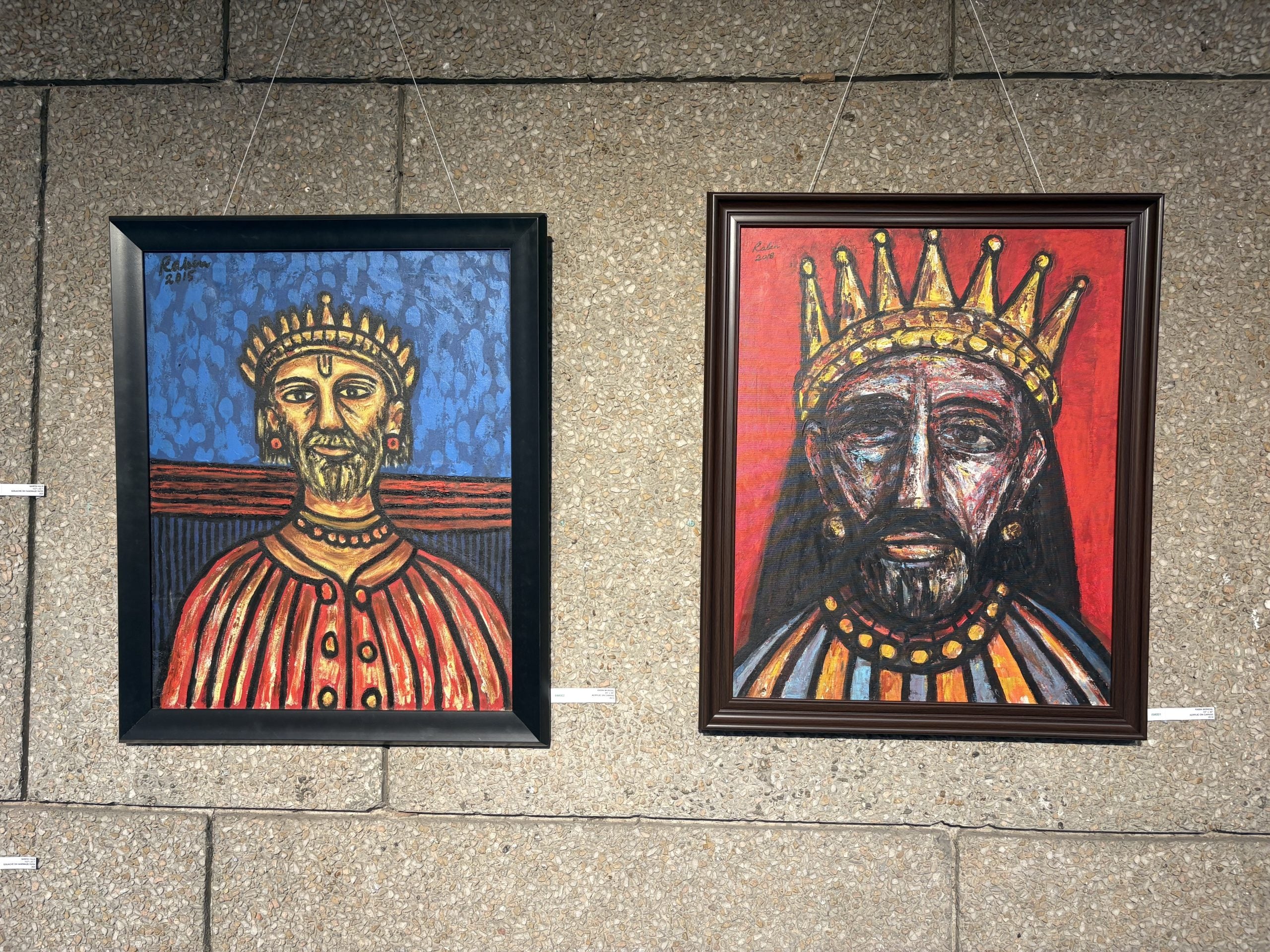
Titled Ritual Oblation, the painting by Manu Parekh features a face rendered in vivid shades of orange and red, with multiple eyes and sharp, dark lines. Parekh’s painting relied on distorted features and bold colours.
Born in Ahmedabad in 1939, Parekh studied at the Sir J.J. School of Art in Mumbai before working at the Weavers’ Service Centre. He is perhaps best known for his paintings of Banaras, a city he first visited in 1980 following his father’s death. Its ghats, temples, river and changing light became recurring subjects.
Original art across price ranges
Satyapriya said prices vary depending on the artist and the work. K.G. Subramanyan’s paintings were priced between Rs 6 lakh and Rs 8 lakh, while works by Manu Parekh range from Rs 3 lakh to Rs 16 lakh.
Ganesh Haloi’s paintings were priced between Rs 9 lakh and Rs 14 lakh, while a work by Sunil Das was priced at Rs 5 lakh. The prices of Ganesh Badri’s works range from Rs 4 lakh to Rs 25 lakh. Drawings and sketches offer visitors less expensive alternatives, with prices starting at Rs 25,000.
Satyapriya said around six to eight paintings had already been sold. The buyers include art patrons, senior advocates and businessmen from Kolkata, Hyderabad and Mumbai.
For Roy, the idea is to encourage more people to buy original art, including those who may never have considered themselves art collectors.
“Many people who come here are art lovers. You would be surprised to see how many of them end up buying a painting,” she said.
The drawings and sketches in the exhibition were displayed separately from the paintings. Satyapriya said these offer a closer look at the artists’ working processes, while the paintings represent their more established visual expressions.
The collection includes works by younger practitioners as well, including Deva Deep Ghosh and Hari Sadan Dey, giving emerging artists space alongside established names.
“Basically, this is a celebration of art, wherein if you are a buyer or a curator or a gallery owner, you come and see. From the buyer’s perspective, according to your price range, you can celebrate art,” Satyapriya said.
(Edited by Maryam Hassan)