



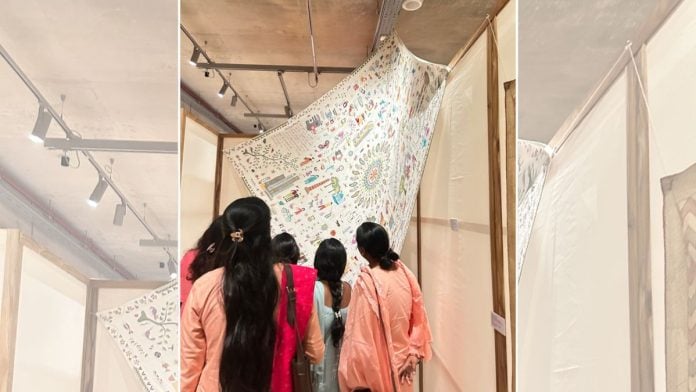
New Delhi: Shivani Mazumdar and Sitimadha Biswas stand in Gallery 1 of Arthshila Delhi, looking at their kantha embroidery work on display. The artwork captures their fading memories of migrating from Bangladesh to India, moving between different places before finally settling in an area allotted to them by the government.
They have stitched their story into kantha, a traditional craft practised across eastern India, particularly in West Bengal and Odisha. It took the artists around three months to come up with the pieces for the exhibition ‘Sui Dhaga 2026: The Continuing Threadline’, which opened on 25 October.
Curated by Sujata Prasad and Oroon Das, the exhibition is a collection of “evidence from across India, the Asia Pacific and part of West Asia”. It honours the age-old handiwork inherited across generations.
“Our exhibition challenges the fallibility of memory and its imperfections. It foregrounds women artists pulling back the curtain on the marginalisation of women in art history,” said Prasad while addressing a packed hall, filled with people who had gathered to witness the intergenerational exchange.
‘Sui Dhaga’ was first held in 2005. The current exhibition is organised by the Ahad Anhad Collective in collaboration with the Asia Pacific Crafts Alliance, Arthashila, the Crafts Council of India, and the Delhi Crafts Council. The initiative is also positioned within the upcoming India Art, Architecture and Design Biennale, organised by the Ministry of Culture.
Also read: How the Maharaja of Baroda helped make Raja Ravi Varma an artist of the masses
Stories etched into cloth
The evening began with a performance by award-winning choreographer Navtej Johar, followed by people thronging the two galleries that exhibited textiles from Palestine, the Philippines, Jammu and Kashmir, West Bengal, and other Indian states.
‘Sui Dhaga’ is a tapestry of social histories and archives, created largely by women, often within the private spaces of their homes.
In her address, Prasad argued that most of the embroidered pieces were born out of “momentous political changes, migration, and displacement”.
For Biswas and Mazumdar, the statement rang true. Mazumdar was a child when she came to Kolkata, and Biswas was married at the age of 14 before she migrated. It has been more than four decades that the duo have been producing these intricate and traditional pieces from their homes.
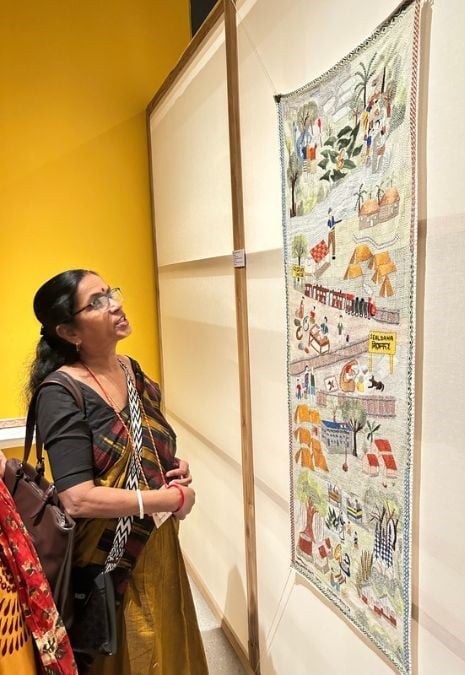
In a large, rectangular white frame, Biswas and Mazumdar traced the lives of migrants from Bangladesh—staying at a camp in Madhya Pradesh, escaping to Kolkata, settling on marshy land where they had to battle snakes, and gradually adapting to their new lives.
“We worked day and night for the exhibition, after all, this was our story,” said Biswas.
More pieces, each made carefully by these women, were on display.
Twenty-five-year-old Manav Timbalaya from Mumbai stood in one corner of Gallery 2, humbly explaining the artwork. It is an installation of blood-red mesh dotted with sanitary pads.
He captures the chaos of menstruation by weaving sanitary pads and red mesh fabric into a deliberately haphazard arrangement.
“I saw my mother struggling during periods; she would not complain or talk about it,” Timbalaya said.
A piece of aari embroidery was also displayed at the exhibition. The craft originated during the Mughal era and continued to flourish in Kashmir.
On the same floor, the printed version of a red Thoub-el-Malek, the Royal Bethlehemite Dress from Palestine by artist Osama Sataiti, was showcased along with a Palestinian choga, sourced from Anjana Somany.
The Thoub-el-Malek, made of red silk, has vertical stripes across the sleeves and skirt. The dress is distinct because of its geometric embroidery. It is a highly ornate royal dress from Palestine.
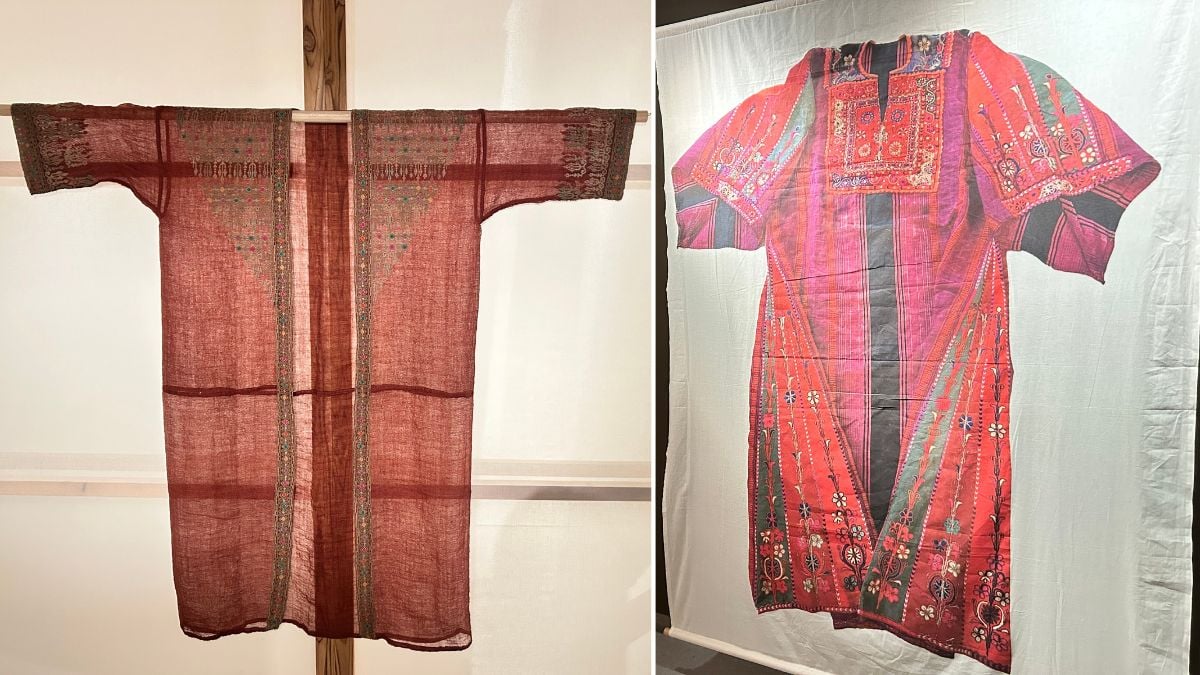
While the choga, a Palestinian robe, is a loose-fitting, long-sleeved garment worn over other clothes, much like a modern-day shrug, the piece displayed at the exhibition measured 56 x 52 inches. The choga is known for its cross-stitch embroidery and is traditionally worn by women.
The exhibition will be on view until 17 January 2027.
(Edited by Prasanna Bachchhav)