



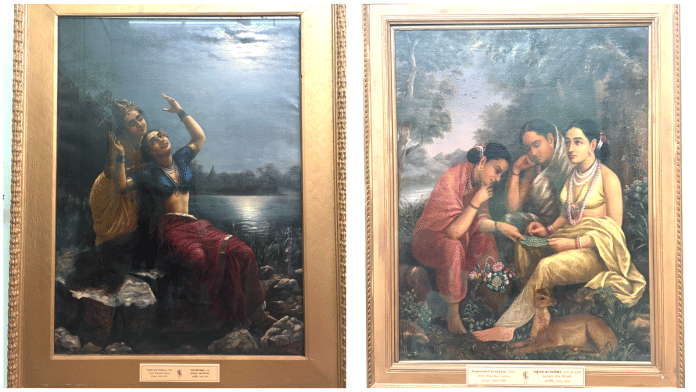
Vadodara: Before his paintings of Lakshmi, Saraswati and Krishna became familiar in millions of Indian homes, Raja Ravi Varma was known primarily for his portraits of royalty. That began to change when he came to Baroda in 1881 to paint Maharaja Sayajirao Gaekwad III at his investiture ceremony. The patronage that followed helped him move beyond royal portraiture and create images of Hindu gods and goddesses that would shape how generations of Indians came to visualise them.
“He knew that he was part of a moment. He knew he was part of something interesting that was happening in the country,” historian Manu S. Pillai said during his talk, Magic, Myth and Reality in the World of Raja Ravi Varma, at AIKYAM 2026, a cultural festival held in Vadodara on 10 and 11 October. Organised by Sopaan, the festival sought to connect India’s heritage with the rest of the world.
Aided by royal patronage, Raja Ravi Varma’s paintings, later reproduced as prints, helped create a shared Hindu religious visual language at a time when the country was developing a sense of national identity.
Sayajirao, who ruled Baroda from 1875 to 1939, was a patron of Indian and European art, but his interests extended beyond acquiring paintings and sculptures for the royal household. He supported education, music, crafts and architecture, helping establish Baroda as an important centre of cultural activity.
The Maharaja was introduced to Raja Ravi Varma’s work by T Madhava Rao, who had served as Diwan of Travancore before taking up the same post in Baroda. Impressed, Sayajirao commissioned numerous royal portraits and mythological paintings and even built a studio for him.
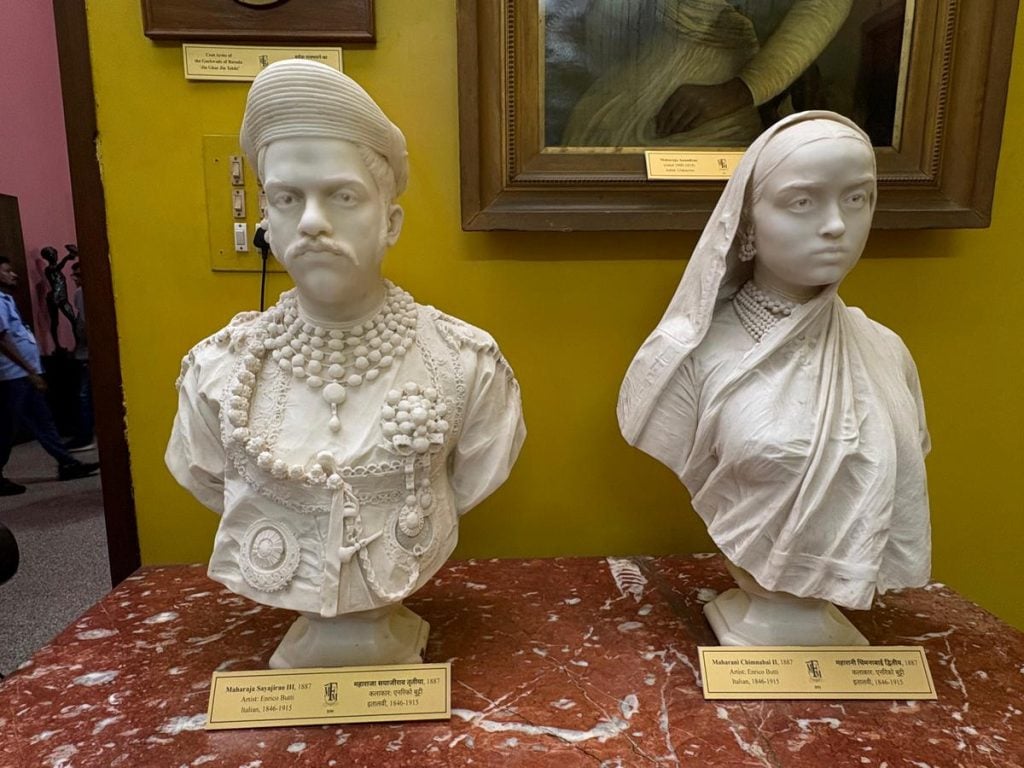
Today, more than 30 original works by Ravi Varma are housed at the Maharaja Fateh Singh Museum in Vadodara, along with European Renaissance and Rococo paintings, marble busts, Chinese and Japanese objects and other works commissioned or acquired by the Gaekwad royal family.
The collection also tells a larger story about how the princely state embraced European artistic traditions while supporting Indian painters and sculptors by inviting them to work in Baroda. Housed in the former Motibaug School on the Lukshmi Vilas Palace estate, the museum opened to the public in April 1961, following its conversion under the guidance of art historian Hermann Goetz. Much of the collection was assembled during Sayajirao’s reign, with guidance from artists and advisers, including the Italian sculptor Augusto Felici.
“During that time, European rulers were the role models for Indian maharajas. They had to show that they were interested in art and culture. Collecting art was considered one of the qualifications of a good king. That is why maharajas across India acquired works of art, including marble copies of Baroque sculptures, to demonstrate their cultural standing,” said Jayaram Poduval, an art historian and professor and dean of Fine Arts at Parul University.
He added that unlike many other maharajas, Sayajirao was also interested in Indian culture, crafts and architecture.
“He started the Sangeetshala, which later became the Faculty of Performing Arts in Baroda, and Kalabhavan, which focused on teaching art and craft,” said Poduval.
Also Read: What were 30 foreign envoys doing in Vadodara? Garba, Gaekwads & a bid for soft power
Western sensibilities, Indian soul
For Sayajirao, collecting art was part of a wider effort to make Baroda a centre of culture and learning. He also founded the Baroda Museum in 1887, with a collection spanning Indian sculpture, Mughal miniatures, European paintings and archaeological objects. Its Picture Gallery opened in 1921, after the First World War delayed the arrival of European paintings.
But perhaps his most consequential act of patronage was backing Raja Ravi Varma and ushering in a new era of popular art in India.
Deepak Kannal, an art historian and sculptor, pointed to how Ravi Varma’s work differed from traditional Indian painting. While miniature paintings followed established conventions for depicting mythological figures, Ravi Varma used European techniques to give his Indian subjects more lifelike forms.
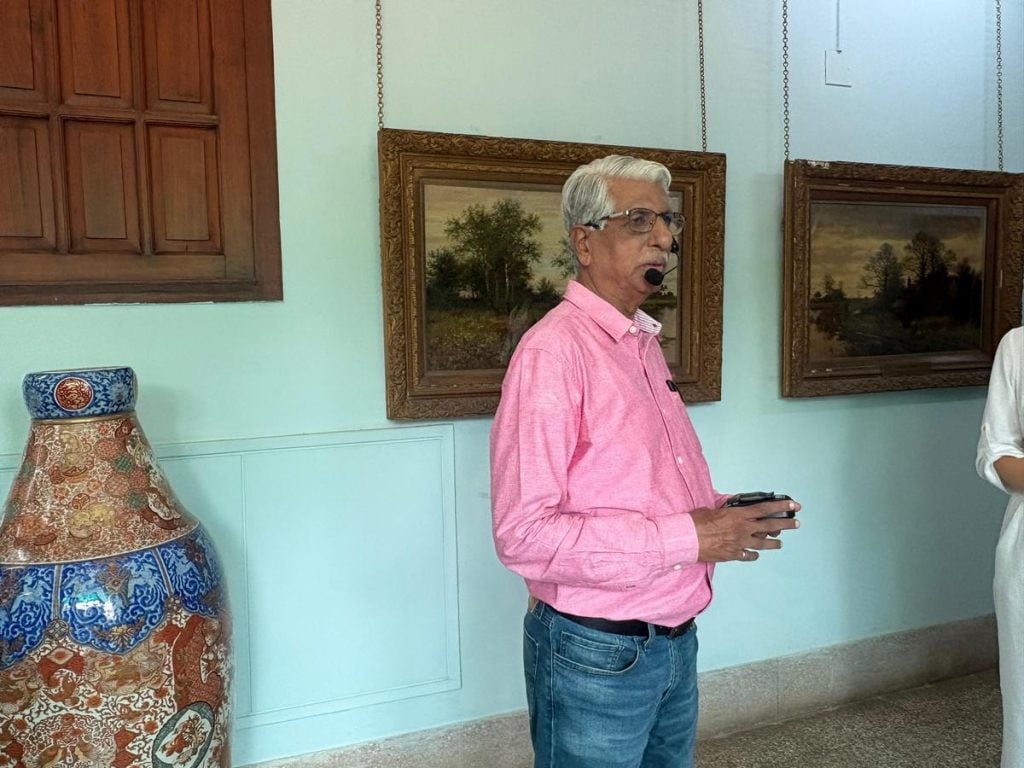
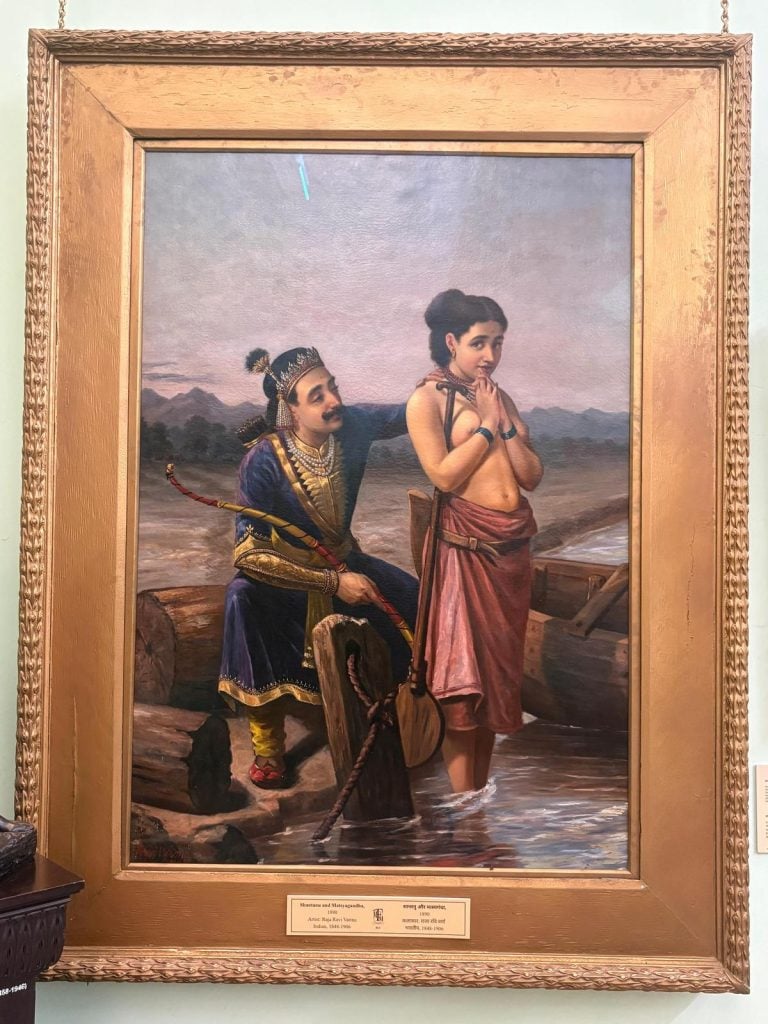
Pointing to Ravi Varma’s painting of Matsyagandha (also known as Satyavati) and King Shantanu, Kannal highlighted the brown leather belt around Satyavati’s waist. He said Ravi Varma’s travels influenced his depiction of the belt, which was not necessarily typical of the period.
The draping of saris in Ravi Varma’s paintings also reflected his imagination rather than the dress of the period, Kannal said.
“He knew the mythology, but he didn’t know what kind of garments were used in that particular period. So he imagined, and perhaps adopted something from the Western tradition,” he said.
Portraits of Sayajirao and members of the royal family offer another view of the Maharaja’s patronage. Ravi Varma painted Maharani Chimnabai II and Prince Fatehsinhrao I, as well as Sayajirao himself—the investiture portrait shows the young Maharaja in a jewelled turban, with a sombre expression.
The museum’s sculptures also give a glimpse of Sayajirao’s ideas about governance. Kannal showed a depiction of the goddess of justice with open eyes and a book in hand rather than the blindfold and sword of her more familiar Western counterpart.
“Sayajirao thought that justice cannot be blind,” Kannal said. “So he imagined another image with a book in hand, with open eyes and a book in hand.”
Also Read: ‘Calendar artist’ to Rs 167 cr sale—how Raja Ravi Varma still defines India’s imagination
A royal artist for the people
Raja Ravi Varma’s gods and goddesses did not stay confined within palace walls but became familiar in homes, temples, calendars and films across India. His influence can be seen to this day in popular imagery, from Lakshmi standing on a lotus to Saraswati in a white sari holding a veena.
His depictions broke through regional traditions and gave India a common religious iconography.
“We don’t really shut our eyes when we think of Krishna or Saraswati or Lakshmi and think of a temple sculpture or think of a mural painting. We shut our eyes, and we think of the painting that’s sitting inside the palace behind me. This in many ways was Ravi Varma’s triumph, the fact that he was able to leave this enduring imagery for the entire country and the country worked with it,” Pillai said.
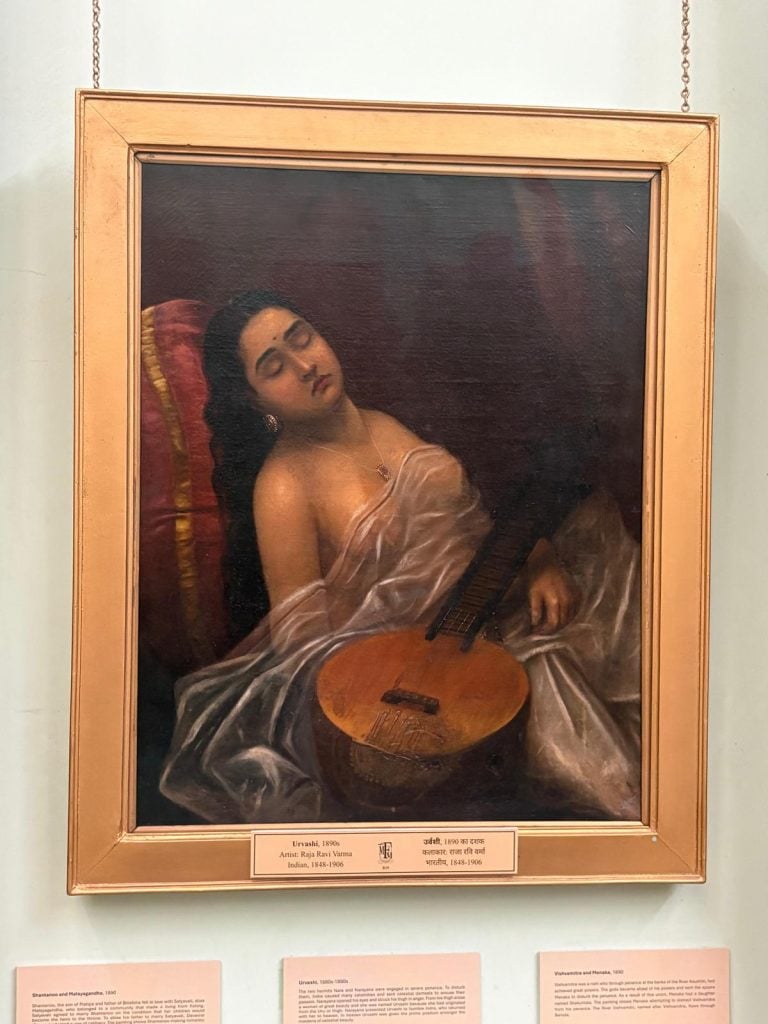
When Ravi Varma began his career, portraiture was an important source of work for artists serving royal households. But he came from the aristocracy of Kerala and could move among princes and other elites with a social standing that many other artists did not enjoy.
“He was never treated like an artisan, which is what artists were treated like till then. He was treated as an equal, was treated as an artist and as somebody who deserved to be treated at a certain level,” Pillai said. “He was not considered your run-of-the-mill local craftsman as people in those days thought of artists.”
According to Pillai, Ravi Varma learnt by observing the European painter Theodore Jensen. His ability to capture his subjects realistically soon set him apart from other artists of his time.
Pillai said it was T Madhava Rao who encouraged Ravi Varma to turn to the stories and characters of India’s epics. The Ramayana and the Mahabharata were already familiar across regions and languages, but their characters appeared in different artistic forms, from temple sculptures to murals to miniature paintings.
“One of the things that existed across India, despite the diversity of languages, despite the diversity of dress, the diversity of cuisine, the epics were everywhere,” Pillai said. “The stories of Rama, of Sita, the story of the Mahabharata—epics were everywhere, not just in Sanskrit but also in the local languages.”
Though initially painted for royal patrons like the Gaekwads of Baroda and the rulers of Mysore, Ravi Varma’s paintings also moved ordinary people. Pillai said some even bowed before the paintings as they would before a deity.
“Ravi Varma noticed that people would come and this was the first time they were seeing their Gods embodied this way,” he said.
Pillai said Ravi Varma later invested in a printing press in the 1890s, driven by a desire to make his art accessible to ordinary people.
“He wanted people to have a shared cultural imagery, something they could recognise, something that they would have in common as they were forming themselves into a new nation, as they were developing their sense of identity and nationalism,” he said.
(Edited by Asavari Singh)