


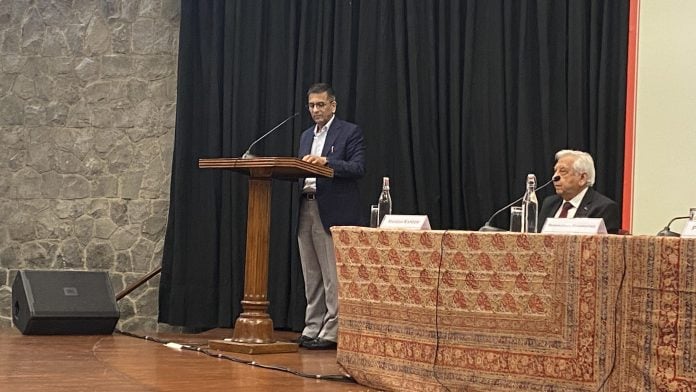
New Delhi: Clean air, clean water, safe roads, and the safety of women are not the responsibility of the government alone, former CJI DY Chandrachud said at a Delhi event Tuesday. These, he said, are the “shared responsibility of the government and the people.”
Chandrachud added that “holding the government to account is both easy and necessary” because the Constitution expects us to do so.
“But the Constitution expects something else from us as well… Article 51(A), which sets out the fundamental duties of every citizen. These are the duties to abide by the Constitution and respect its institutions,” he said.
Chandrachud was delivering the keynote address at the annual Sardar Patel Lecture on Governance, organised by Delhi’s IC Centre for Governance at the India International Centre (IIC). The centre defines its goal as the ‘quest for naitik (ethical) Bharat’, and invites a different speaker every year to tackle the issue of ‘good governance’. Past speakers include India’s National Security Advisor Ajit Doval, External Affairs Minister S Jaishankar, and Karan Singh, a statesman, philosopher, and thinker.
The nearly 200-member-strong audience at IIC’s CD Deshmukh Auditorium comprised primarily retired civil servants, government officials, and some young lawyers.
Prabhat Kumar, first Governor of Jharkhand and President of the centre, outlined the contemporary context underlying the lecture in his opening remarks.
“The India of today is certainly not the India of Sardar’s dreams. After eight decades of Independence, the picture that emerges is of a nation that is potentially great, but in a state of ethical decay. We are suffering from a dysfunction of our conscience and an unchecked erosion of foundational values,” he said.
Chandrachud’s address sought to expand Patel’s idea of the civil services as the “steel frame of India”.
“He [Patel] called upon the officers to serve the people with a true spirit of service. The people in their turn must prove worthy of their service. Not by gratitude but by conduct,” said Chandrachud, highlighting Patel’s address to the first probationers of the All India Administrative Service (IAS) in 1947.
‘Easy to complain, more meaningful to contribute’
For Chandrachud, collective responsibility and competent administration go hand in hand. The former CJI elaborated on his argument by pointing to the large number of road accidents that take place in the country—about 20 deaths an hour, according to data, he said.
While good infrastructure is the government’s responsibility, “no amount of infrastructure will stop a driver from blocking an intersection because he could not bear to wait for the next traffic signal,” Chandrachud said.
Similarly, he added, in the cases of bribes, water conservation, and general cleanliness, the administration’s efforts can only result in effective change when supported by citizen effort.
“It’s easy to criticise the condition of our rivers, our streets, and our public spaces. It is more meaningful to ask what each of us can contribute toward improving them,” he said.
Many in the audience related to the need for collective responsibility both within their professional settings and in the country at large.
For Anirudh Bhatia, a lawyer, delays in the judiciary may happen due to delays caused by lawyers or the registry.
“In such a case, it is not always fair to burden the judge. Each side has its flaws and has to accept their blame,” he said. Timely functioning of the judiciary, for him, is the collective responsibility of the many stakeholders.
Aman Bandvi, Director of Bharat Responsible AI Forum, stated that the same principle applies to the country.
“Citizens should be able to live up to the expectations that we have from our fellow citizens. We can’t always keep shifting the onus on the government or the police to put things in order. We also have to acknowledge that we have a duty towards the state and the law,” he said.
Also read: Troubled kings, distorted faces and vivid shades — Inside Delhi’s UTSAV’26 art exhibition
‘Lasting change begins with citizens’
Chandrachud elaborated on his argument by highlighting stories of remarkable citizen action from around the country, both in relation to collective effort as well as individual acts of grace. The first came from his own life, where the efforts of a passerby had helped save his life.
In 1998, Chandrachud met with a serious accident as a young lawyer, while asking his driver to drive extra fast, so that he could catch his flight back to Delhi. He was rescued by a passerby, who saw the wheels of a car having gone down a valley. The good samaritan took the former CJI to the hospital.
“He never again appeared in my life thereafter,” he said.
Chandrachud then shifted his gaze to the village of Mawlynnong, in Meghalaya, which was named “the cleanest village in Asia” by Discover India Magazine in 2003. The title was achieved through collective participation.
The village community has set up bamboo dustbins on the streets. The villagers collect and manage waste, and have taken up the collective responsibility of keeping the village clean. These tasks, Chandrachud added, were not merely assigned to the village municipality, but had become part of the community’s everyday life.
“The example reminds us that lasting change often begins when people stop treating public spaces as someone else’s responsibility, and begin to regard them as their own,” he said.
Purvi Rajpuria is an intern at ThePrint. She is an alumna of ThePrint School of Journalism.
(Edited by Prasanna Bachchhav)