


Kolkata: Often regarded as too cerebral for commerce and too cautious for business, Bengalis have a rich history of building factories, financing enterprises, and defying the colonial economy rigged in the favour of the British.
The 18th and 19th centuries saw the rise of Bengali tycoons like Ramdulal Dey and Mutty Lal Seal, who not only amassed large fortunes by building indigenous business empires but also circumvented caste through business.
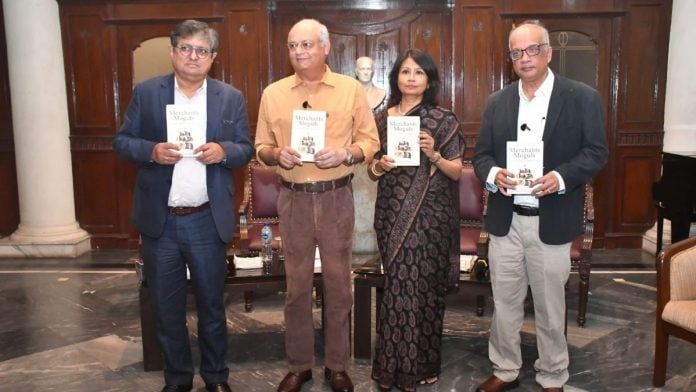
At the launch of academic and author Sarojesh Mukherjee’s new book, Merchants to Moguls: The Story of Bengal’s Business Titans, held on 29 October at the Calcutta Club, discussants expressed hope that Bengal’s golden era of business could return.
Bengal’s animal spirits
Introducing Merchants to Moguls, Dr Kunal Sarkar, a prominent public figure, surgeon and health educator, said the book begins with the story of Bengali entrepreneurship in the 18th century, a period when continental Europe was witnessing political unrest and the Industrial Revolution was beginning to make its presence felt.
In such tumultuous times, what British economist John Maynard Keynes would later refer to as ‘animal spirits’ was unleashed by a group of Bengali industrialists.
Author Sarojesh Mukherjee said it was by no means easy for Bengali industrialists to succeed in business during the colonial period, when they operated within a system meant to undermine them.
“British trade policies, racial discrimination, and foreign investment all worked together to keep local businesses on the outskirts. Yet some individuals like Ramdulal Dey, Mutty Lal Seal, Rustomji Cawasji Banaji, Dwarakanath Tagore, Prafulla Chandra Ray and Rajendra Nath Nath Mookerjee managed to succeed regardless through ingenuity, persistence, and animal spirits. Their journeys span trade, shipping, banking, science, manufacturing and heavy industry,” Mukherjee said.
Mukherjee narrated the story of Ramdulal Dey, a Bengali businessman from the Subarnabnik community. He overcame the adversities he had faced since birth to begin his career as a bill-sarkar, or collection agent, earning a paltry Rs 5 per month. He soon saved up Rs 100, which he “invested in a wood godown in Bagbazar”.
Later, at an auction, Dey put his business instincts to use when he bid for and bought a salvaged sunken ship for Rs 14,000 using his employer’s money. He eventually sold the ship’s remains to an Englishman who was desperate to buy them, for “a price of Rs 1,14,000, making an unprecedented profit of Rs 1 lac within a few hours,” Mukherjee said.
He further added that Dey would go on to make huge profits, “largely on the American shipping trade, which flourished at the expense of Company shipping”.
Mukherjee said the Indo-American trade of that time involved importing “dollars, iron, lead, brandy, Madeira and other wines, fish, spermaceti candles, mackerel, beef, beer, ice, a variety of European articles, tar, large and small spars and exporting tea, sugar, indigo, linseed, saltpetre, gunny bags, and most important textiles”.
“Ramdulal became something like the sole representative of the American trading firms in Calcutta in conducting this trade by aggressively cultivating his relationship with them,” Mukherjee said, adding that Dey has sometimes been described as a pioneer of modern Indo-US trade. As a result, he faced a near boycott by English firms.
Yet such businessmen have been pushed to the margins of collective Bengali memory. Today, one of the few visible reminders of Ramdulal Dey’s legacy is Ramdulal Nibas, the palatial mansion he built in 1784, which still stands on Beadon Street, now known as Abhedananda Road.
Further, Mutty Lal Seal, whose life overlapped with that of Dey, achieved such dazzling success in business that he came to be known as the ‘Rothschild of Calcutta’. He independently imported garments and iron and exported goods such as indigo, silk, sugar, tea and rice.
Seal also invested in ships that carried his cargo to and from Europe and China, and soon became the owner of 13 to 14 large ships.
Historian and academic Rosinka Chaudhuri said Mukherjee’s book demonstrates that business flourishes when there are structures to enable it.
“The British cut them off. But these figures written about in the book found ways of doing business even at such unfavourable times,” she said.
What stood out to Chaudhuri, however, was how successive generations of businesspeople circumvented caste barriers in 19th-century Bengal.
“Caste was shaken up by the fluidity of opportunity that 19th-century Bengal offered,” she said.
Also read: Calcutta in the rear-view mirror. Yellow taxis get a photographic tribute
Money trumped caste
According to Mukherjee, Ramdulal Dey had famously said, “Caste is in my cashbox.”
“The business successes of the period showed how wealth could challenge caste barriers and create avenues for social mobility”, author and academic Avishek Biswas told ThePrint.
“Subarnabaniks like Mutty Lal Seal or Pritaram Marh successfully managed to get a foothold into the Bhadralok Bengali society. They couldn’t change its inherent biases, but numerous temples were built by successful businessmen who were not Brahmins during this time,” Biswas added.
However, such mobility had its limits.
“19th-century Calcutta’s wider bhadralok society remained conservative and firmly attached to caste distinctions. Even Rabindranath Tagore’s great-grandfather Dwarkanath’s immense wealth could not secure marriages for his second-generation descendants into high-caste Brahmin families: the Tagores were Pirali Brahmins, a group regarded as inferior within the Brahmin hierarchy,” Mukherjee told ThePrint.
Can Bengal return to business?
During the discussion, columnist and public affairs commentator Sandip Ghose said he was hopeful that Bengal could get back into business.
Mukherjee said a succession of factors had derailed Bengal’s industries.
“But those shocks are things of the past. Compared to the seventies and eighties, for example, we are probably in a better situation today because, among other things, the importance of investment and industry has been officially recognised. Therefore, I’d say that cautious optimism would be well-founded!” he said.
Deep Halder is an author and a contributing editor at ThePrint. He tweets @deepscribble.
(Edited by Maryam Hassan)