


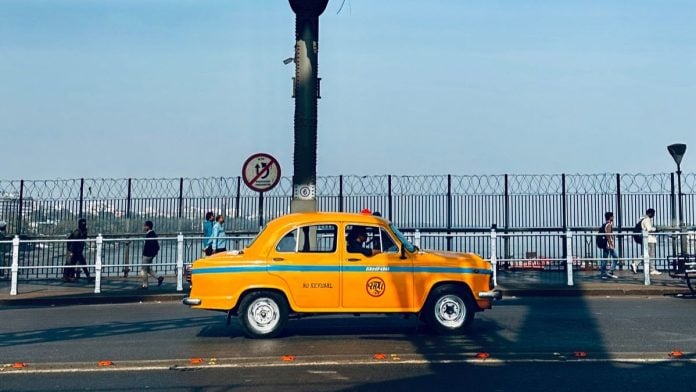
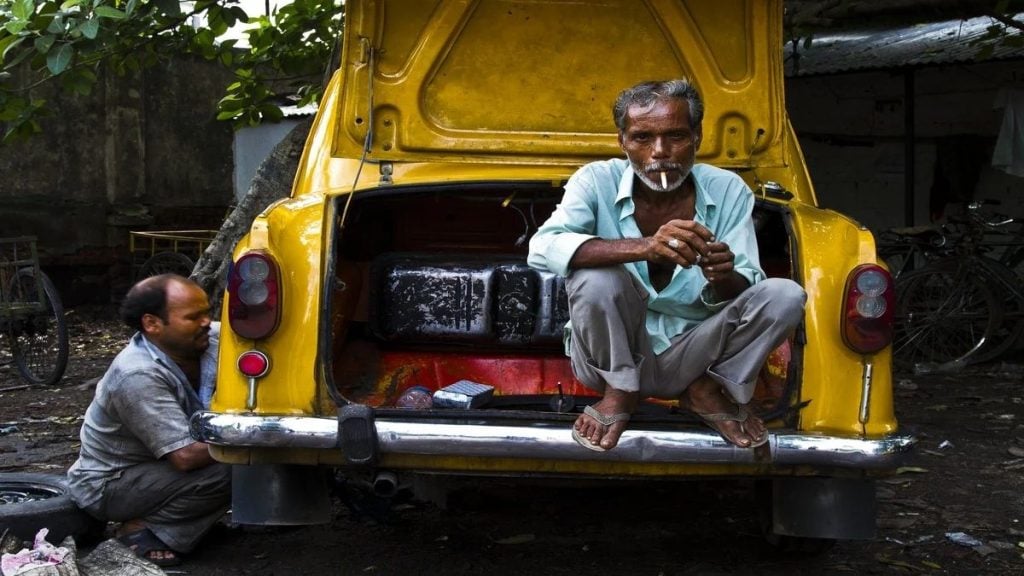
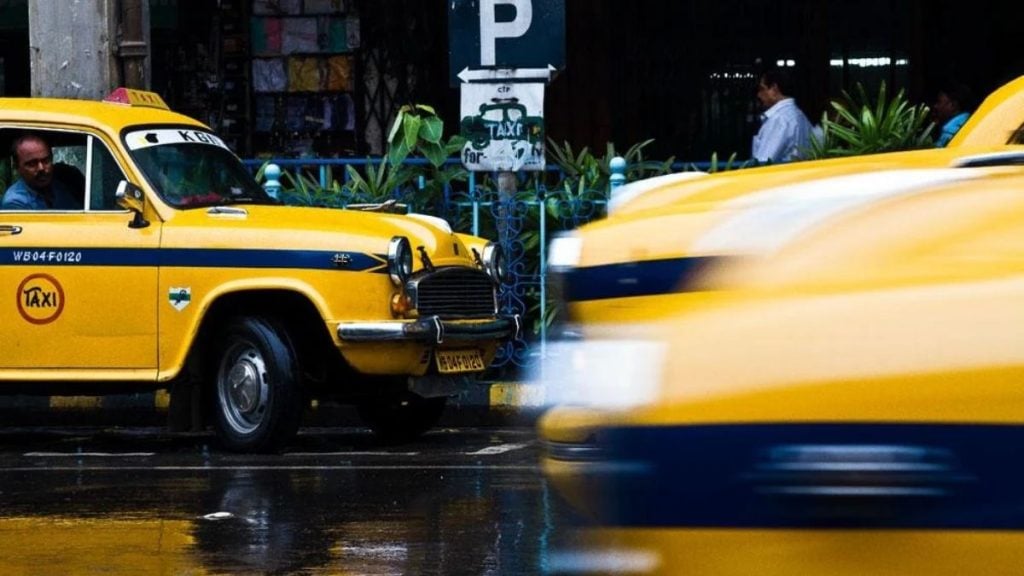
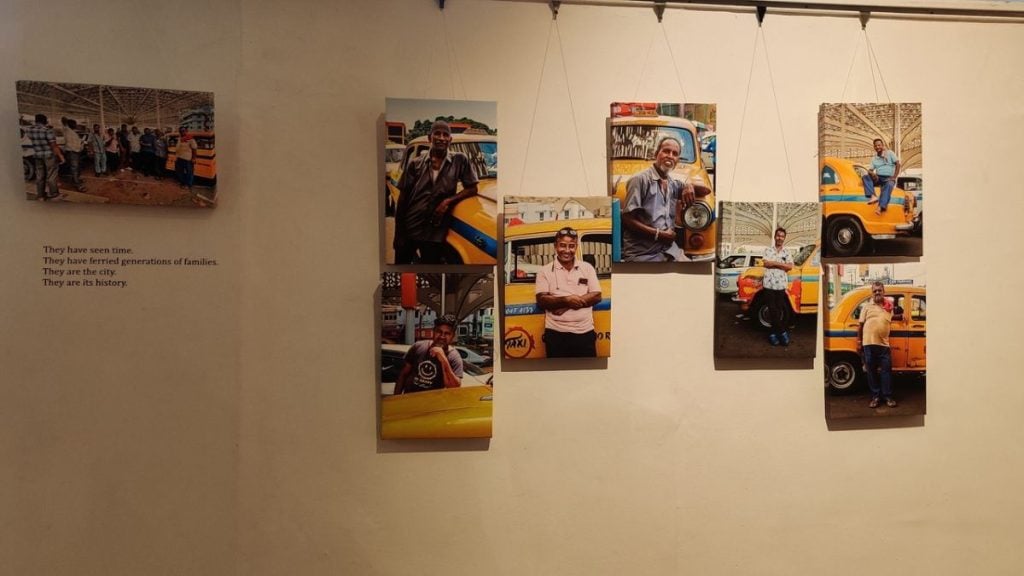
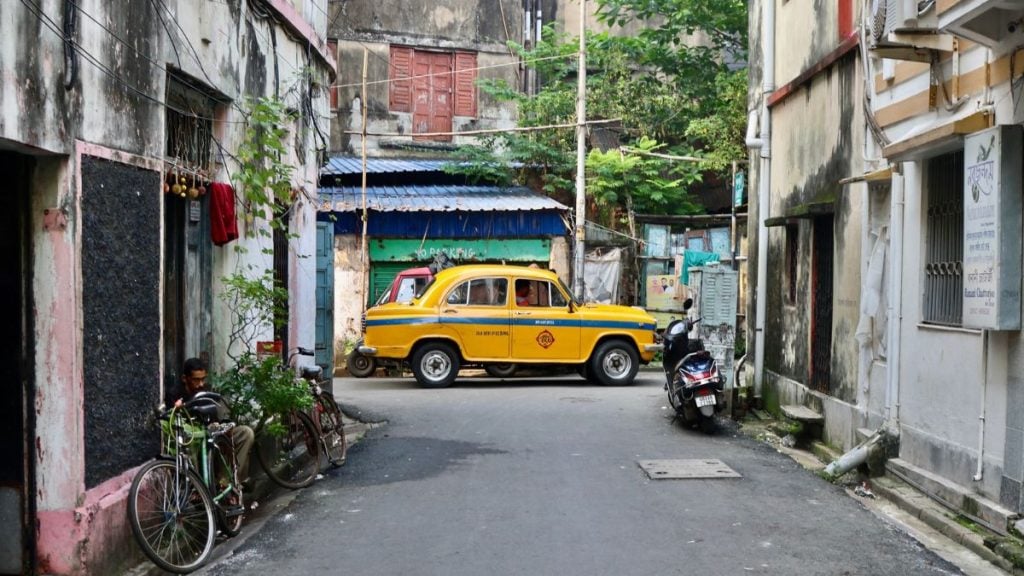
New Delhi: A yellow Ambassador streaks through a Calcutta street, its body blurred by light and motion. In another photograph, it sits abandoned behind a rusted iron gate, its headlamp peering out of an old house. Elsewhere, the cars lie in a graveyard in Howrah, their once-familiar bodies awaiting dismantling. A tanned, lanky driver who has ferried millions of passengers perches on the trunk of one, lighting a cigarette. The yellow taxi has travelled from Calcutta’s old-world bustle to the stillness of scrap; from ubiquity to near-obsolescence, captured by photographer, author, and HarperCollins India CEO Ananth Padmanabhan.
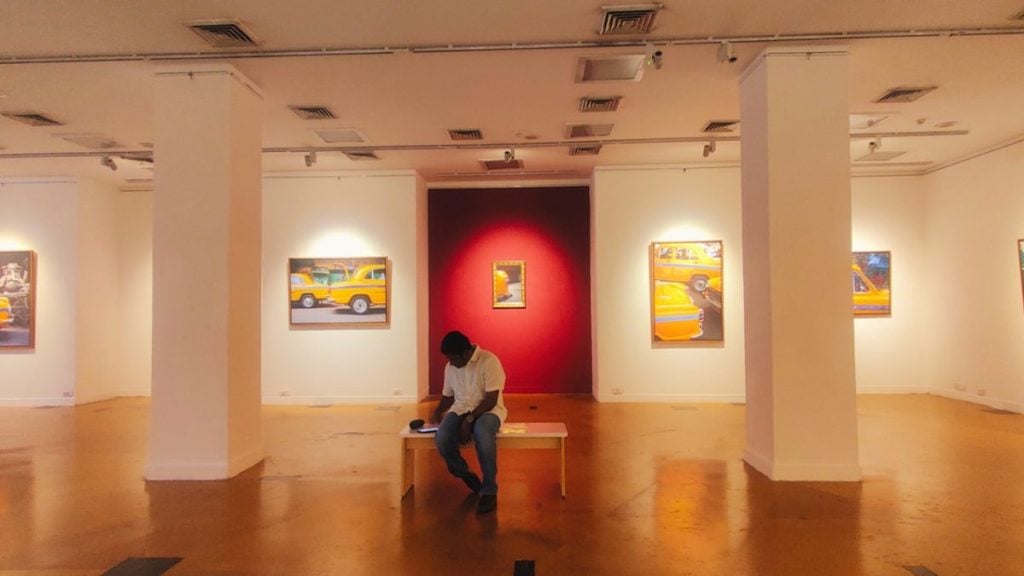
At the Visual Arts Gallery of the India Habitat Centre in New Delhi, Padmanabhan’s photography exhibition No Refusal, running from 4 to 10 November, traces the many incarnations of one of Calcutta’s most enduring urban yet archaic symbols — on rain-soaked streets, in car graveyards, and alongside the men whose livelihoods and identities have been tied to them.
The yellow Ambassador taxi, much like trams, is a moving landmark of Calcutta, omnipresent outside railway stations, trundling past colonial buildings, squeezing through narrow lanes and carrying generations of passengers through the city’s innumerable dramas. But with production discontinued in 2014, the rise of air-conditioned, app-based cabs and restrictions on ageing commercial vehicles, the fleet has steadily dwindled and will soon be extinct. Padmanabhan’s photographs are an attempt to preserve the city’s memory of it and the people, streets and histories that travelled inside these cabs.
“I have always said that there is no Calcutta for me without this car,” Padmanabhan said of the 32 photographs on display. “It was time I immortalised it.”
For No Refusal, Padmanabhan collated nearly thirty years of photographs taken during his various trips to the city. A Tamilian from Chennai, he has never lived in the city but fell in love with the yellow taxi when he landed in the city back in 1998 aboard the Delhi-Howrah Rajdhani Express.
“It was love at first sight. My fascination with the car would continue for decades later and has now become my personal muse,” he said. “Halting a yellow ambassador made me feel at home.”
The exhibition’s title comes from a phrase associated with a government directive requiring Calcutta’s taxi drivers not to refuse passengers a few years ago. The words were painted in blue across the yellow taxis, sometimes scratched out, and ironically, not always followed. In Padmanabhan’s hands, the phrase becomes a metaphor for Calcutta’s stubborn reluctance to let go of a piece of itself that has outlasted its usefulness in the eyes of modern transport economics.
The Ambassador and Ananth’s Calcutta
Calcutta’s streets had motorised taxis long before the Ambassador became their defining vehicle. Hindustan Motors began manufacturing the car at Uttarpara, near Kolkata, in 1958. Based on a British design, its roomy body and sturdy build made it a fixture in government fleets and on potholed streets, earning the sobriquet ‘King of Indian Roads’. In 1962, the Calcutta Taxi Association adopted it as its standard model and over time, its yellow paint — chosen for better visibility after dusk — became an unmistakable marker of the city.
Padmanabhan’s interest in Calcutta, however, extends well beyond the taxi. For nearly three decades, he has photographed its streets, approaching the city as a reader might approach a book — looking for stories in its details, its juxtapositions and its resistance to erasure.
“At any traffic light you stand in, wherever you go, Calcutta is a million images happening parallelly, simultaneously,” he said.
In one photo, two yellow taxis pass in front of two giant busts of Gandhi and former Bangladesh president Sheikh Mujibur Rahman erected outside a bustling Sealdah railway station.
“Can you imagine the statement? Gandhi and Mujibur welcoming passengers to the city?” he chuckled.
His method was deliberately unhurried. He would hire a taxi for the day, ask the driver to wait where parking was possible, and walk the surrounding neighbourhood with his camera, and mobile phone. Sometimes, he would simply get off at an unfamiliar spot and begin exploring. Ambassadors appear beside political offices, old houses, shopfronts and temples, embedded in the city’s dense, layered architecture in the photos captured by the wandering eye.
In one photograph, a hand-pulled rickshaw and a yellow taxi occupy the same frame — two modes of transport, one having displaced the other, and now facing its own replacement.
“This is a political image, kind of. I don’t think something like this exists anywhere in the country,” he said. “We are obsessed with our neighbour in the West but we don’t have much obsession with the neighbour in the East.”
In another, a rusted derelict of an Ambassador sits behind a locked iron gate.
“I had asked the owner if I could buy it. But he refused to part with it,” Padmanabhan said. “It is all about sentiment in Calcutta.”
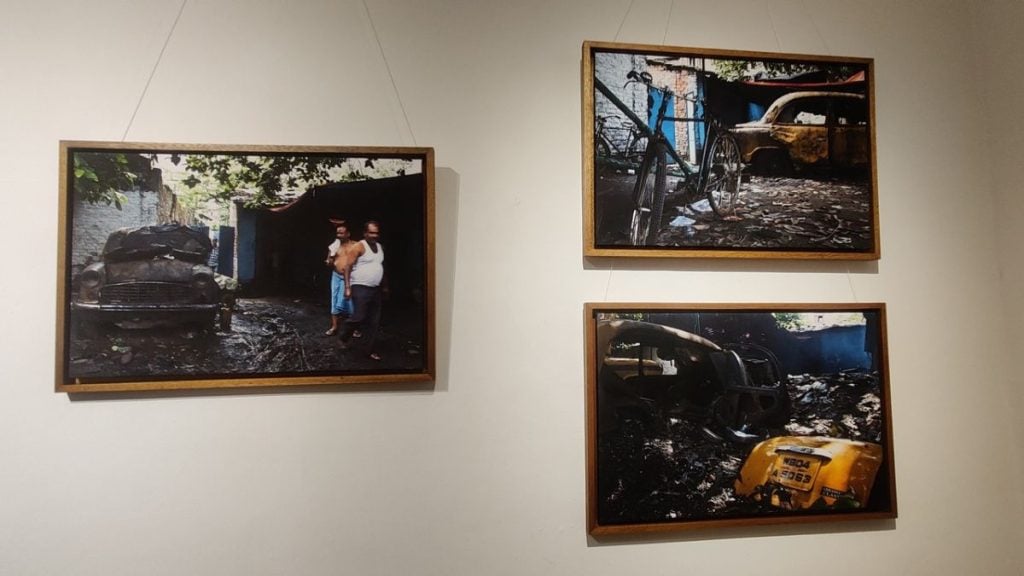
At a graveyard in Howrah where taxis are dismantled, the cars that once carried the city’s daily traffic are reduced to their bodies and parts. For their drivers, the end of the Ambassador is far more intimate.
Taking the cars from the drivers, Padmanbhan says, is like taking a child away from a parent.
“They will be given a cheap loan to buy a Maruti and drive around now. The yellow taxi has been their identity forever,” he said. “Its their entire life.”
The many drivers of Calcutta often navigated the city’s streets by memory rather than maps, knew the city’s lanes and neighbourhoods intimately, ferrying families returning from weddings, patients to hospitals, children on their first journeys alone, and mourners to funerals.
Padmanabhan says their lives will go on.
“They will have their livelihoods with their new car. They are happy men,” he said. “They will adapt.”
Also Read: Satyajit Ray beyond the visionary. Photo exhibition shows the labour behind iconic frames
The beauty of the ordinary
What does a city choose to preserve, and what does it sacrifice in the name of modernisation?
An elderly visitor at the exhibition, while interacting with Padmanabhan, shared the story of his daughter who lives in the baroque town of Erlangen, Germany. Instead of trading the old for new, the buildings are preserved as part of the city’s character. The upkeep and rents of the older houses are also considerably more expensive than those of newer units. Padmanabhan draws the parallel with India.
“We are homogenising cities. Hyderabad, Banaras. What’s the point of modernising a city?” he asked. “I’m glad Calcutta hasn’t changed.”
He points to Mumbai’s Atal Setu, now a symbol of the city’s infrastructure ambitions, and asks whether a new landmark should come to represent the city.
“Atal Setu is the new landmark when there is the Gateway of India? That’s the saddest way of looking at our past,” he said.
Padmanabhan is not arguing that Calcutta should remain frozen in time. Rather, he questions a version of progress in which the city’s distinctive objects and history are discarded, leaving its urban identity increasingly indistinguishable from that of other places. The Ambassador may no longer be the most efficient taxi, but it has carried the city through decades of change, appearing in films and photographs by Satyajit Ray to Sujoy Ghosh and becoming a character in its own right.
“What does it mean, the idea of beauty and art, and how you want to immortalise it and remind generations that there’s great beauty in the ordinary?” Padmanabhan asked.
In No Refusal, the yellow taxi is both subject and witness. The photographs do not ask Calcutta to stand still, or pretend that its old cab can be restored to its former glory on the road. But as the city moves forward, it should not forget what once moved through and with it.