



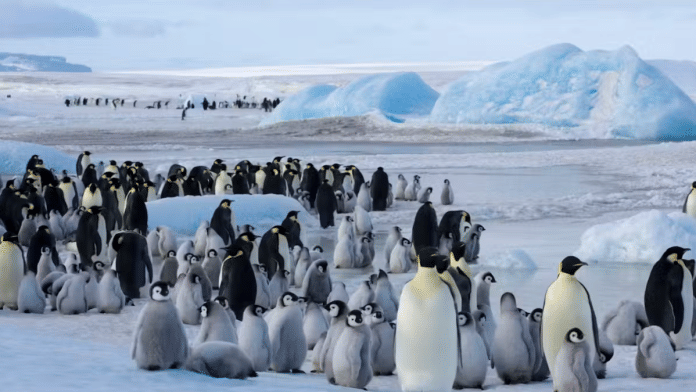
New Delhi: Scientists found that penguin poop is boosting green algae growth across Antarctica, melting snow faster. A new study in the Journal of Geophysical Research: Biogeosciences, published on 7 October, explains that snow algae patches in Antarctica are growing because penguins roaming the continent supply the plants with nutrients from their excreta.
“The link between wildlife, nutrients, and snow algae is a critical missing component in projections of expansion of ice-free areas in Antarctica,” said Alia Khan, a cryosphere biogeochemist at the University of Colorado, Boulder and senior author on the study, in a press release.
Antarctica is home to a variety of ‘colour-changing’ algae, which make the snow look red, green or yellow in different pockets of the continent. Additionally, these algae have active compounds and change their colour depending on their access to sunlight and other nutrients. During the austral summer, they turn green, using pigments like chlorophyll, but during the winter they’re known to turn red or yellow too.
This algae grows on the snow and turns the entire snow into a similar colour too, making it difficult to differentiate snow from algae.
Penguin poop and algae
Khan and her colleagues wanted to study both red and green algae, and travelled within Antarctica to collect samples. They went to the West Antarctic Peninsula, across the Drake Passage, in areas both with and without penguin colonies. Along with the algae, they also collected snow samples.
This is where the scientists also noticed that penguins’ poop looked very similar to red algae, and most penguins would excrete and then walk around in that very excrement, spreading it across the continent.
Later in the lab, the scientists studied the different algae to understand what nutrients they had. In green algae-covered snow, they noticed a heavy presence of phosphate, which is also present in penguin poop. However, this was relatively low in red algae-covered snow.
This confirmed that there’s a broader link between the marine food web and Antarctic ecology; penguins and seabirds feed on fish, producing phosphate in the process, and then deposit it through their poop onto the Antarctic surface, fuelling dense green algae growth.
Red and green algae, in the process of changing the snow’s colour, also enhance its melting rate. According to the study, snow algae darkens parts of the Antarctic surface and combines with higher temperatures to increase snow melt.
Additionally, red and green algae have different rates of melting. Red snow absorbs 20% more energy from sunlight than white snow, which increases energy and leads to faster snowmelt. Similarly, green snow absorbs 40% more energy than white snow, and leads to even higher snow melting rates.
(Edited by Aakriti Handa)