



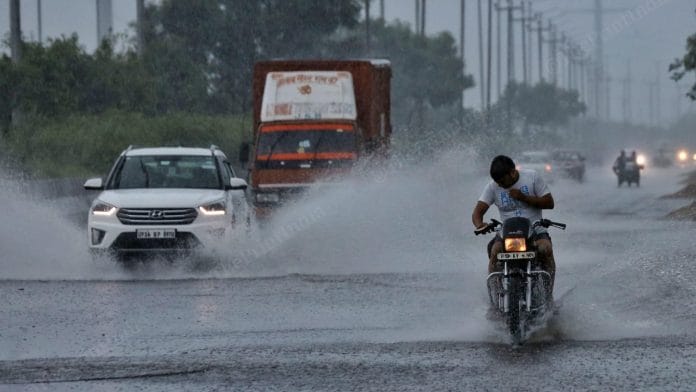
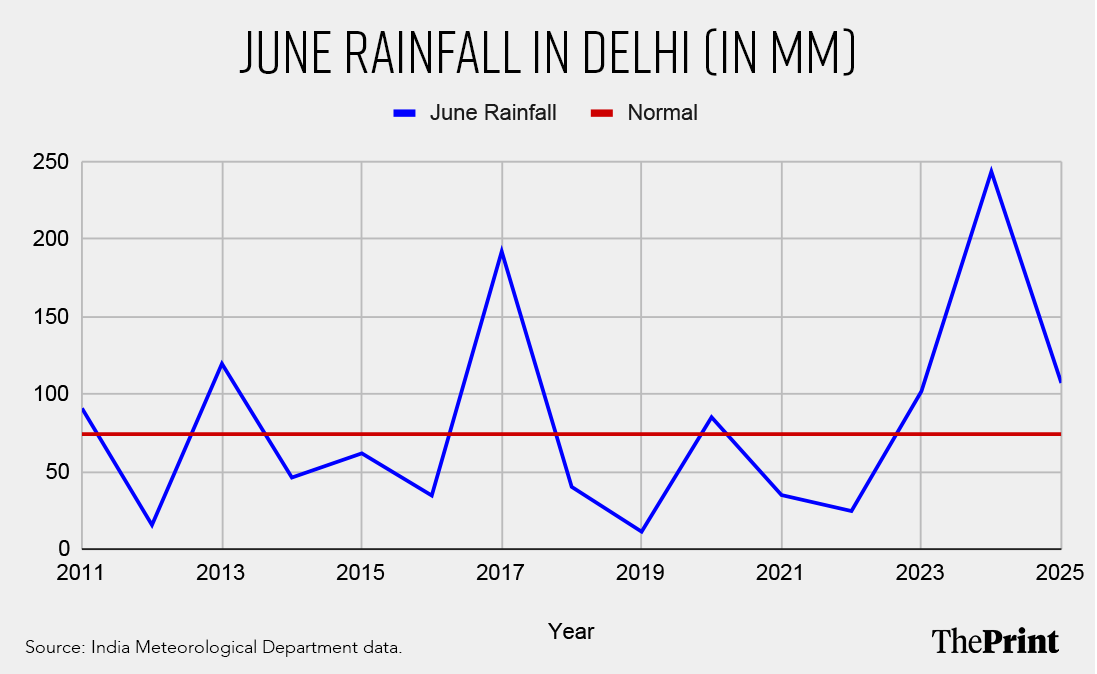
New Delhi: With 41.8 mm of rainfall recorded in June this year, Delhi received only half of its average rainfall, 74 mm, for the month. The southwest monsoon officially arrived in Delhi on 2 July, five days later than expected. But even after the India Meteorological Department announced its arrival, parts of Delhi remained dry.
Even as Mumbai gets red-alert warnings for extreme rainfall this week, Delhi’s maximum temperature touched 39 degrees Celsius on 7 July, and is expected to stay high. Humidity too was recorded at 85 per cent on 6 July, shooting the ‘feels like’ temperature to 43 degrees Celsius, according to private forecaster Accuweather.
In June last year, however, Delhi received 107 mm rainfall — more than double the rain it got this year. In June 2024, rainfall in the capital city was at an all-time high of 243 mm, almost three times the average June rainfall of 74 mm.
“There is no set pattern for Delhi rain during monsoon. However, we can say that the rains have been erratic in the past 8-10 years,” said Mahesh Palawat, Vice President of Meteorology and Climate Change at Skymet Weather.
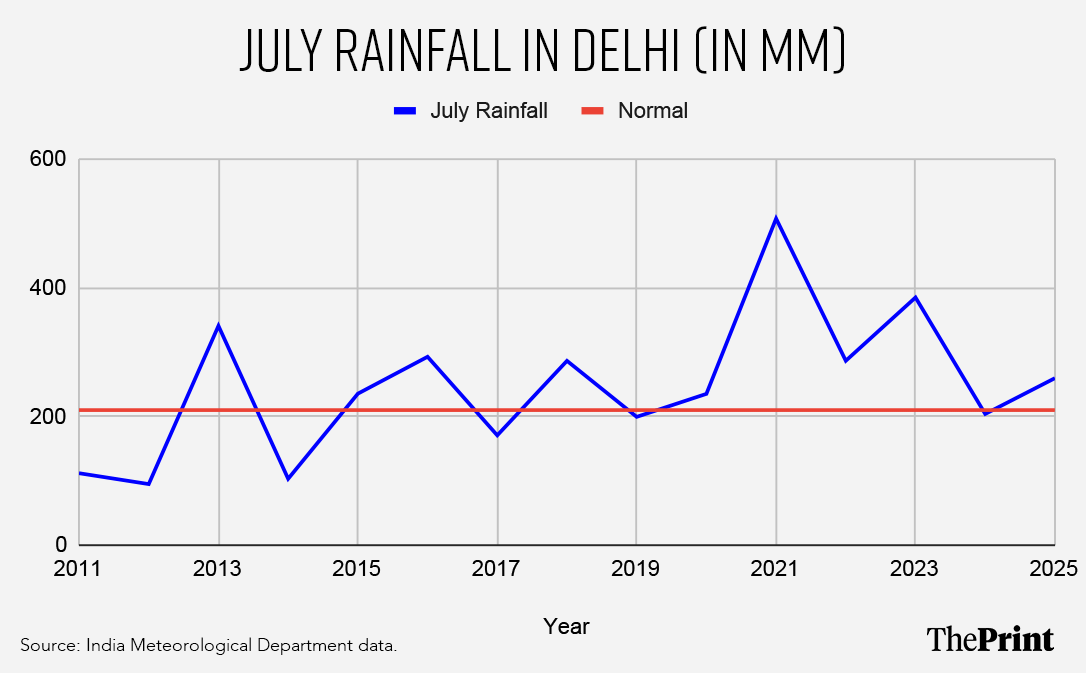
IMD’s monsoon data archives indicate the rainfall extremes in Delhi each year, swinging from deficient to excess rainfall, sometimes in consecutive years. ThePrint analysed Delhi’s rainfall data for the past 15 years to decode this pattern of interannual variability.
Since 2011, the lowest monsoon rainfall in Delhi was recorded in 2014, at 370 mm. This was also a moderate El Nino year, and the country as a whole received 10 per cent less rainfall than its monsoon average.
Meanwhile, 2021 recorded the heaviest monsoon rains in Delhi in the last 15 years, when the city received 1,169 mm of rainfall. This was more than 83 per cent of Delhi’s long period average (LPA) rainfall, which is the average rainfall in a region over a 30-year period, and serves as the benchmark rainfall metric.
Palawat also explained that more often than not, the heavy monsoon years in Delhi will see extreme rainfall events concentrated over one or two days, rather than over a prolonged period of time.
“The continuous rainfall, which was normal during the 80s and 90s, is missing now. Instead, we see more short, intense bursts of rainfall in Delhi,” said Palawat.
What causes Delhi monsoon?
Much like the rest of the country, Delhi’s rainfall too comes from the southwest monsoon that enters from Kerala and moves upwards into the Indian subcontinent. However, its landlocked position, the geographic proximity to the Himalayas and the Aravallis, as well as local wind circulations have a significant impact on the Delhi’s rainfall.
According to IMD, while the southwest monsoon sets in around late June, most of Delhi’s rainfall is concentrated in the months of July and August, with September bringing the rainy season to a close.
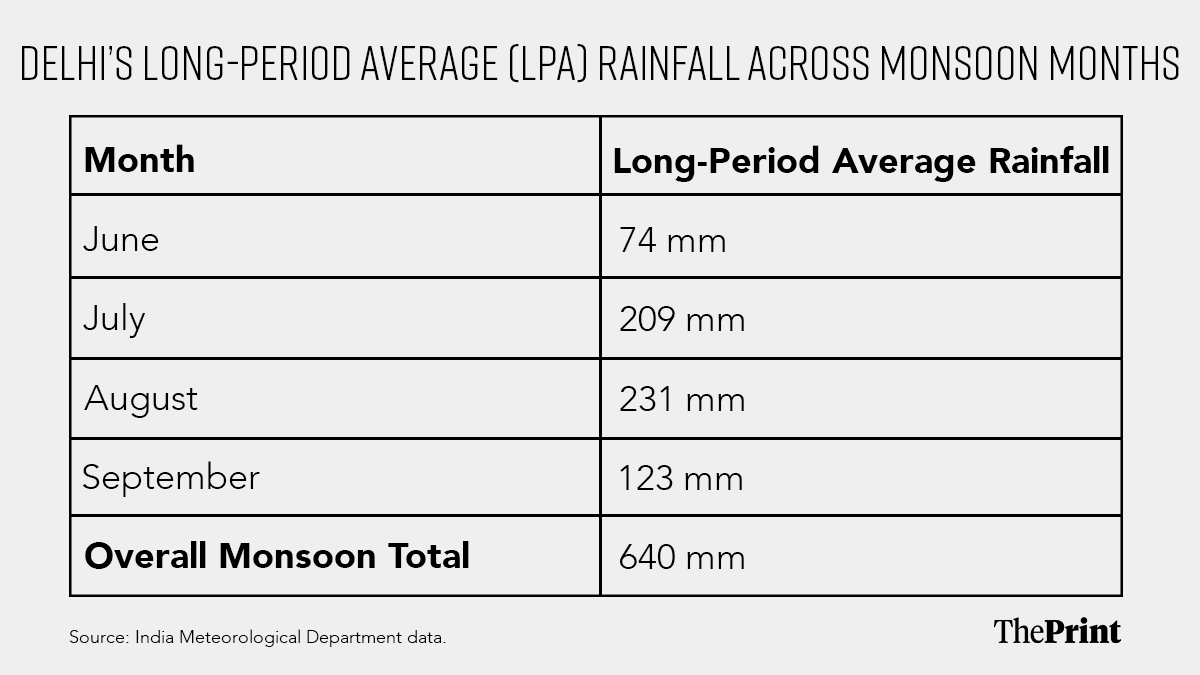
Data from the last 15 years, however, shows that Delhi received “normal” or “average” rainfall only in two years – 2011 and 2023. The city recorded below-normal monsoon rainfall in seven years, while it recorded above-normal rainfall for the remaining six years.
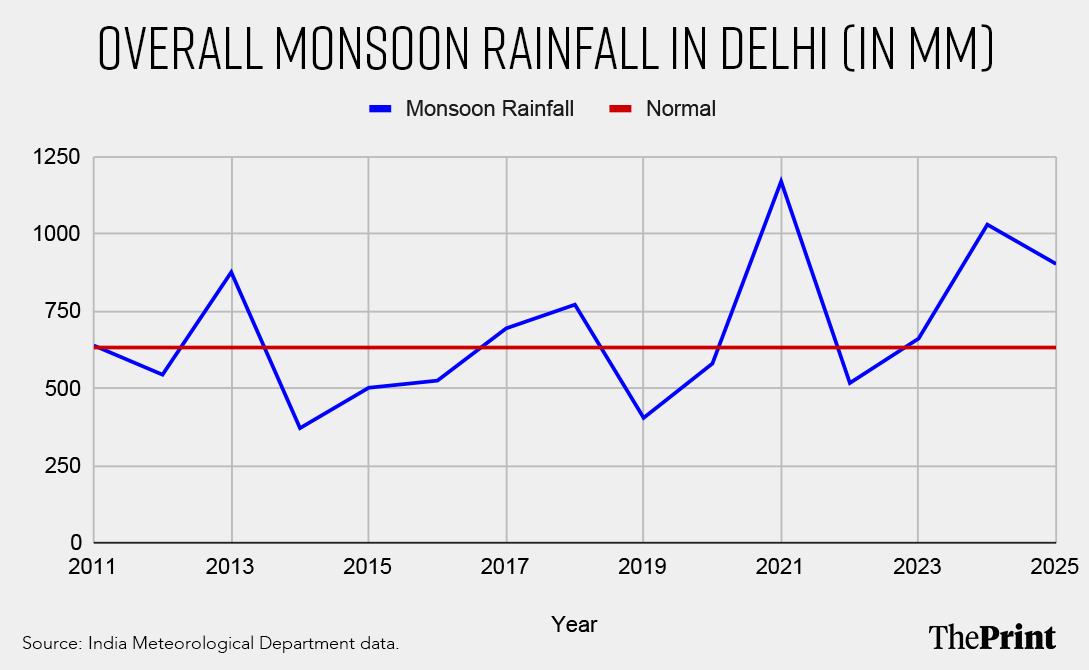
The data also indicates how broader climatic trends, such as El Niño and La Niña, shape Delhi’s monsoon. These phenomena originate in the tropical Pacific Ocean, and are characterised by rising sea surface temperatures. During El Niño periods, high ocean temperatures usually result in a weak southwest monsoon in India. During La Niña, the opposite happens, and India sees a stronger monsoon.
For example, in 2014, 2015 and 2016 when a strong El Niño was developing over the Pacific Ocean — it was the second-strongest El Niño event on record — Delhi’s rainfall remained deficient for all three years.
Also Read: Something’s changed in the kind of monsoon clouds over India in 30 years
Why are Delhi rains so erratic?
In 2019, however, when India as a whole got 110 per cent of its long-period average rainfall, Delhi’s rain dipped to its second-lowest in a decade, at 404 mm.
This shows how Delhi’s monsoon rains don’t always follow the same pattern as the rest of the country, and that local factors do have a part to play.
A study in 2022 by the Centre for Atmospheric Sciences at Indian Institute of Technology (IIT) Delhi, said that Delhi’s overall monsoon rainfall had declined from the 1980s to 2016 for two reasons — one, because large-scale monsoon circulation has weakened; and two, because rapid urbanisation in Delhi has directly affected where rain falls and where it doesn’t.
The study took 1987-1996 rainfall as the baseline, and found that in subsequent decades (1997-2006 and 2007-2016), Delhi’s monsoon rainfall was almost 30 per cent lower. They found that this was because the monsoon low-level jet (MLLJ) weakened over time, bringing in less rainfall. The MLLJ is a wind circulation in the lower atmosphere that travels over the Arabian sea and brings moisture with it. It is majorly responsible for Indian monsoon rains.
But the study also found that Delhi’s urbanisation contributed to different areas receiving different amounts of rain within the city, all thanks to the urban heat island (UHI) effect. UHI effect leads to pockets with more buildings and concrete recording significantly higher temperatures than rural areas.
This doesn’t mean that Delhi has received lower rainfall per se, but that the amount and range of rainfall within the city has become more variable.
These findings are also consistent with broader analyses by meteorologists from the Indian Institute of Tropical Meteorology (IITM) Pune, who found that extreme rainfall events have increased threefold in India since the 1950s, even though the total monsoon rainfall and moisture has decreased.
Meanwhile, the IMD’s latest forecast for monsoon rains in July said that the country will see below-normal rainfall in most places, except for some parts of north-west India. This forecast also warned about the availability of water for agriculture, drinking purposes, and others. Delhi too, according to the IMD’s map, is set to receive below-normal rainfall this month.
“Such conditions may increase the risk of heat stress, and pressure on available water resources in several regions,” said the IMD.
(Edited by Aakriti Handa)