


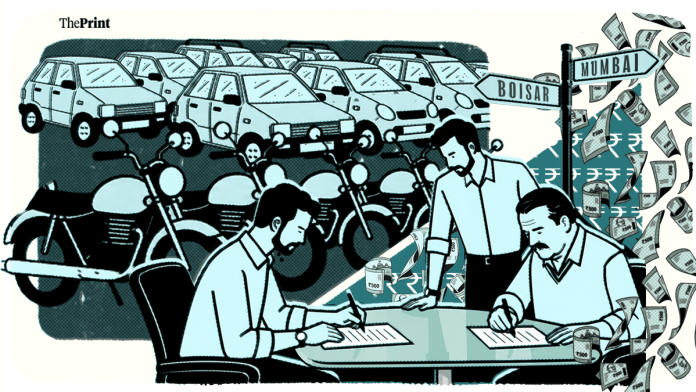
New Delhi: In India’s New Kings & Queens are Flourishing in Small Towns, we showed that the number of Indians declaring more than Rs 1 crore of income has risen about seven-fold in the last twelve years. Companies earning Rs 50–500 crore of profit have more than doubled in number and the growth has come from independent promoters rather than old business houses, and it has been fastest away from the big metros. We highlighted the Adhikaris of Maharashtra’s Boisar, a family that has grown from supplying building materials into a conglomerate spanning hospitals, schools, logistics and an Indian Oil fuel station on the state highway.
That fuel station is a clue. In our view, some of the most reliable building blocks of small-town family wealth are franchises granted by large national companies—a fuel pump, a cement or fast-moving consumer goods (FMCG) distributorship, and above all, an auto dealership. In this piece, we follow the money from one of India’s most consistently growing industries to the families who sit at the end of its supply chain.
10 years of 11% growth in India’s auto sector
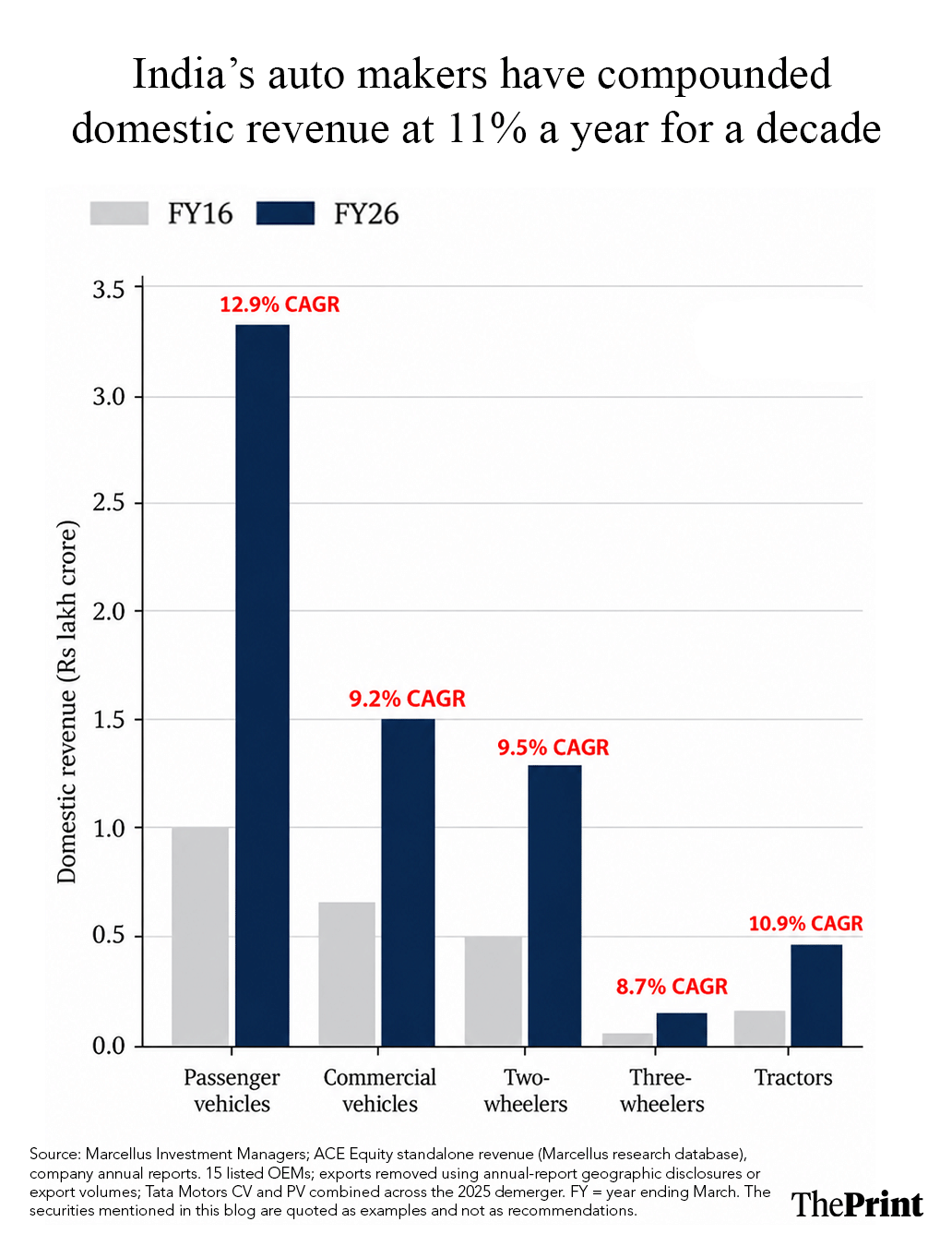
Over the past decade the domestic revenue of India’s 15 listed auto makers—passenger vehicles, two- and three-wheelers, trucks and tractors—has grown from about Rs 2.35 lakh crore in FY16 to Rs 6.72 lakh crore in FY26, a compound annual growth rate of 11.1 percent. That growth came despite demonetisation, GST, the switch to BS-VI emission norms, a credit crunch and Covid. Passenger vehicles led the way at 12.9 percent a year on the back of India’s shift to SUVs, followed by tractors at 10.9 percent.
A sector growing at 11 percent a year for a decade creates a lot of wealth. Much of it accrues to the shareholders of the auto makers. But how has this growth translated into wealth for the new Kings & Queens of small-town India—the families who do not own listed shares in Maruti or Mahindra, but who own something just as valuable in their towns?
The answer: A nationwide web of auto dealerships
Nearly every vehicle sold in India passes through a dealer. According to the Federation of Automobile Dealers Associations (FADA), India has about 15,000 dealer businesses running more than 30,000 outlets. If we count the many rural tractor and two-wheeler dealers outside FADA, the total number of dealers is estimated to be about 18,000. Almost all of them are privately owned, most by local business families.
To size their earnings, we built a bottom-up model of the average dealer in each segment. We start from the auto makers’ domestic revenue, add the dealer’s margin on each vehicle (which FADA’s survey puts at roughly 3.7–5 percent of the price), add service, spare parts, accessories and insurance and finance commissions, and deduct customer discounts, operating costs, depreciation, interest and tax. The result was calibrated to India’s two listed dealer groups, Landmark Cars and Popular Vehicles. These are estimates rather than reported figures, but they give a sense of scale.
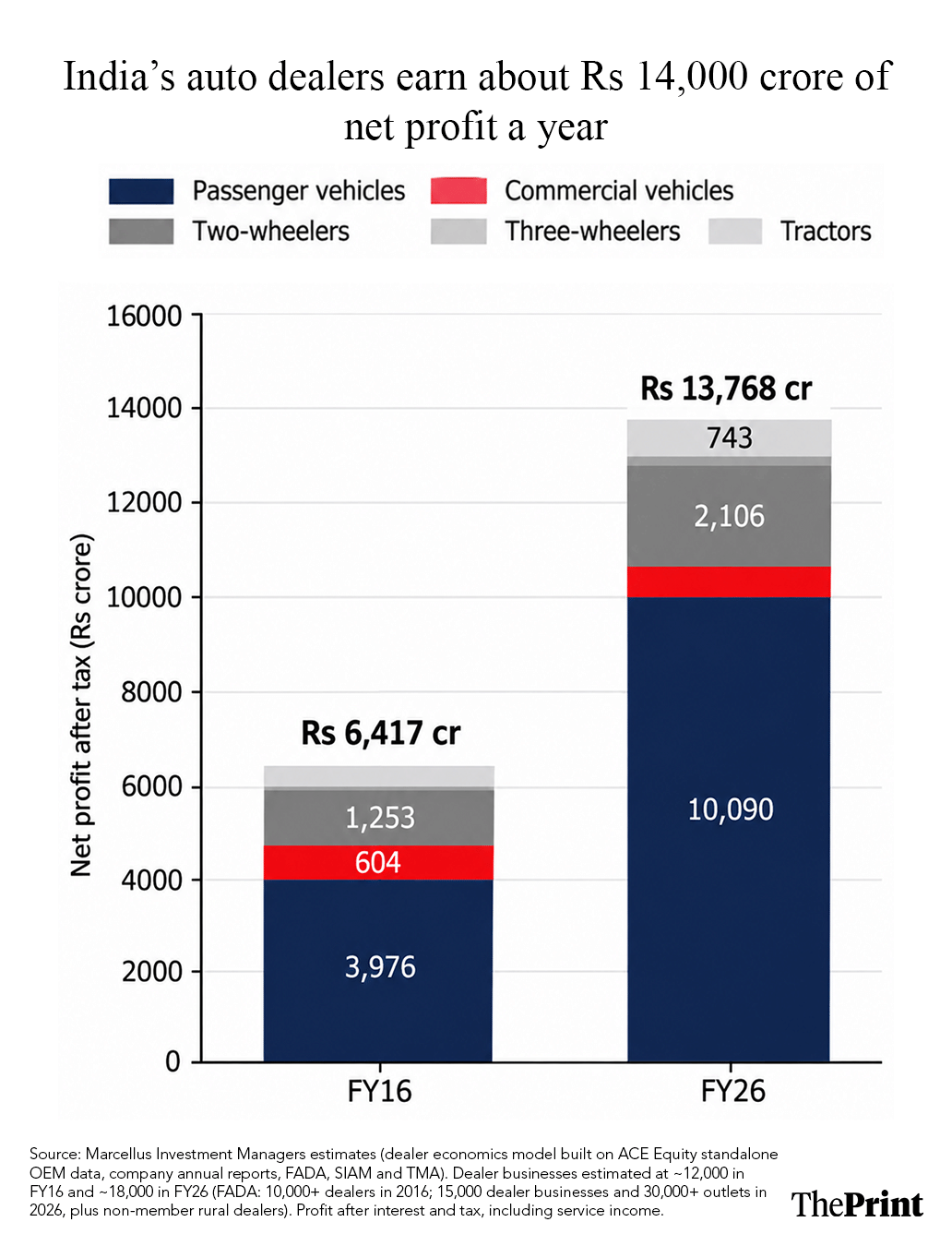
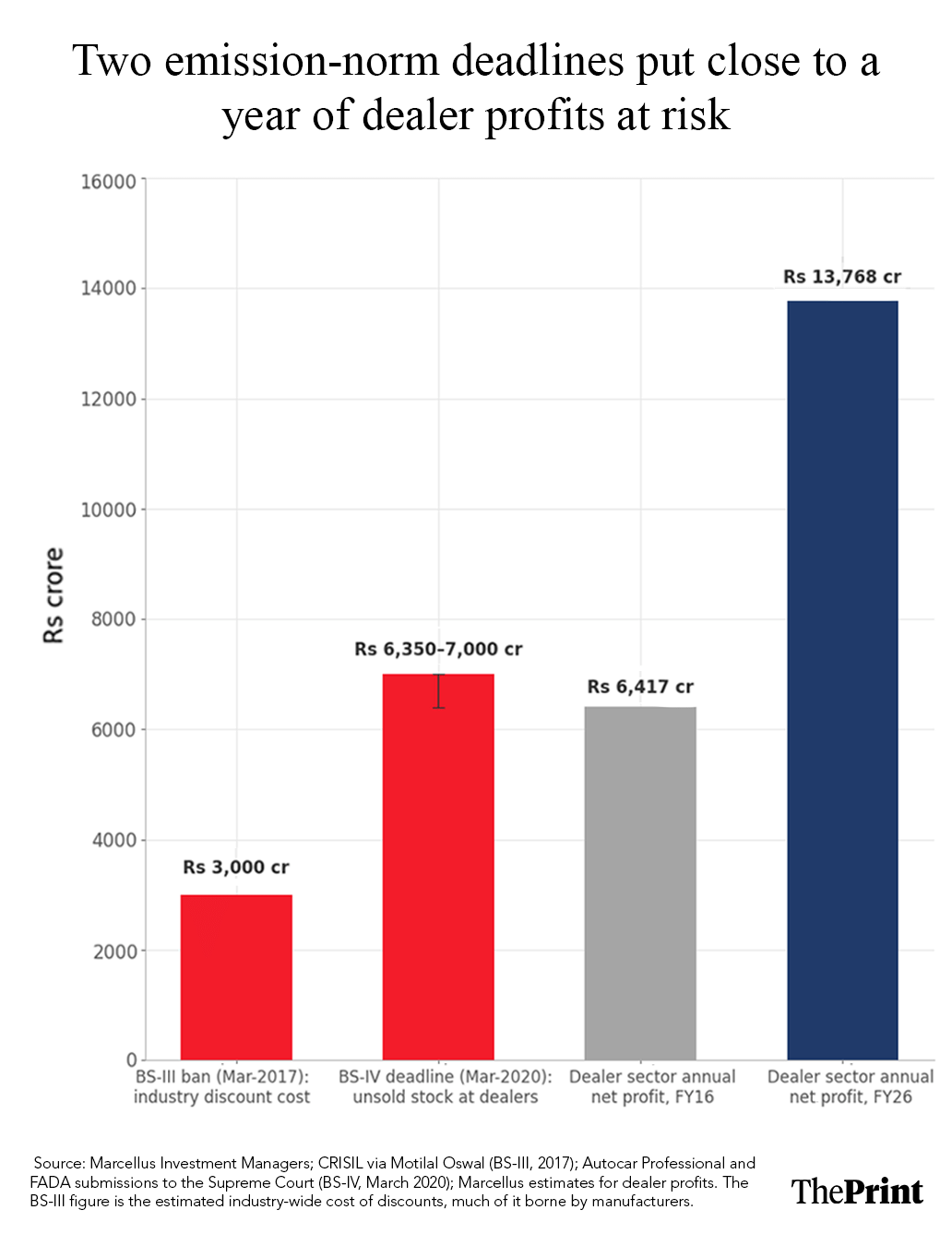
The answer is striking. India’s auto dealers earned about Rs 13,800 crore of net profit in FY26, up from about Rs 6,400 crore in FY16—roughly Rs 1 lakh crore of PAT earned cumulatively over the decade. Before interest, depreciation and tax, they generate about Rs 40,000 crore a year of profit. Car dealers account for nearly three-quarters of that profit pool.
To understand the scale of the annual PAT earned by the auto dealers, let us consider the PAT of L&T—an industrial giant with a market cap of Rs 5 lakh crore ($50bn)—which stands at Rs 15,000 crore.
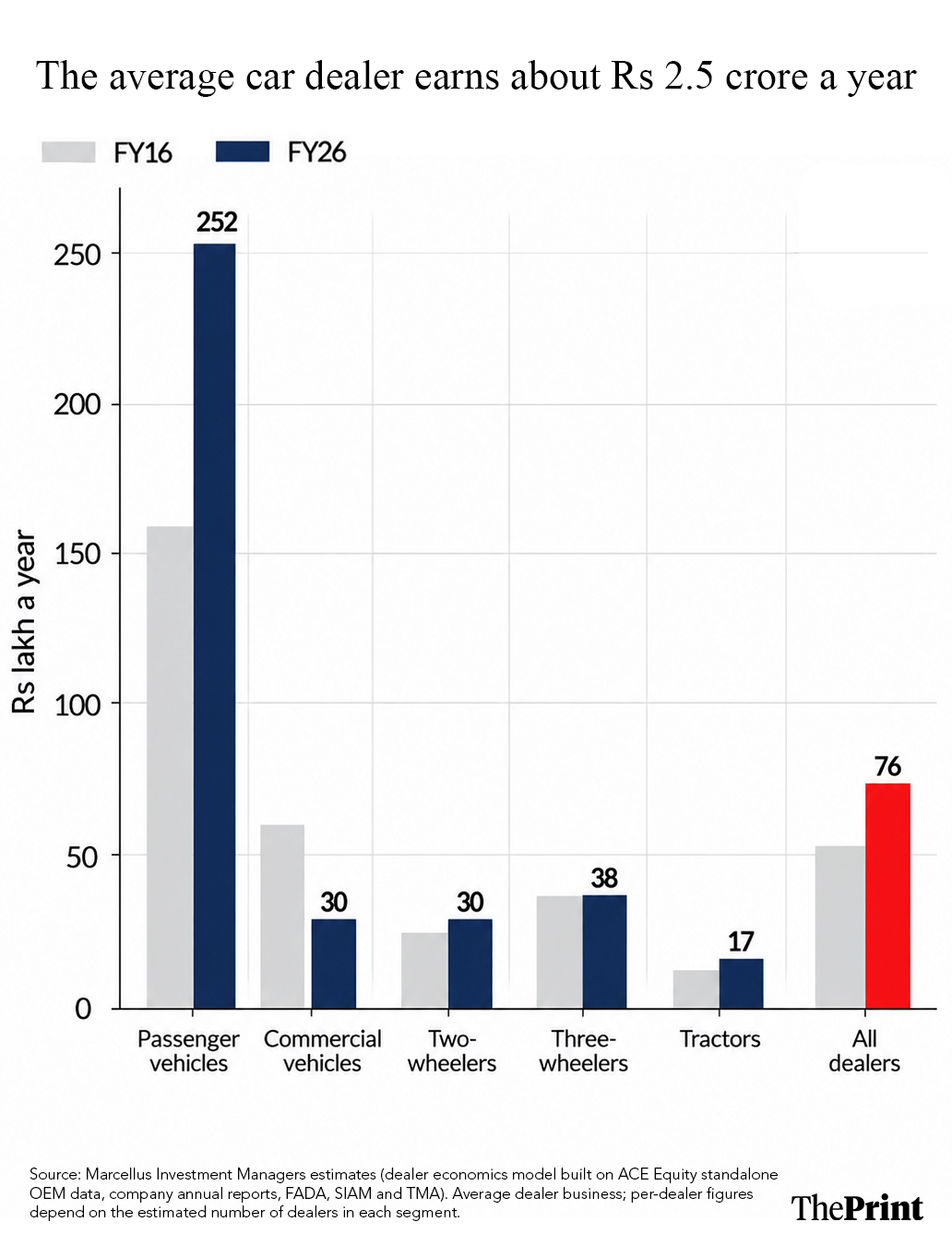
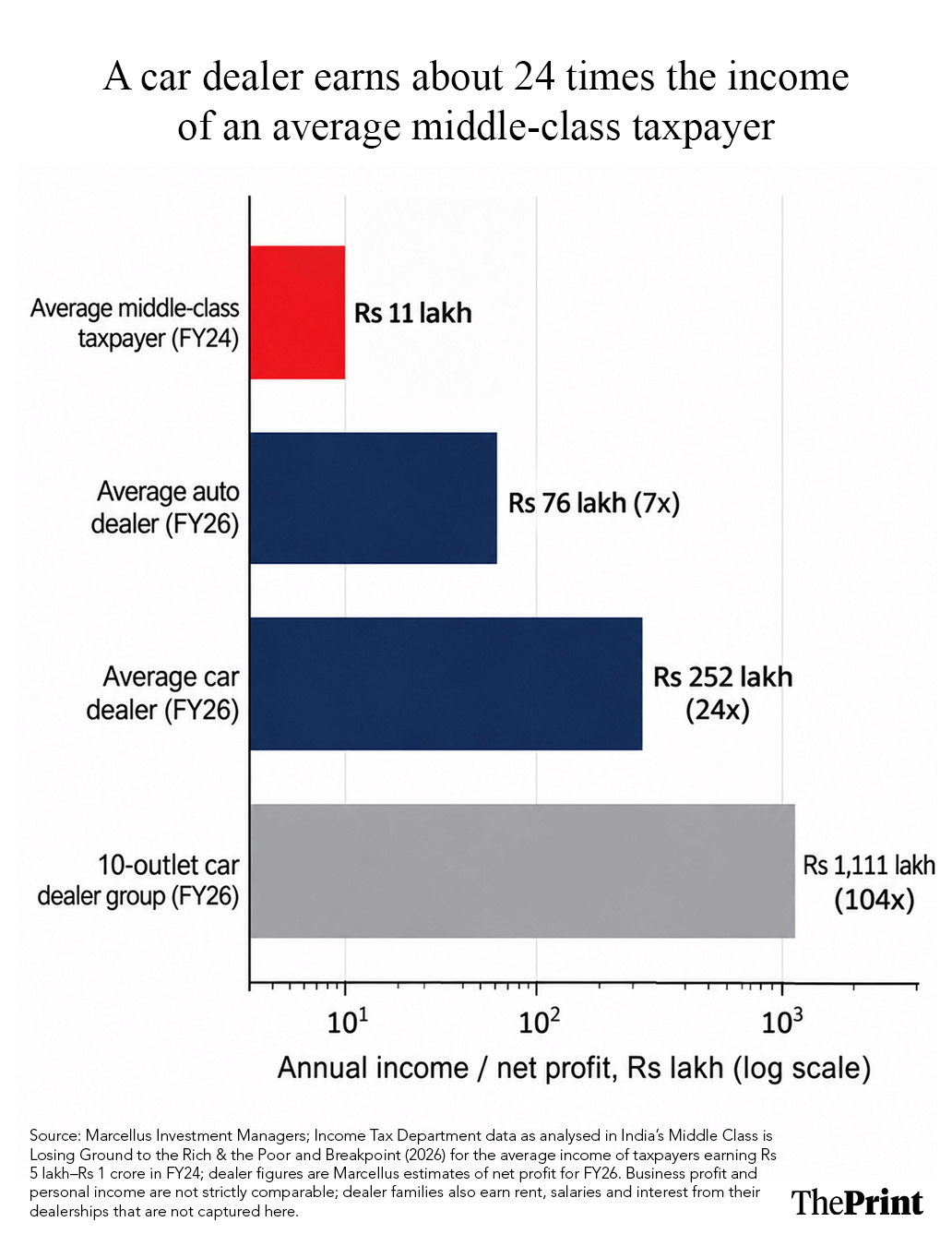
Spread across these businesses, the average dealer earns about Rs 76 lakh a year of PAT. The average car dealer—who typically runs about three outlets—makes about Rs 2.5 crore per year (similar to the compensation received by a Board Director of a BSE 100 listed company). Two-wheeler, three-wheeler, truck and tractor dealers are smaller businesses, earning Rs 17–38 lakh a year. Commercial vehicle dealers are the exception as their profits per dealer have roughly halved, squeezed by thin margins, heavy discounting on fleet deals and rising costs.
Set against the middle class we wrote about in our last piece, these are princely sums. The average dealer family earns about seven times what the average middle-class taxpayer does; a car dealer earns about 24 times as much; and a car dealer group with ten outlets, about 100 times. It is no surprise that every district town in India has dealership-owning families among its most prominent.
Why are auto dealerships so lucrative?
On the face of it, selling cars is a thin business. The dealer’s margin on a new vehicle has not improved in ten years, and much of it is given away to customers as discounts. Yet three features turn a dealership into a durable engine of family wealth.
1. After-sales service is where the money is—especially in small towns
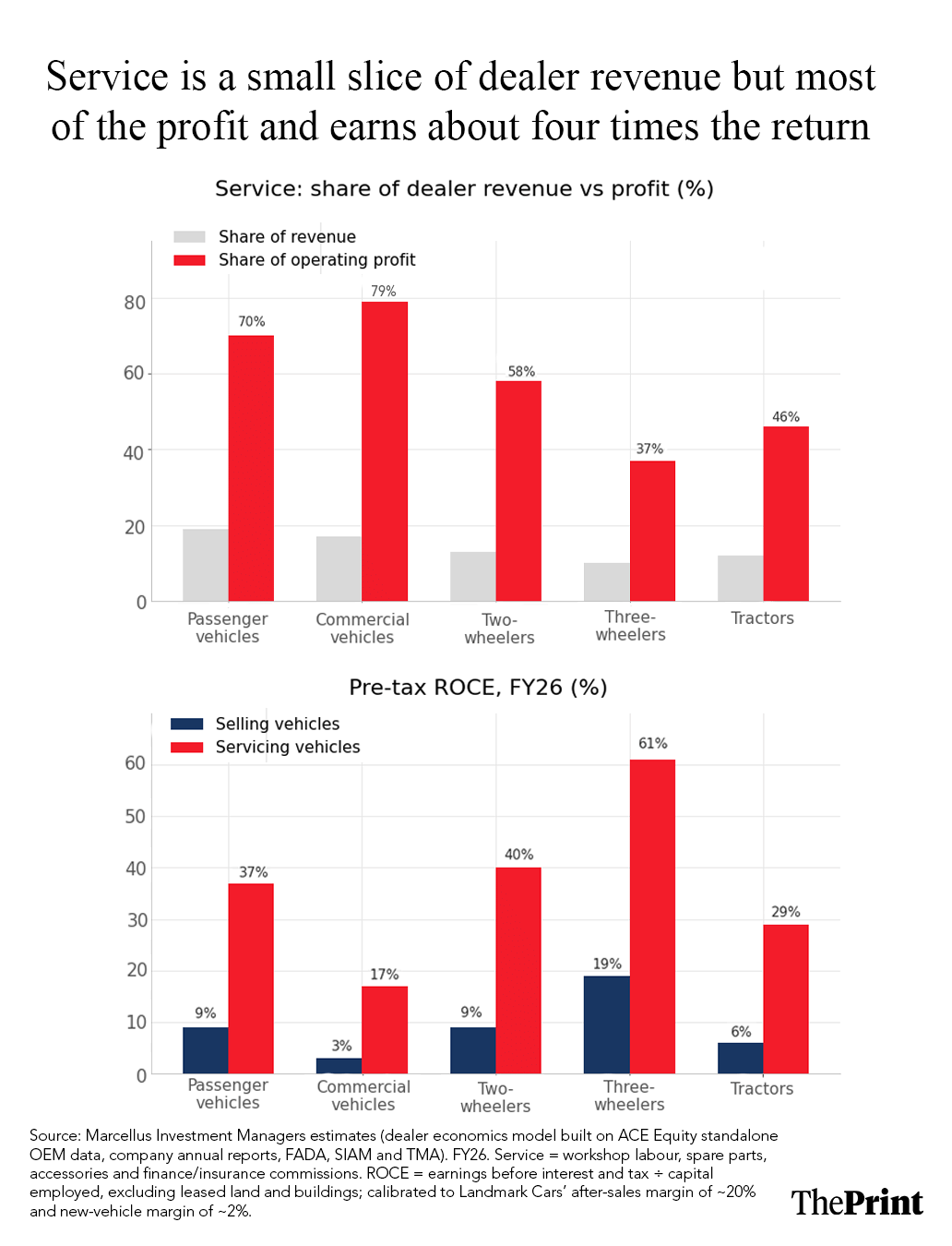
Selling a vehicle earns a dealer a gross margin of 3–5 percent and a net margin close to zero. Servicing it earns a gross margin of 30–40 percent from labour, spare parts, accessories, body-shop work paid for by insurers, and commissions on loans and insurance. As a result, service makes up only about a fifth of a car dealer’s revenue but about 70 percent of its operating profit, and nearly 80 percent for a truck dealer. Our estimates show that a car dealer earns a return on capital of about 37 percent on its workshops against about 9 percent on its showrooms. Each car sold is the start of an annuity—the owner typically returns for servicing for five to seven years.
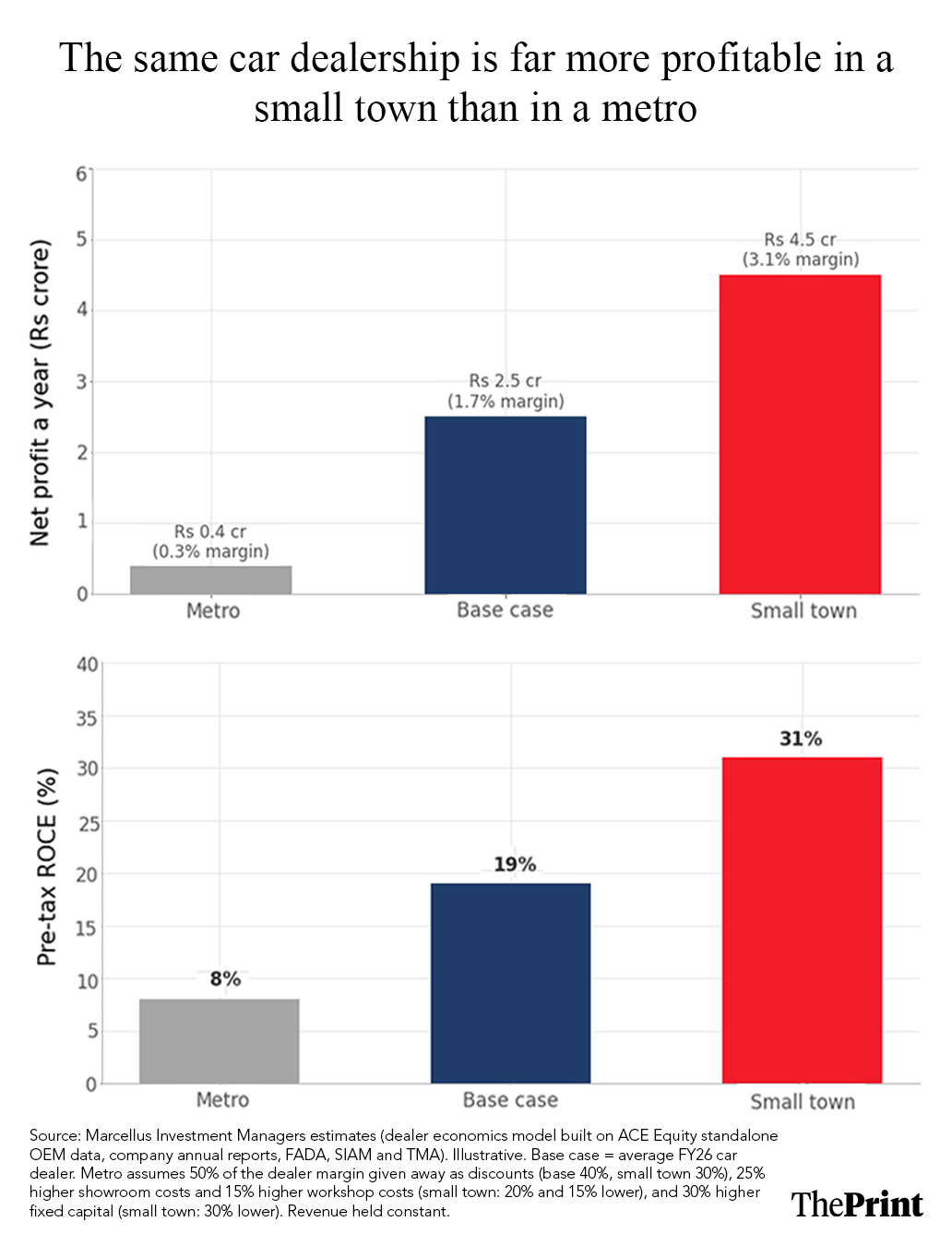
Location matters as much. In the metros, dealers pay high rents and salaries, face several outlets of the same brand in one city and have to discount heavily to win customers. Maruti’s own premium Nexa network, built around big cities, has carried the burden of lower returns because of high real estate, employee and operating costs, which is why the company began building smaller-format showrooms for small towns. Mayank Pareek, who was Maruti’s Chief Operating Officer and Executive Director (Marketing and Sales) and built the company’s rural sales network, put it simply—rural customers are much more profitable than city customers. Small-town dealers often own their land, pay less for staff, face less competition from same-brand outlets and with many customers paying cash, give away less of their margin.
To illustrate, we took the same car dealership with around Rs 150 crore of annual revenue and placed it in a metro and a small town. Higher costs and deeper discounts in the metro reduce its net profit to under Rs 0.5 crore, while in a small town the same business earns about Rs 4.5 crore and a return on capital of about 31 percent. It is no coincidence that India’s two listed dealer groups, both with large metro exposure, earn low returns.
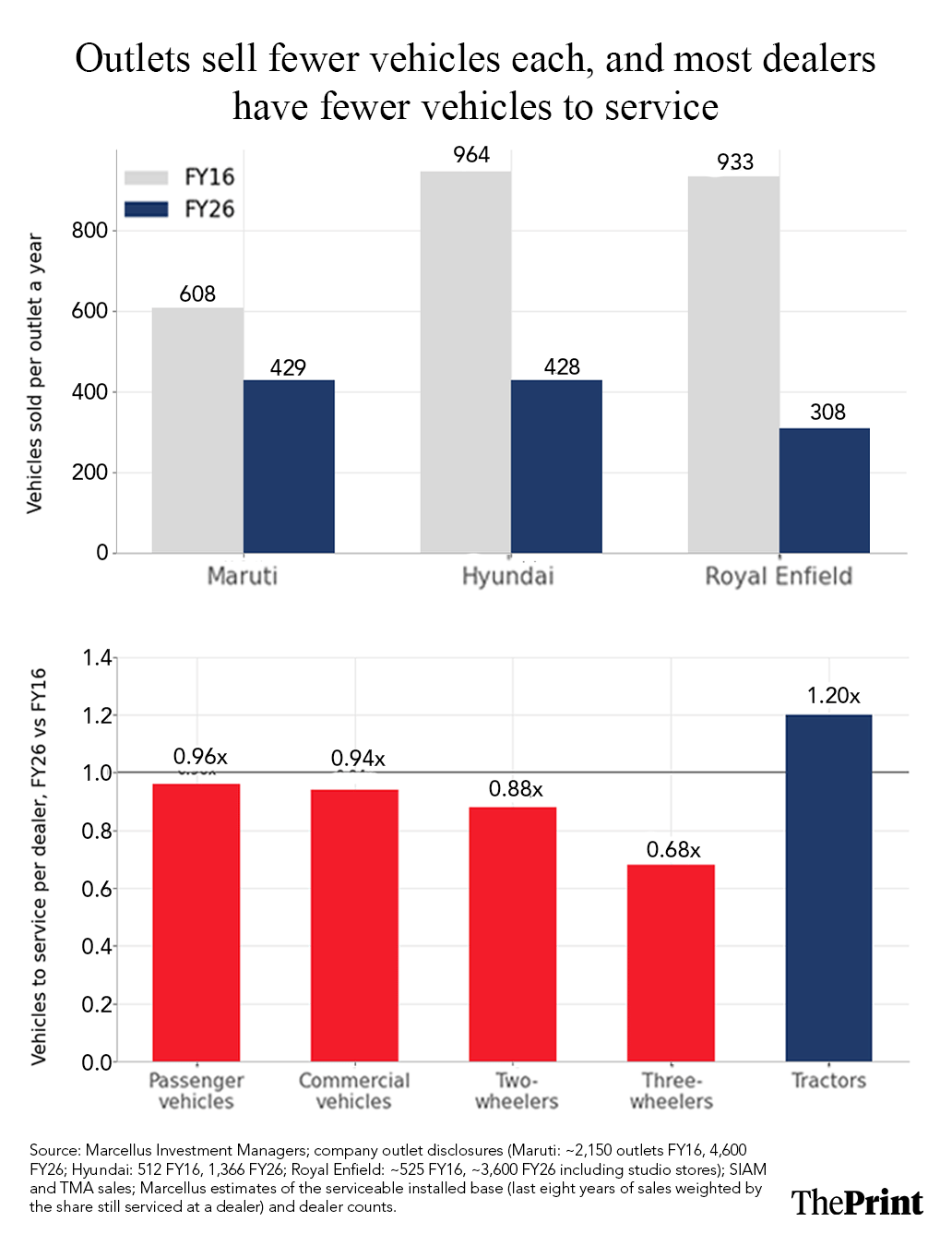
This helps explain why growth in auto sales has tilted towards smaller towns. Rural retail sales grew 7.6 percent in FY25 against 5.1 percent in cities, and in April 2026, rural retail grew 20.4 percent against 7.1 percent in urban India, according to FADA. Maruti alone has more than doubled its sales outlets over the decade, from about 2,150 to 4,600, with a large part of the additions aimed at smaller towns.
2. Scaling lifts profitability
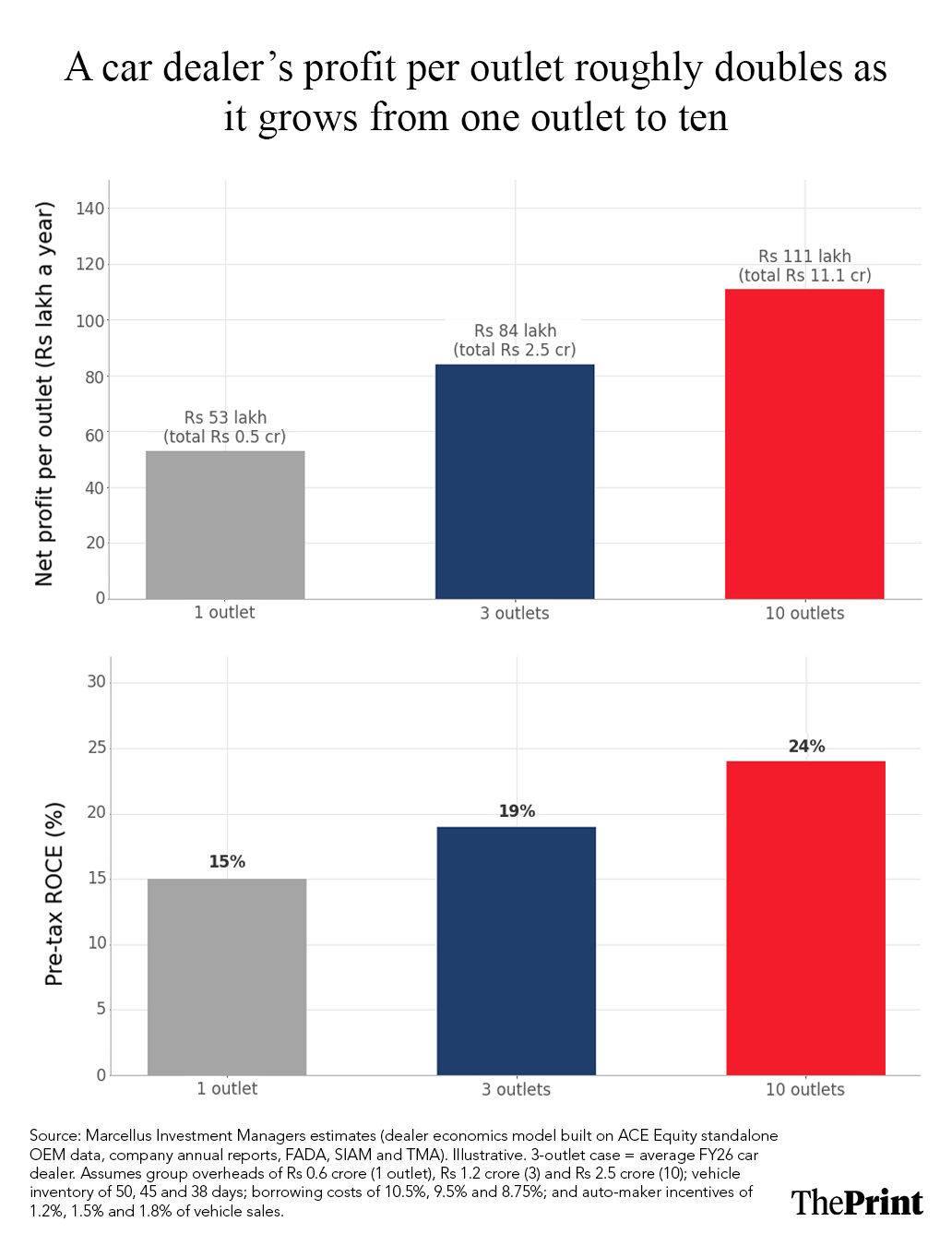
A family that runs one showroom bears the full cost of an owner’s office, accounts, HR and IT systems on a single outlet’s sales. On the other hand, a family that runs ten spreads those costs across ten outlets, pools its inventory so that it needs fewer days of stock, borrows at better rates and earns higher volume incentives from the auto maker. Auto makers, in turn, prefer to award new territories and satellite outlets to existing dealers who have performed. In our illustration, net profit per outlet roughly doubles and the return on capital rises from about 15 percent to about 24 percent as a car dealer grows from one outlet to ten. A ten-outlet car dealer group earns about Rs 11 crore a year (comparable to the compensation of a Board Director of a Nifty50 company).
3. Each new generation gets its own dealership
In a business family, every generation brings more heirs. Dealerships offer a ready way to give each of them a substantial, self-contained business—a new brand, a new district or a new satellite network, run by a son, daughter or nephew, financed by the cash flows of the existing outlets and backed by the family’s standing with the auto maker. Over decades, this turns a single showroom into a regional dynasty.
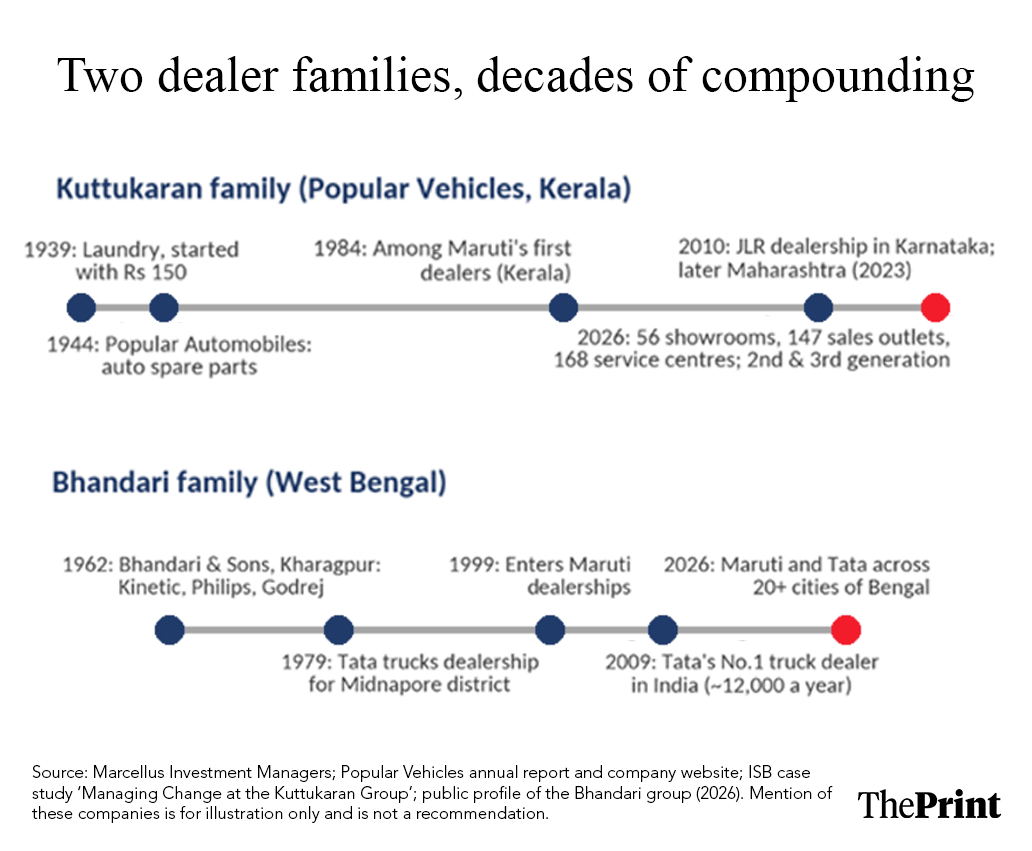
For instance, the Kuttukaran family of Kerala began with a laundry in 1939, entered the auto parts business in 1944 and became one of Maruti’s first dealers in 1984. With the second and third generations at the helm, its group now runs 56 sales showrooms and 168 service centres across several states.
The Bhandari family arrived in Kharagpur in Bengal in 1905 as traders, took its first Tata dealership in 1979 and its first Maruti dealership in 1999. Three generations on, it runs more than 150 touchpoints in West Bengal with about Rs 3,000 crore of revenue.
These families share the traits that helped the Adhikaris of Boisar—capital and land from an earlier trading business, which spares them the rent and interest that sink new entrants; a trader’s discipline over stock and cash; and relationships with local bankers, financiers, insurers and fleet buyers built over decades. Only a few outsiders try to break in as a car dealership today ties up roughly Rs 25–30 crore of capital which is precisely why the business keeps rewarding those already inside it.
The risks: What can go wrong
As with any profitable enterprise in a free-market economy, dealerships carry risks. Three stand out.
1. Abrupt regulatory changes
A dealer’s biggest asset is its stock of unsold vehicles, which makes it acutely exposed to sudden rule changes. In March 2017, the Supreme Court banned the sale of BS-III vehicles, forcing discounts that CRISIL estimated cost the industry about Rs 3,000 crore. Three years later, the switch from BS-IV to BS-VI norms on 1 April 2020 collided with the Covid lockdown and dealers were left holding an estimated Rs 6,350–7,000 crore of BS-IV stock including some 15,000 cars, 12,000 commercial vehicles and seven lakh two-wheelers. The Supreme Court allowed only 10 percent of it to be sold after the lockdown, which is close to a full year of the entire sector’s profits.
2. Economic cycles
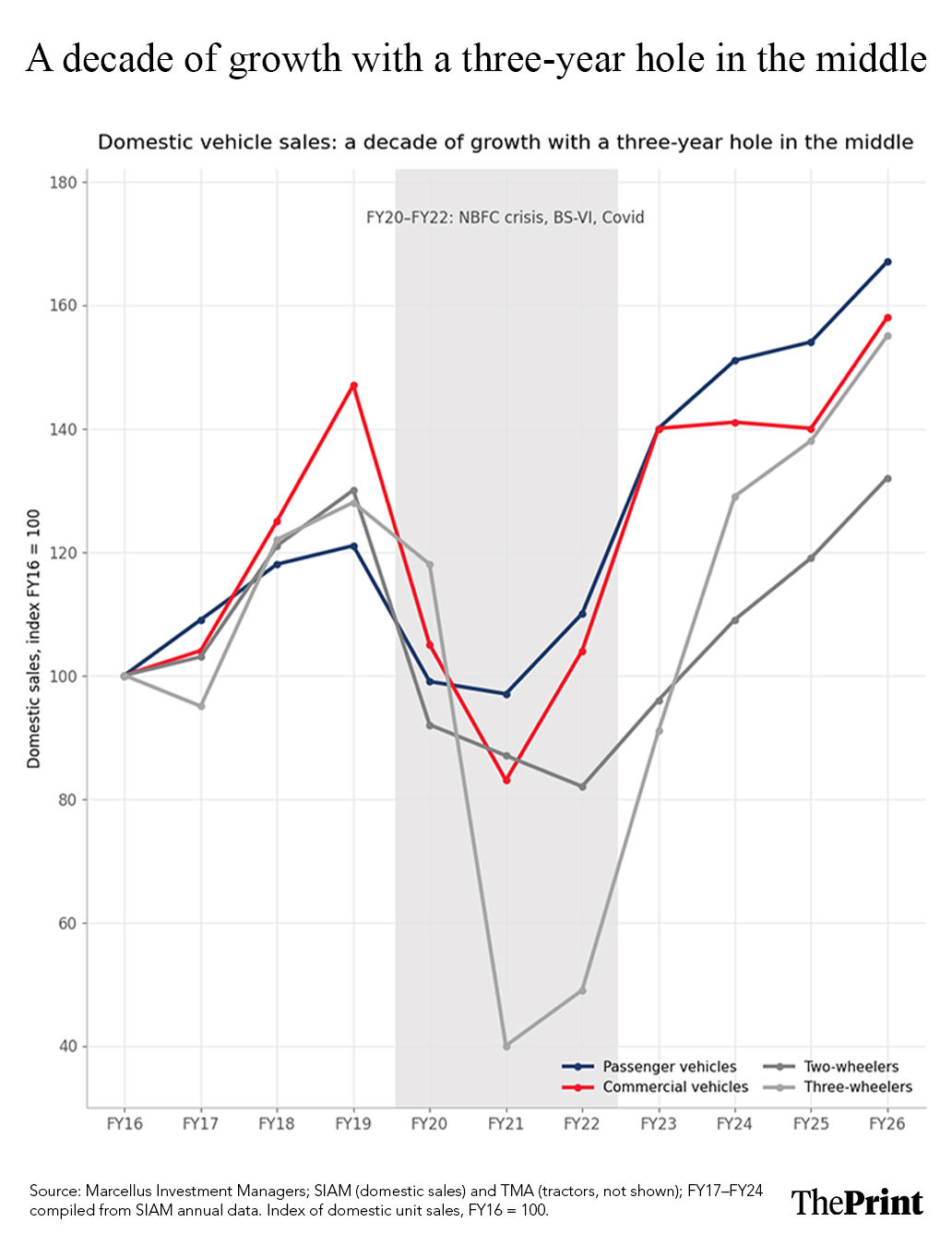
Dealers carry fixed costs and borrowed inventory, so a downturn hits them harder than the auto makers. Between FY19 and FY22, India’s auto market went through the NBFC credit crunch, the BS-VI transition and Covid. Car sales did not regain their FY19 level until FY23 and two-wheeler sales fell by more than a third while three-wheeler sales collapsed by two-thirds. In 2019 alone, around 300 car and bike outlets shut down, and only about 30 percent of dealers were estimated to be profitable.
3. Large networks squeezing smaller ones
Auto makers have expanded their dealer networks faster than the market. Maruti more than doubled its sales outlets over the decade, Hyundai nearly tripled theirs and Royal Enfield added hundreds of small studio stores. As a result, the average outlet now sells far fewer vehicles than it did in FY16, and in most segments each dealer has fewer vehicles to service. The families that have added outlets have captured this expansion while single-outlet dealers that stayed small have seen their throughput and profits squeezed by larger groups selling the same brand in the same district.
Further into Boisar
In our previous piece, we met the Adhikaris of Boisar, the industrial town 100 km north of Mumbai. This time, to see how a dealership family is built, we went further into Boisar. Deep inside the Tarapur MIDC industrial estate is Sonith Motors, the area’s Royal Enfield showroom and service centre, run and partly owned by Jackie Chaturani. We have visited him with our team several times since 2016.
Jackie’s brother-in-law, Jairaj Bhagchandani, entered the two-wheeler trade in 1996 with a multi-brand showroom and took his first Royal Enfield dealership in 2004, before Chairman Siddhartha Lal’s turnaround made the brand one of India’s most profitable motorcycle makers. In 2016, Bhagchandani got an offer from Royal Enfield to open a store in Boisar. He conducted a recce, saw an industrial area that would keep growing, and opened the store later that year. “Then Sid Lal arrived… and we just kept growing,” Jackie told us.
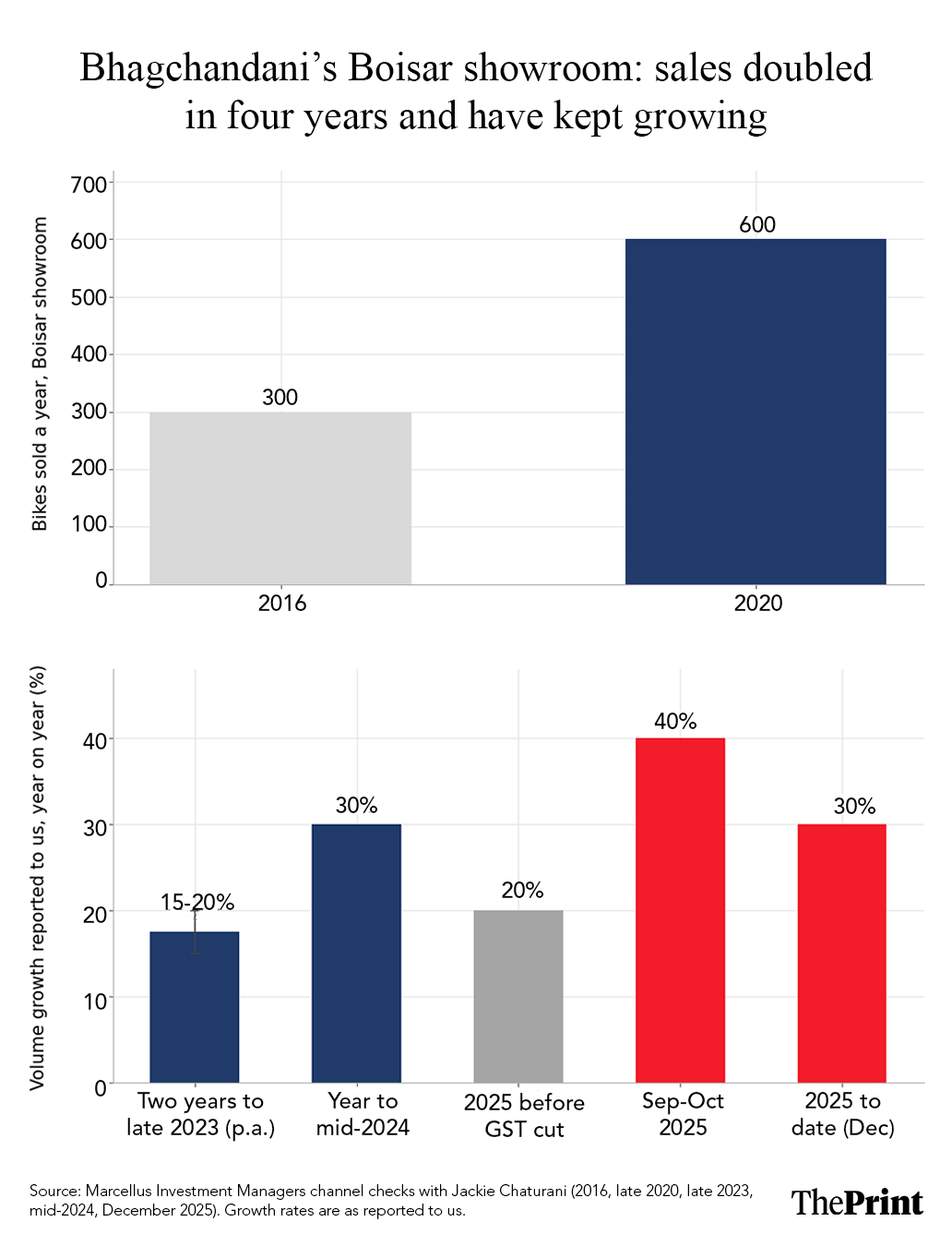
When we visited Jackie’s Boisar showroom in late 2020, it was a compact 1,000 sq ft space with four bikes on display, beautifully fitted out to Royal Enfield’s specifications. It had doubled its sales from about 300 bikes a year to 600 in four years. This growth took place while the town’s Bajaj showroom had just shut down. Jackie, who rides a Royal Enfield Himalayan himself, said, “I don’t think you can sell a Royal Enfield to a customer without driving one yourself.”
Their growth has continued on every visit since—15–20 percent a year to late 2023, about 30 percent to mid-2024 and about 30 percent in 2025, when the GST cut on bikes of up to 350cc pushed September–October sales up 40 percent and lifted the 350cc share of the family’s sales from 85 percent to 92–95 percent. The extras that make dealerships lucrative have grown faster still—genuine accessories per bike have risen from Rs 3,500–5,000 to about Rs 12,000, apparel per bike has doubled, almost every buyer now takes accessories, and about half buy on credit. Jackie’s customers are a cross-section of the new Boisar and include local Adivasi and fishing families with land and savings, officers at Tata, JSW and Viraj Steel earning Rs 5–50 lakh a year, migrant workers and college students.
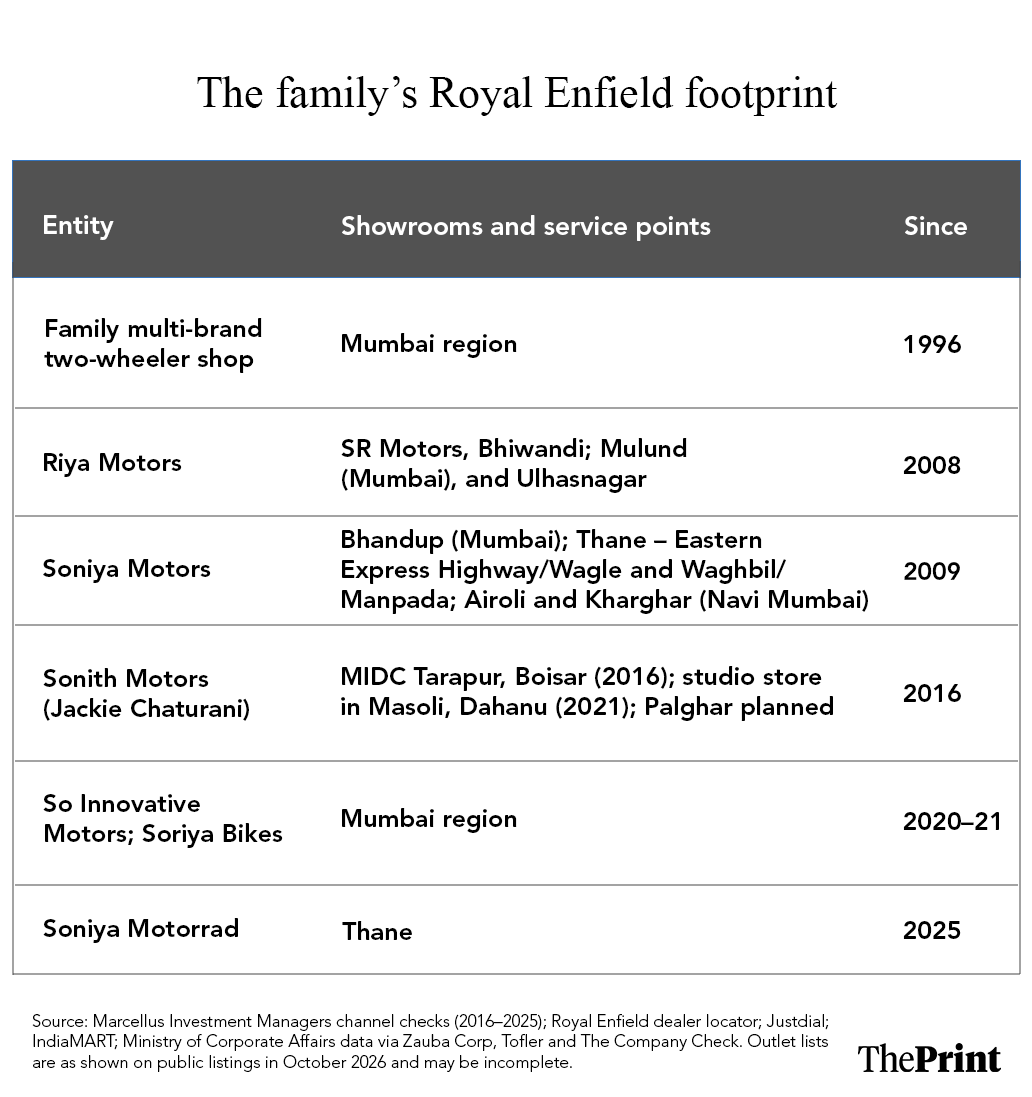
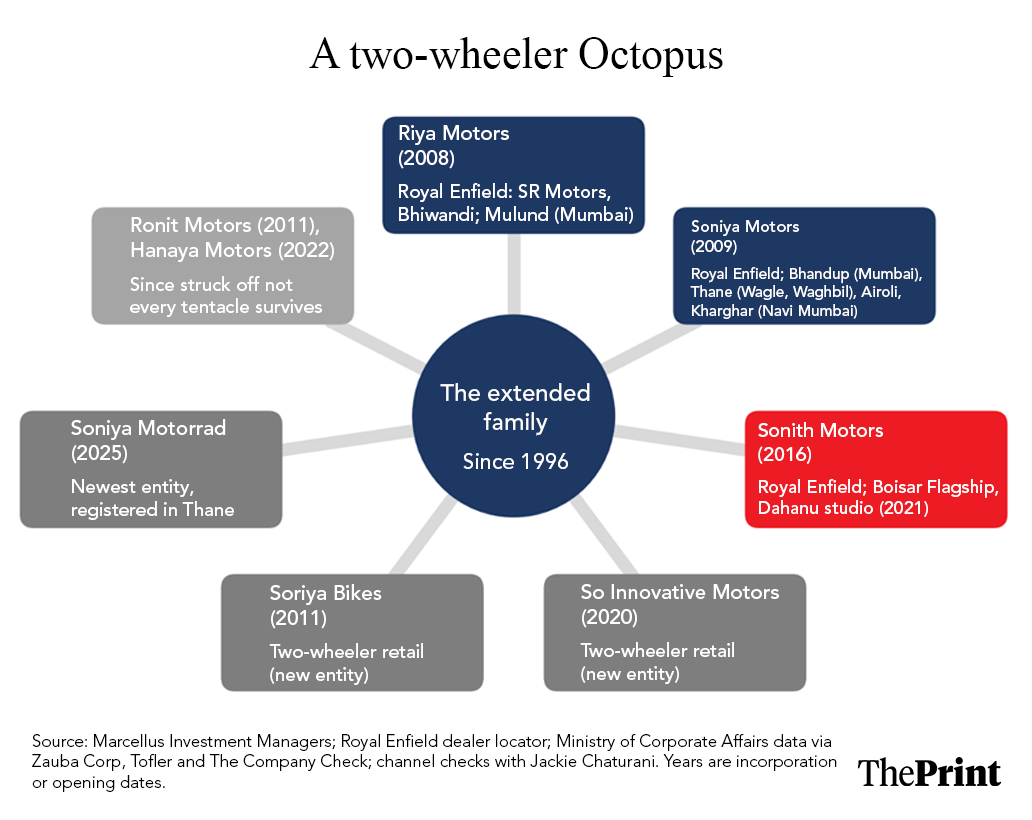
Bhagchandani’s business is a textbook example of the Octopus model, displaying all three features that make auto dealerships lucrative. First, it scaled from a single shop into a network of outlets, adding studio stores around its flagship showrooms (Dahanu in 2021). Second, it has expanded into smaller, faster-growing towns when the manufacturer came calling. Third, it has created separate businesses for successive family members. Company filings and Royal Enfield’s dealer listings reveal a network of family companies with common partners and directors—Riya Motors (2008), Soniya Motors (2008), Sonith Motors (an LLP since 2019), So Innovative Motors (2020), Soriya Bikes (2021) and Soniya Motorrad (2025)—that together operate at least nine Royal Enfield showrooms and service points, stretching from Bhandup in Mumbai through Thane, Navi Mumbai, Ulhasnagar and Bhiwandi to Boisar and Dahanu. Soniya Motors alone reports an annual turnover in the Rs 25–100 crore band. Not every tentacle survives: two entities set up in 2011 and 2022 were deliberately discontinued by Bhagchandani and his family. But a new one has emerged every couple of years.
Like the Adhikaris, the family also consumes the services that the new class prizes—Jackie’s children study at the IB school that opened in the area after Covid. On our rough estimates, Bhagchandani, the owner and originator of this family enterprise, generates an income of approximately Rs 1 crore a year; and across the extended family’s network, the stores’ earnings would comfortably place several of its members among the 3.24 lakh Indians declaring more than Rs 1 crore in income.
India: A dealership in every district, a dynasty in every dealership
The auto sector’s decade of 11 percent growth has created wealth well beyond the stock market. A large part of it has flowed to some 18,000 dealer businesses—most of them family-owned, many of them in India’s smaller towns—that together earn about Rs 14,000 crore a year. The model rewards those with capital, land, local relationships and the patience to scale across districts and generations, and punishes the over-leveraged and the sub-scale when regulation or the economy turns. In that sense, the auto dealership is the quintessential tentacle of the small-town ‘Octopus’ we described in our book, Behold the Leviathan—a franchise from a national brand, run with local trust, funding the family’s next venture. Every district headquarters and highway town in India has its own Jackie Chaturani.
Nandita Rajhansa and Saurabh Mukherjea work for Marcellus Investment Managers. The views and opinions expressed in this material are those of the authors and do not necessarily reflect official policy.
(Edited by Chingkheinganbi Mayengbam)
Also Read: India’s manufacturing export engine is finally revving up. Four forces are oiling the machine