



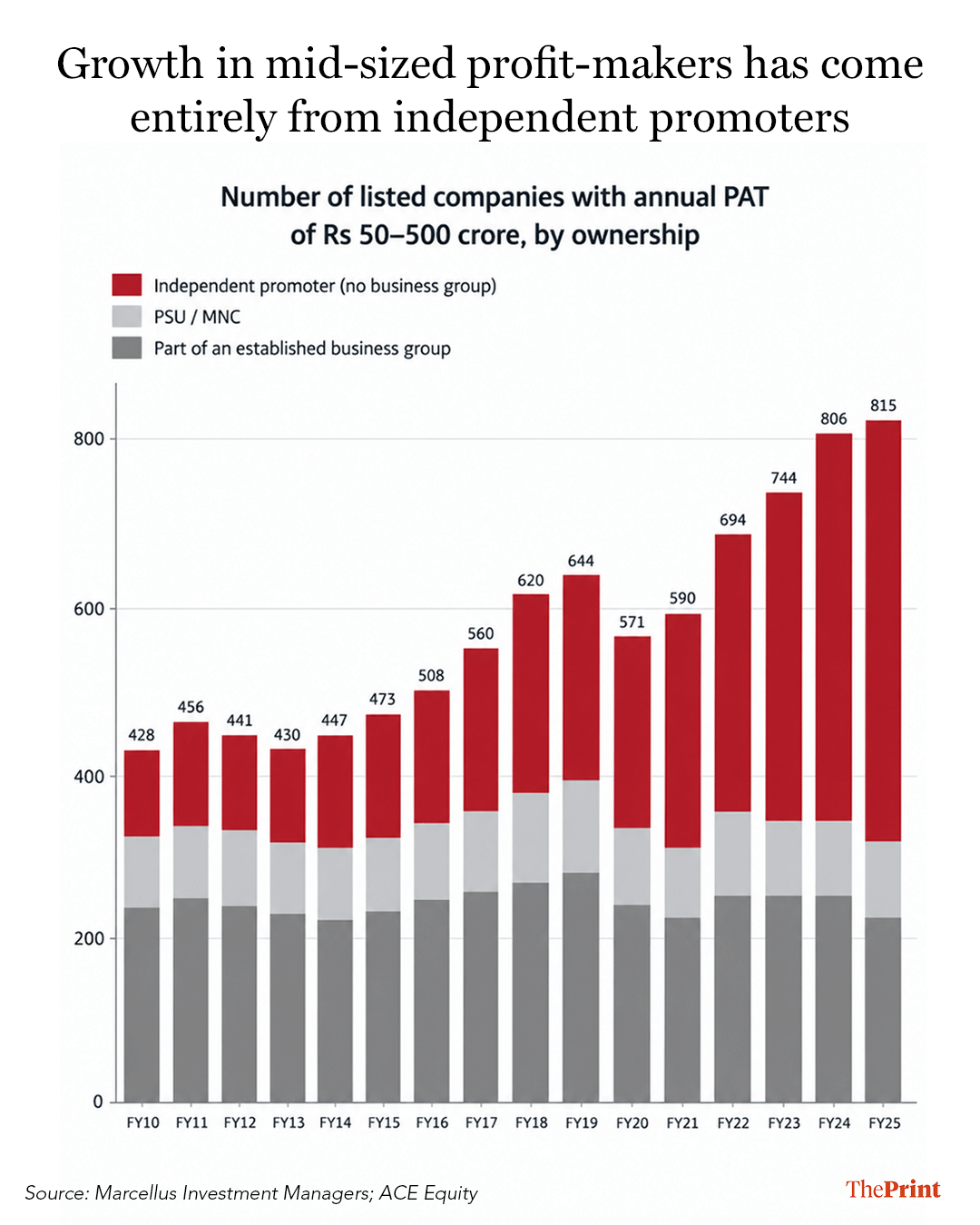
New Delhi: Even as the conventional tax-paying middle class in India feels economically crushed, the number of individuals declaring an income of more than Rs 1 crore has risen about eight-fold in the last 12 years to 3.24 lakh, and the number of listed companies earning Rs 50–500 crore of annual profit has almost doubled since FY10, with the entire increase coming from independent promoters rather than India’s established business houses.
Company-level data for over 35,000 listed and unlisted companies tells the same story: companies earning US$6–60mn (roughly Rs 50–500 crore) of profit after tax (PAT) more than doubled in number between FY15 and FY25, grew aggregated profits faster than India’s largest companies, and nearly one in five of them has since seen their PAT surpass Rs 500 crore.
This new class owes little to India’s education system and much to local dominance. To see what this class looks like, the authors travelled 100 km north of Mumbai to Boisar, where the Adhikari family has grown from a building-materials supplier in 1989 into a conglomerate spanning hospitals, construction, logistics, a school and fuel retail—the quintessential ‘octopus’.
Also Read: Indians are marrying later, having fewer kids. It’s signalling the end of the demographic dividend
The middle class: running harder to stand still
In their bestseller Breakpoint (March 2026), and in their blog India’s Middle Class is Losing Ground to the Rich & the Poor, the authors used a decade of income tax data to show that the Indian middle class has stalled economically.
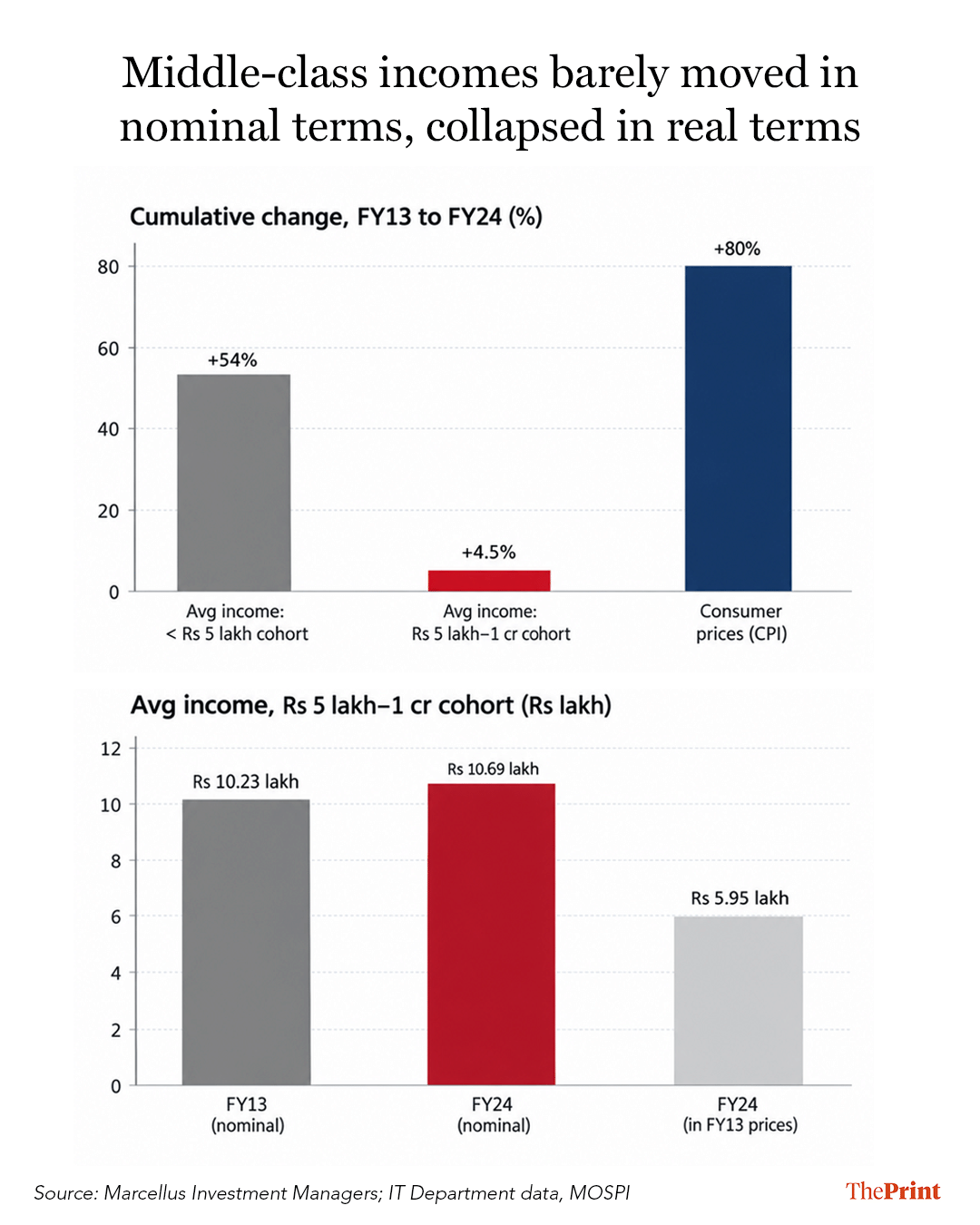
Taxpayers earning Rs 5 lakh to Rs 1 crore a year—53 per cent of those filing non-negative returns in 2023-24—saw their average income move from Rs 10.23 lakh in 2012-13 to just Rs 10.69 lakh in 2023-24, a compound annual growth of 0.4 per cent.
Adjusted for inflation, the picture gets even starker. Consumer prices rose about 80 per cent between FY13 and FY24, which means that the average income of taxpayers in this band is now worth about 42 per cent less in real terms than it was a decade ago (because the band is defined in nominal rupees, this partly reflects changes over time in who falls within it). In FY13 rupees, the Rs 10.69 lakh earned in FY24 buys what Rs 5.95 lakh did then.
A new class quietly taking charge
Interestingly, even as the middle class struggles to stay afloat, a different class is thriving. In Behold the Leviathan (2024), the authors wrote about a new elite emerging from India’s interiors—people without IIT, IIM or foreign degrees, for whom pedigree matters far less than it did for the generation before (source: Business Standard review). These are individuals who earn more than Rs 1 crore a year, or who run a cluster of small businesses that together add up to a local conglomerate. The largest among them own businesses earning anywhere between Rs 50 crore and Rs 500 crore of profit after tax a year.
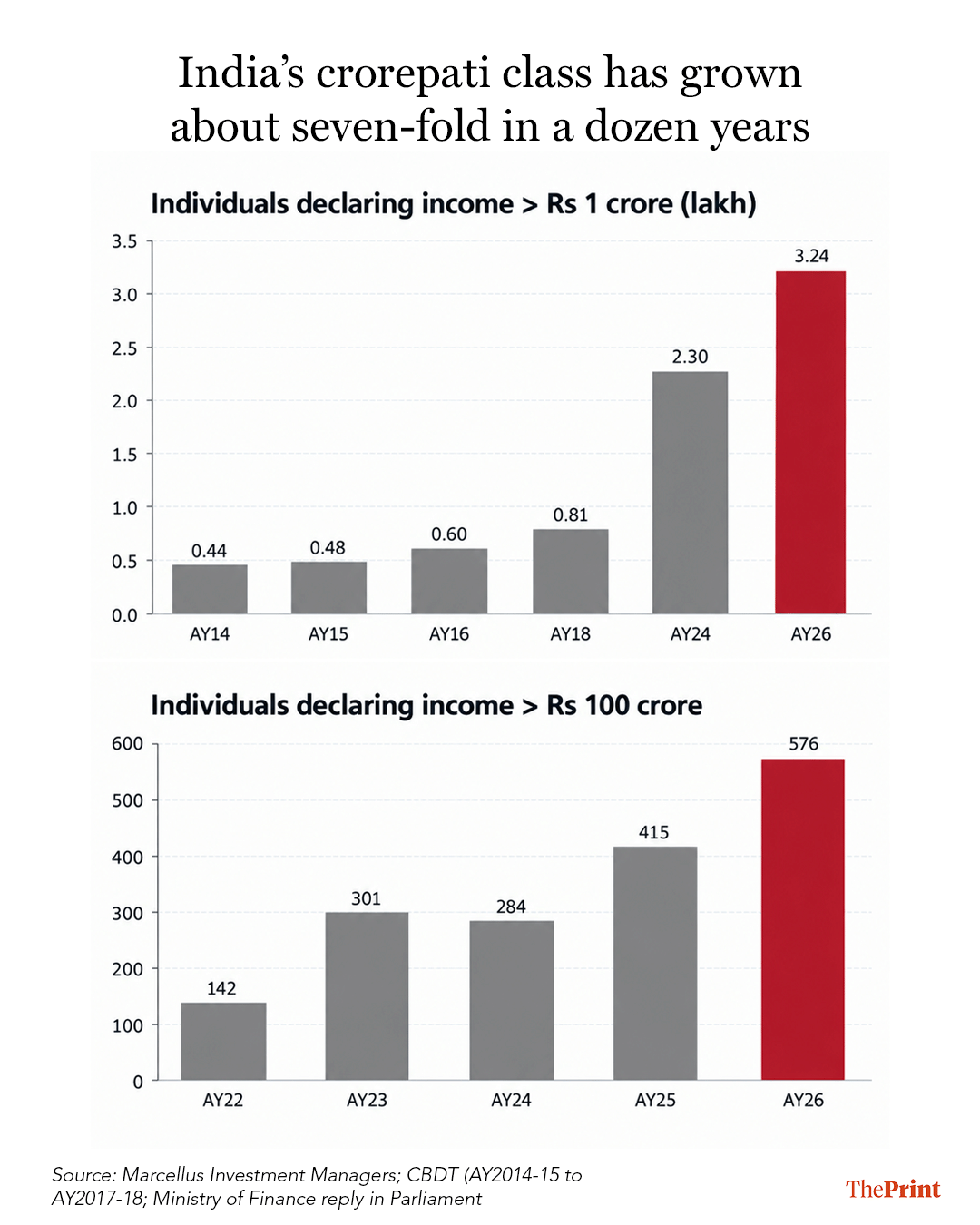
The tax data captures their rise clearly. The number of individuals declaring an income above Rs 1 crore has risen from 44,078 in AY2013-14 to just under 2.3 lakh in AY2023-24, and to 3.24 lakh in AY2025-26—roughly an eight-fold increase in twelve years.
At the very top, the number of individuals declaring more than Rs 100 crore has quadrupled from 142 to 576 in just four years.
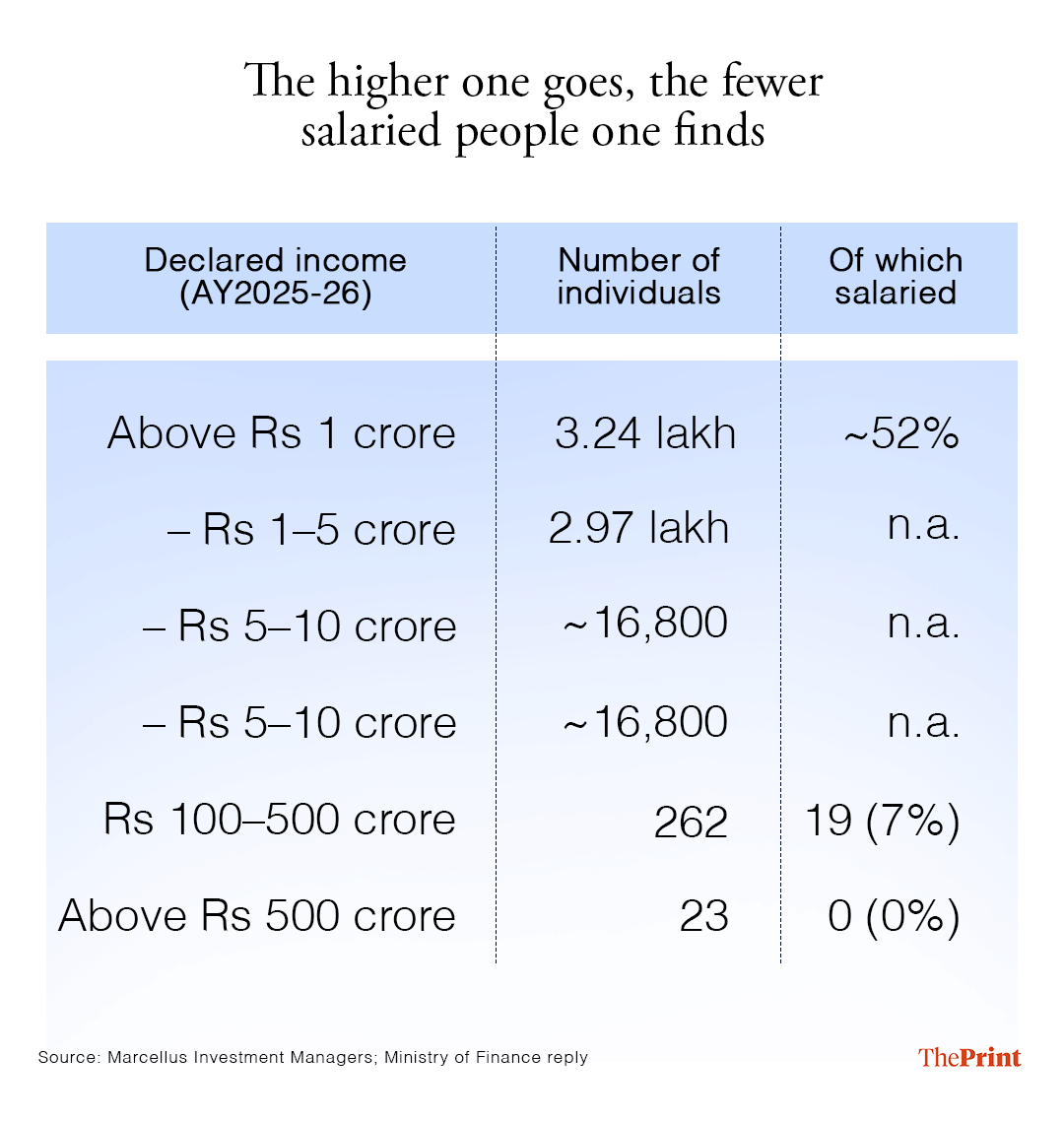
And crucially, those declaring an income of more than Rs 1 crore are not a class of salaried executives. While about 52 per cent of them are salaried—many of them senior corporate and startup employees—the share collapses as one goes up the ladder.
Of the 262 individuals declaring Rs 100–500 crore, only 19 draw a salary; of the 23 declaring more than Rs 500 crore, none do. The top of India’s income pyramid belongs to business owners, promoters and investors.
The same pattern shows up in the companies that this class builds. Using annual financial statements for about 2,000 listed companies, the authors counted those earning Rs 50–500 crore of PAT each year.
That number has risen from 428 in FY10 to 815 in FY25. But the more revealing finding is who owns them. Companies belonging to long established business groups—the Tatas, Birlas, Kirloskars, Kalyanis and their peers—numbered 247 in FY10 and 230 in FY25 i.e. no growth at all!
The entire increase has come from independent promoters with no business-group affiliation, whose count in this profit band has risen from 96 in FY10 (127 in FY14) to 497 in FY25. Of these 497, 277 listed only after April 2015. In other words, India’s mid-sized profit pool is being colonised by new families, not old ones.
These listed companies are only the visible tip of a much larger iceberg—most such enterprises are unlisted, family-owned and, as discussed below, spread across several unrelated lines of business.
For the owners of these flourishing enterprises, it matters little how much or where one is educated—a basic school education often suffices. This newly ascendant business class are increasingly the ones driving investment, hiring and consumption in India’s towns.
Analysing a decade of company-level data beyond the listed universe
To look beneath the tip of the iceberg, the authors analysed profit data from the Centre for Monitoring Indian Economy (CMIE) for more than 35,000 listed and unlisted companies in FY15 and FY25. They used standalone profits for banking, financial services and insurance companies, and consolidated profits for the rest.
For the purpose, companies have been sorted into three classes by PAT: ‘rulers’—earning more than US$60mn (about Rs 507 crore in FY25); ‘challengers’—earning US$6–60mn (about Rs 50–507 crore in FY25); and ‘plebeians’—earning less than that.
The challenger band is, in effect, the Rs 50–500 crore PAT band in which the enterprises of India’s newly ascendant business class sits. Each company is tagged with its FY15 class and followed through to FY25, so that a challenger that grew into a ruler still counts as a challenger when that cohort’s growth is measured.
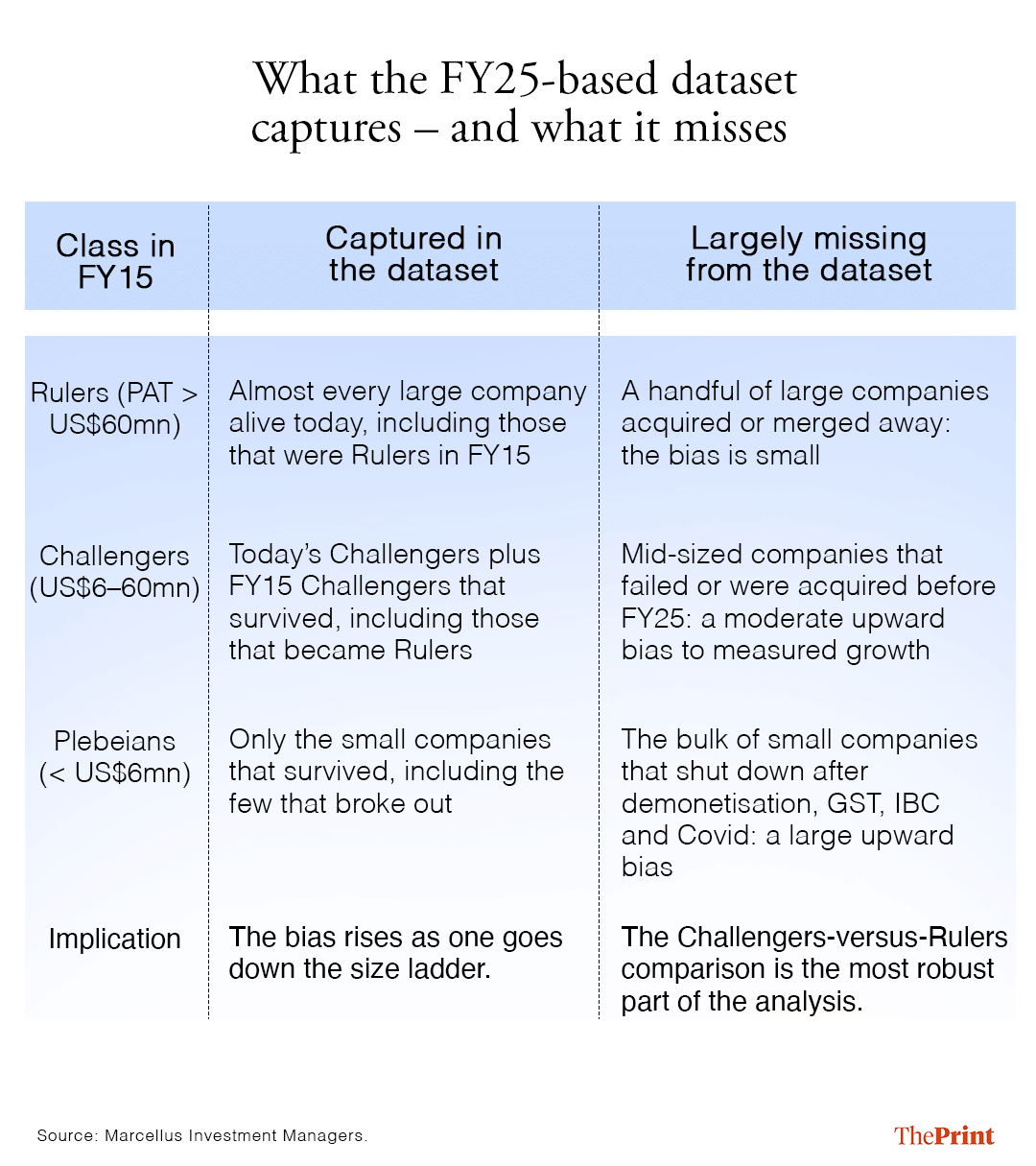
One caveat is essential. The dataset is built from the companies that exist in the database as of FY25, with their history filled backwards to FY15. Companies that shut down, were struck off or were merged away before FY25 are, therefore, largely missing.
The authors’ FY15 cohorts are thus made up of companies that, by and large, survived the decade, which flatters the growth measured in this blog. There is no clean way around this, as a complete list of companies alive in FY15—including those that later died—with comparable financials is sadly not available.
However, even among the survivors, the state of the plebeians is not a happy one. Half of the companies that were plebeians in FY15 were either loss-making in FY25 or had no FY25 profit in the database (because they had merged, gone dormant or not filed), compared with a quarter of the FY15 challengers and a sixth of the FY15 rulers.
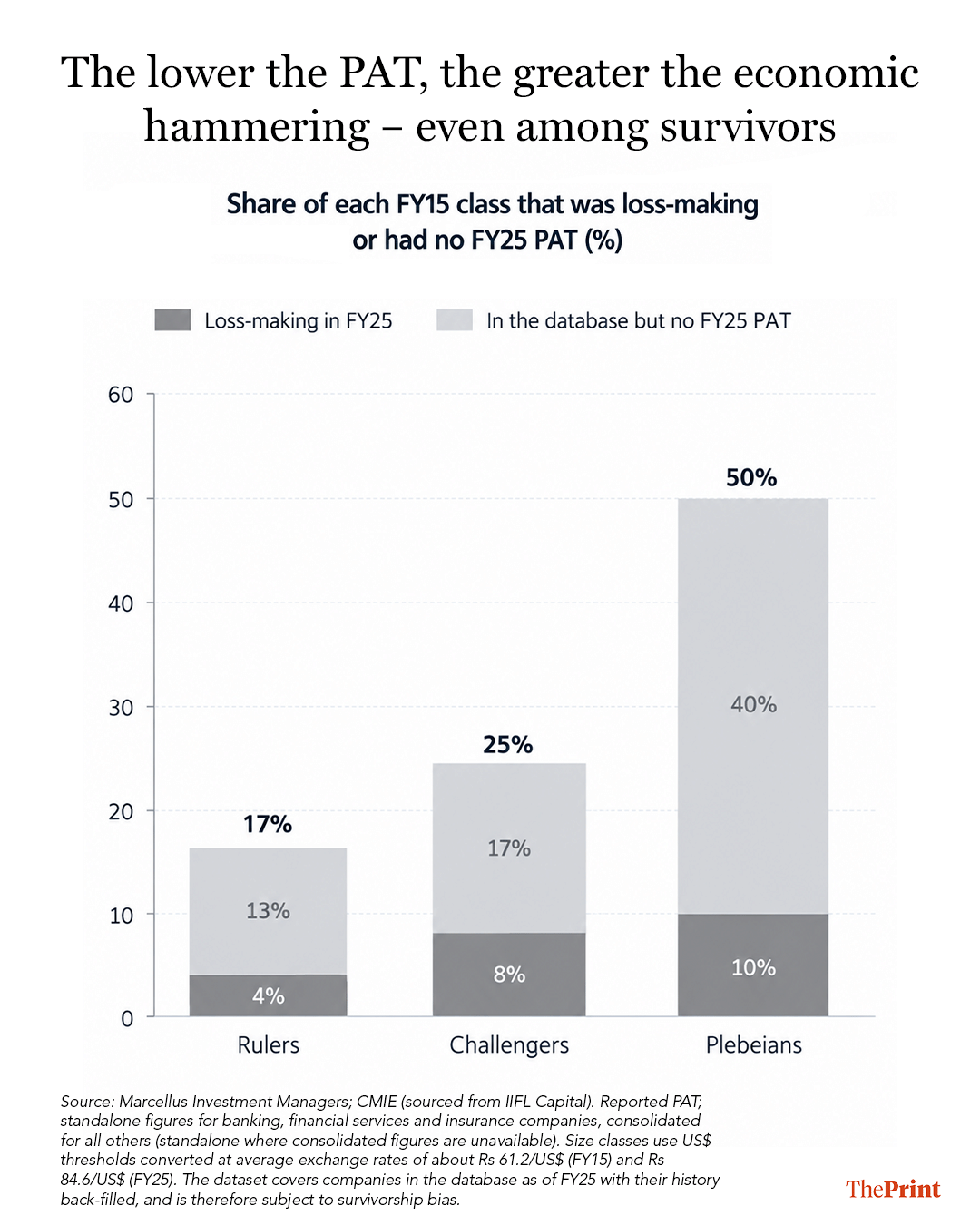
Since companies that died before FY25 are not in the data at all, the true attrition among small companies is still higher. In short, India is a really difficult country to run a small business.
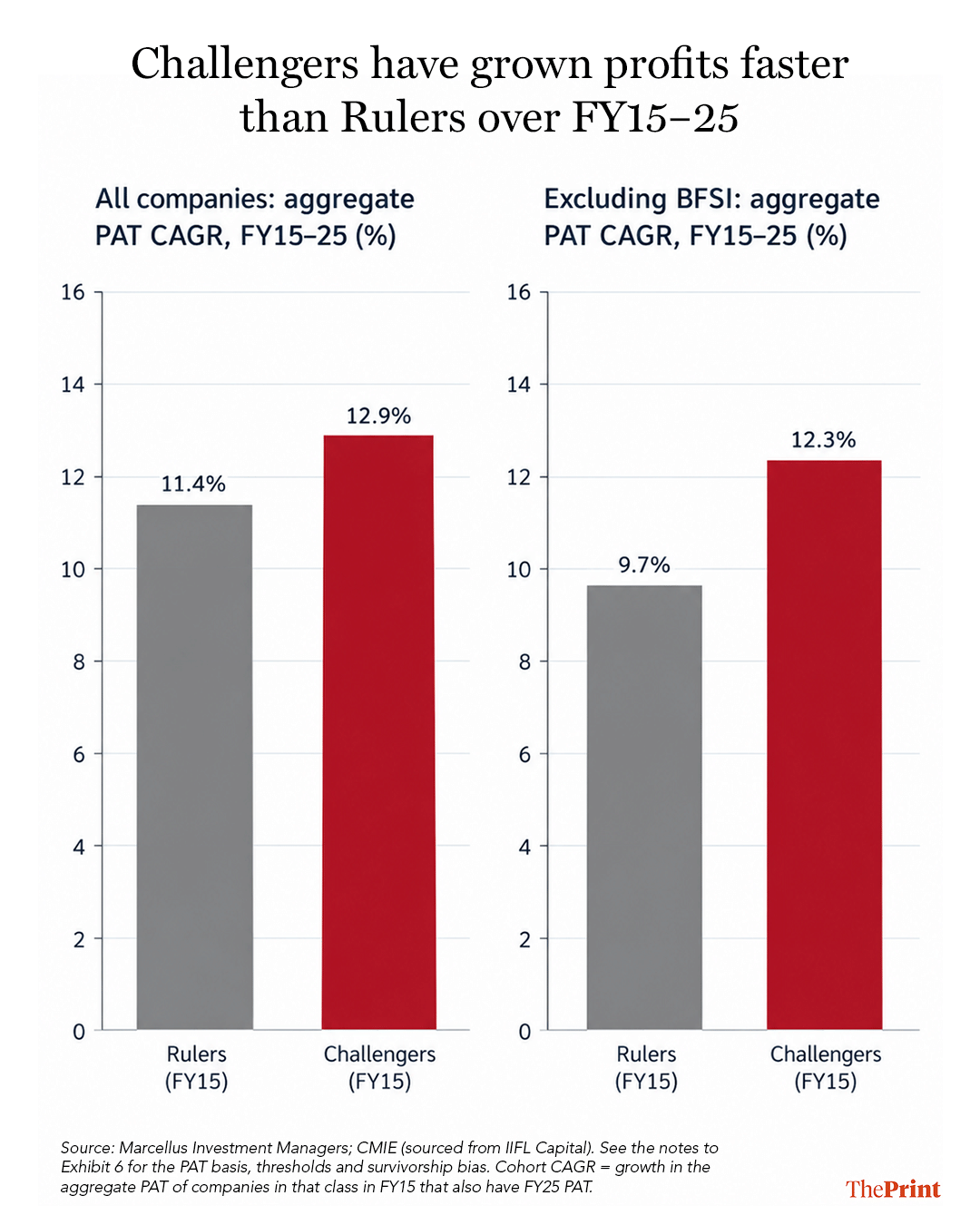
With that caveat in mind, three findings stand out. First, the challengers have outgrown the rulers. Companies that were challengers in FY15 grew their aggregate profits at 12.9 per cent a year over the next decade, against 11.4 per cent for those that were rulers. Exclude BFSI (banking, financial services and insurance) companies, and the gap widens to 12.3 per cent versus 9.7 per cent.
The result holds if we use a fixed Rs 50–500 crore band instead of dollar thresholds (12.4 per cent vs 11.4 per cent).
Second, their numbers have more than doubled: there were 1,522 challengers in FY15 and 3,414 in FY25. Measured by aggregate profits and by their numbers, the Rs 50–500 crore PAT companies are flourishing in modern India.
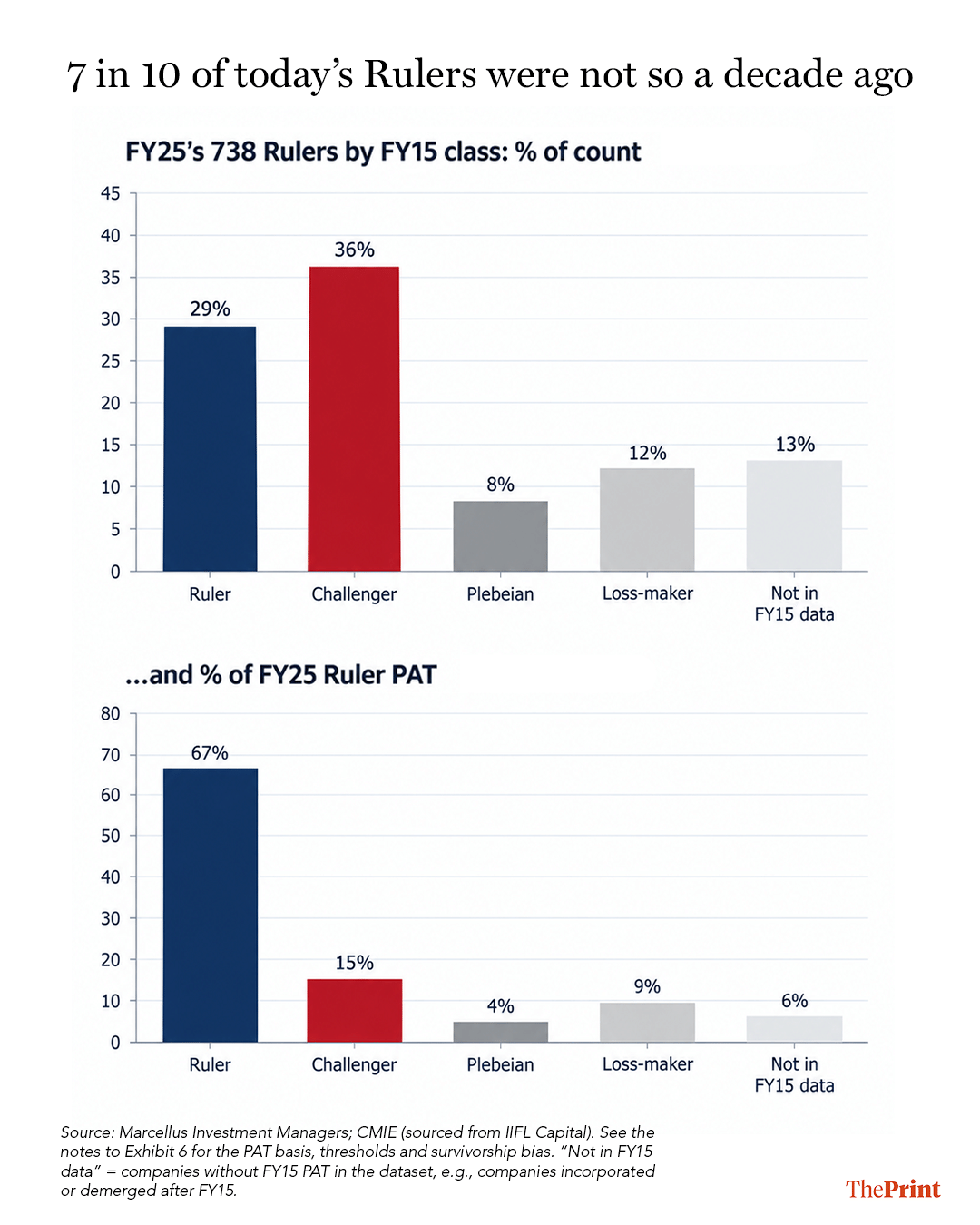
Third, the challengers are storming the top league. Of the 1,522 challengers of FY15, 268 (or 18 per cent) are rulers today. Furthermore, only 29 per cent of FY25’s 738 rulers were rulers a decade ago, implying that 71 per cent of the corporates earning PAT above Rs 500 crore today were challengers a decade ago.
While the largest source of new rulers is the FY15 challenger cohort, the growth is concentrated: the median challenger’s profit grew 2.2 times over the decade, and the top tenth of challengers accounts for two-thirds of the cohort’s entire increase in profits.
This is a contest in which the fittest win big, not a rising tide that lifts all boats, and hence it is difficult to interpret the rise of the challengers as broad-based democraticisation of wealth. This is precisely why the winners are accumulating the wealth, and the local clout, that define the new class.
The who and the wherefrom
Who constitutes this new class? Where in India are they concentrated? And what socioeconomic backgrounds do they come from? These are difficult questions and the authors will invest several months trying to get to the bottom of this.
Tax data shows how much these people earn but not who they are. Corporate databases capture only a small fraction of that list. Household surveys rarely reach the top of the distribution. In the next set of blogs, the authors will try to identify this class—or, more accurately, the many sub-classes within it that are beginning to make their mark on India’s economic growth.
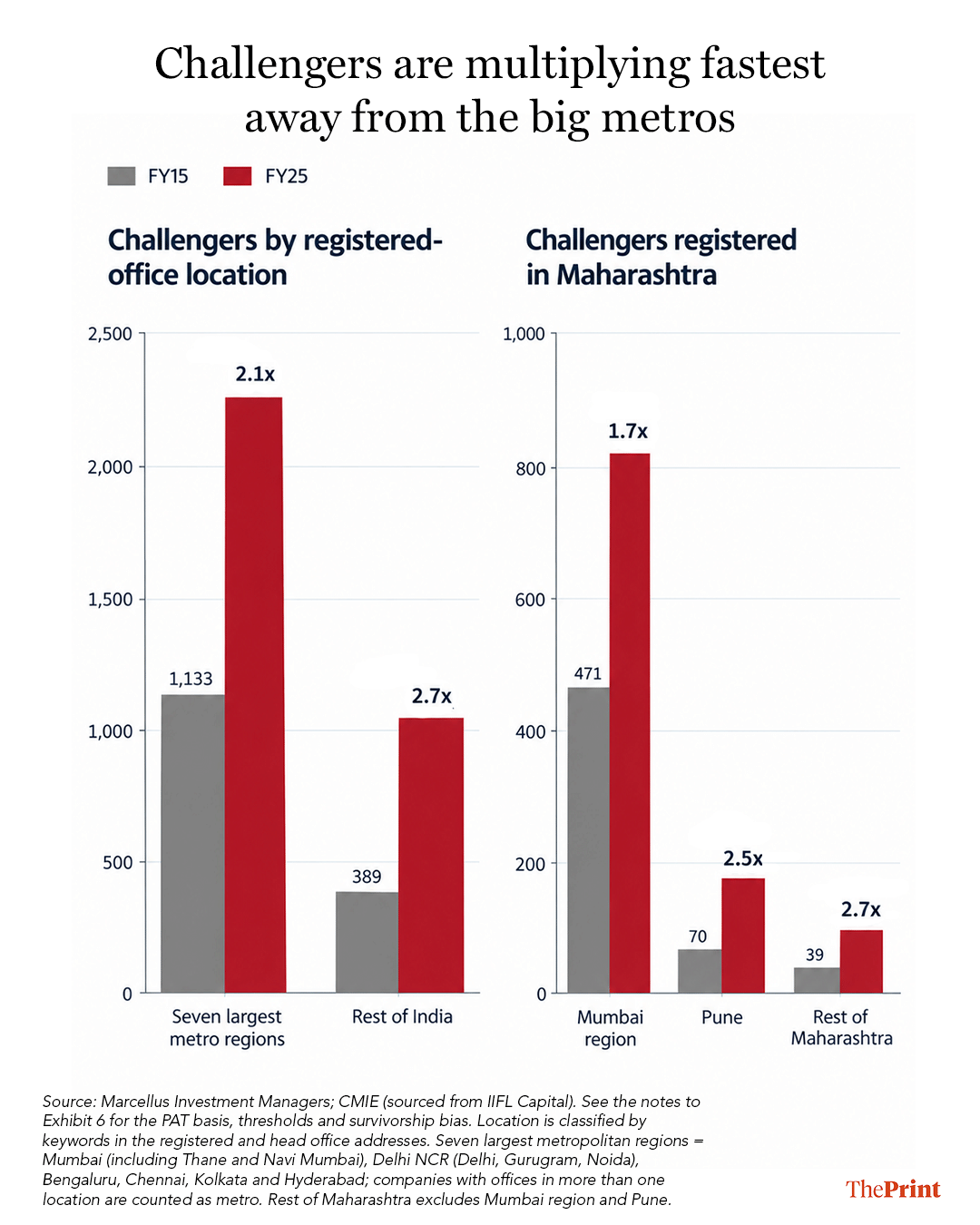
The company-level data does offer a first clue on the ‘where’. Using the registered-office addresses of these companies, the number of challengers based outside India’s seven largest metropolitan regions grew 2.7 times between FY15 and FY25, against 2.1 times within them, lifting their share from 26 per cent to 30 per cent.
Within Maharashtra, the number of challengers registered in the Mumbai region grew 1.7 times, while in Pune it grew 2.5 times and in the rest of the state 2.7 times (albeit from a small base). The new class is spreading outside of India’s traditional corporate centres and into its hinterland.
You don’t have to travel far: the Adhikaris of Boisar
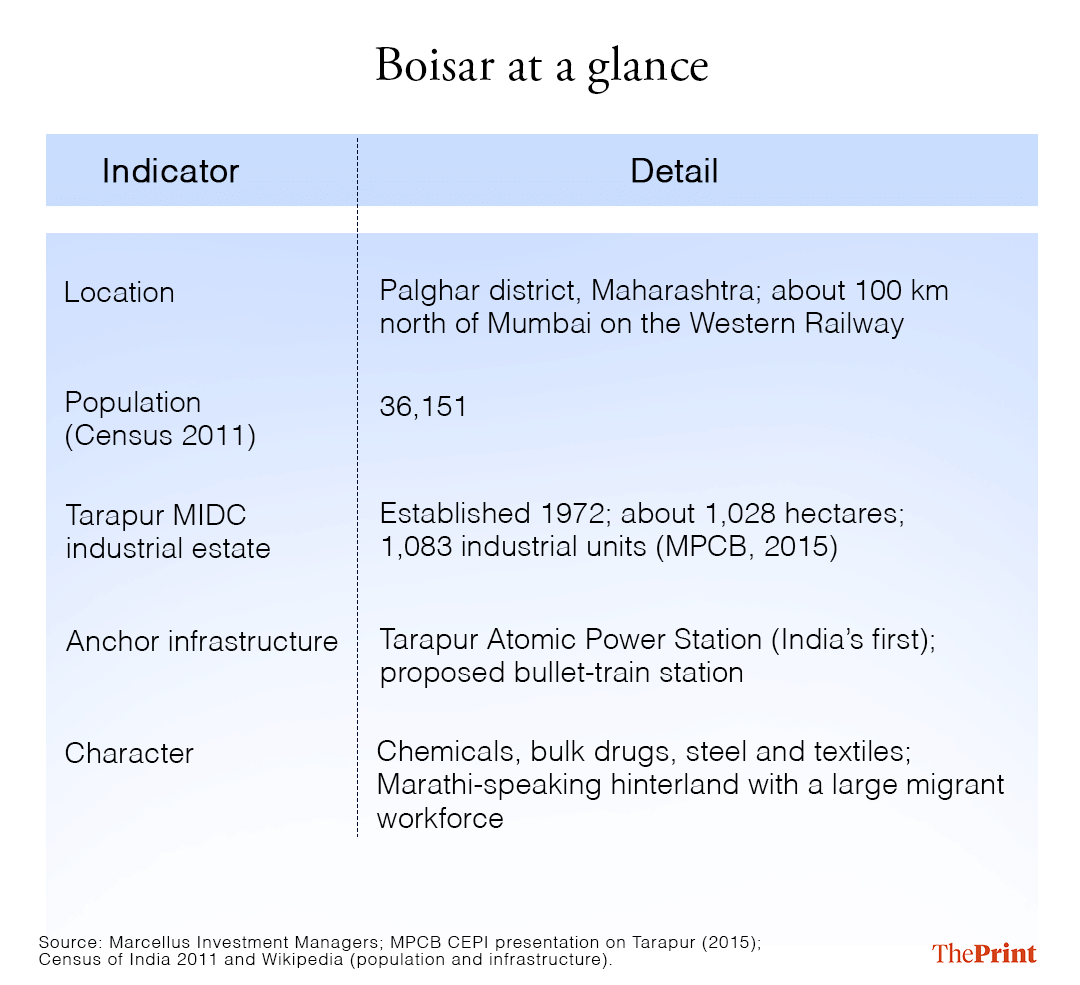
To get a sense of what this class looks like, one does not need to go deep into India’s hinterland. Take the Western Railway line about 100 km north of Mumbai and you reach Boisar, a small industrial town in Palghar, Maharashtra’s northernmost coastal district bordering Gujarat.
Boisar is the residential hub for the Tarapur Maharashtra Industrial Development Corporation (MIDC) industrial estate—set up in 1972 and home to more than 1,000 chemical, pharmaceutical, steel and textile units, as well as for those employed at India’s first nuclear power station at Tarapur. It is also slated to get a station on the Mumbai–Ahmedabad bullet-train corridor.
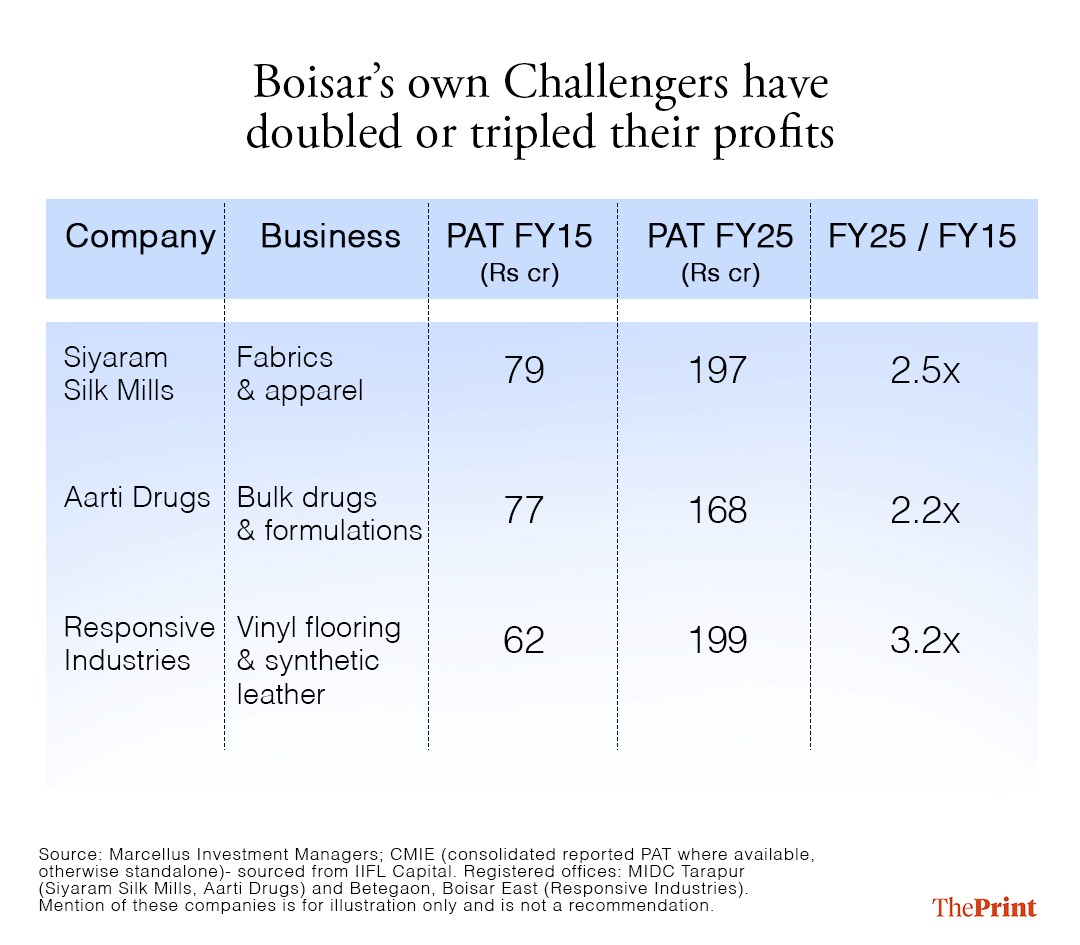
Tarapur’s industrial estate has produced challengers of its own. Three companies with registered offices in Boisar and Tarapur—textile maker Siyaram Silk Mills, bulk-drug maker Aarti Drugs and vinyl-flooring maker Responsive Industries—each earned between Rs 60 crore and Rs 80 crore of PAT in FY15, and two to three times as much, between Rs 165 crore and Rs 200 crore, in FY25. Firms like these are the anchor customers around which a local business ecosystem grows.
In Boisar, one family name is hard to miss. The Adhikaris, as they are known locally, began in 1989 under Vinod Adhikari as a supplier of building materials to the factories and construction projects that the industrial estate was drawing in.
A road transport business followed in 1993 (source: TradeIndia). Over time the group integrated backwards and sideways—into stone metal and artificial crush sand from its own crushers, ready-mix concrete, and a fleet of excavators, tippers and transit mixers. It counts L&T, Tata, Jindal, BARC (Bhabha Atomic Research Centre), Viraj and Siyaram’s among the clients it has served. One of Adhikari’s trading entities alone, Sandhya Traders, reports annual turnover in the Rs 25–100 crore band in its GST profile (source: IndiaMART).
Over the past decade, the Adhikari conglomerate has expanded beyond construction. In 2019, the family opened Adhikari Lifeline, a multispeciality hospital at Nagzari, and followed it with a second at Betegaon in 2020, alongside a cosmetic clinic.
The Betegaon hospital lists 22 doctors and a 4.7 rating from 645 reviews on Justdial. Also in 2020, the Adhikari Group set up Vidyasankul’s Sanskruti World School, a CBSE school running from nursery to Grade 10, with a junior college attached.
On the Boisar–Palghar state highway, an IndianOil outlet trading as Adhikari Fuel sells petrol and CNG and offers EV charging.
Construction, logistics, healthcare, education and fuel: the family now touches almost every aspect of daily life in the town.
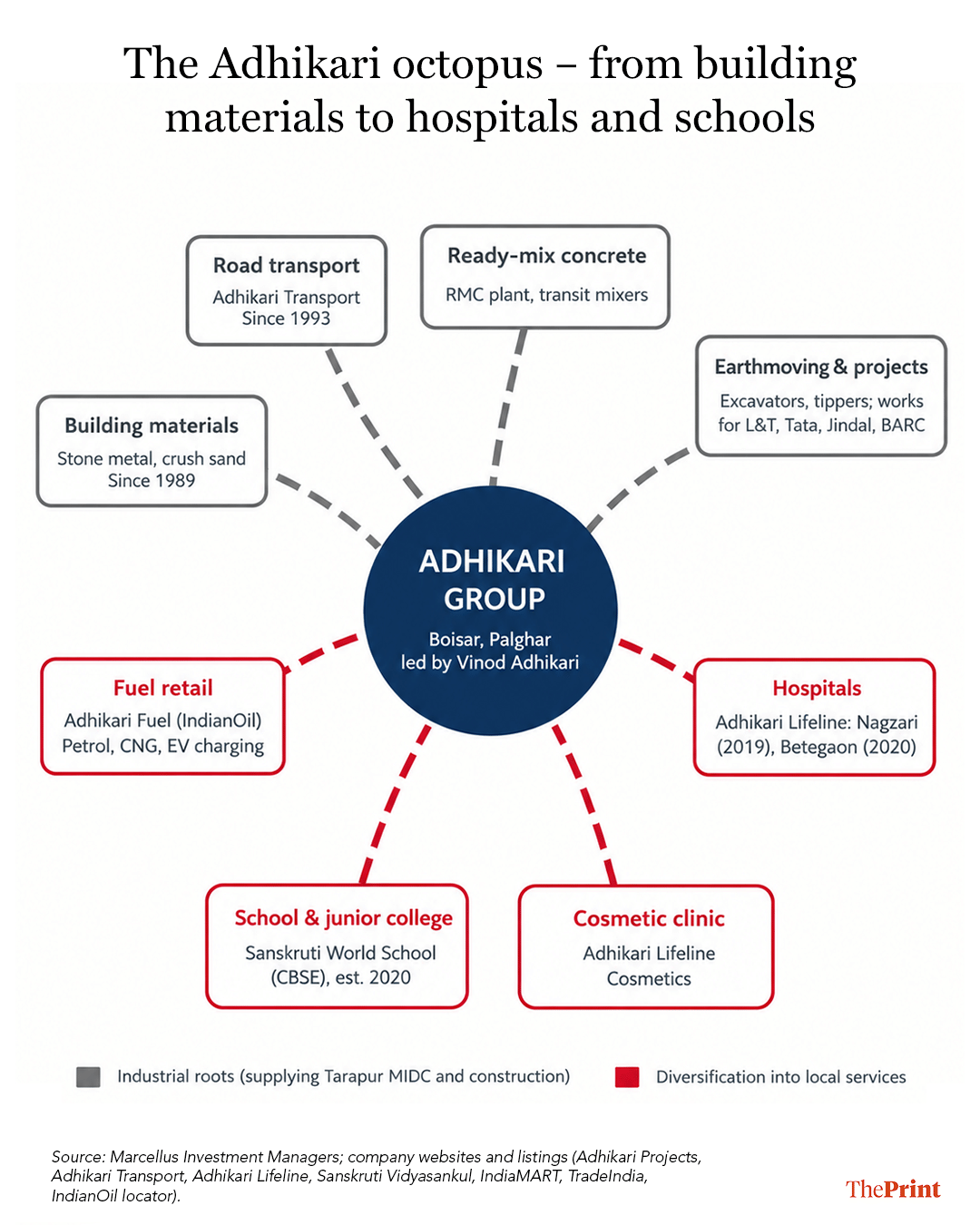
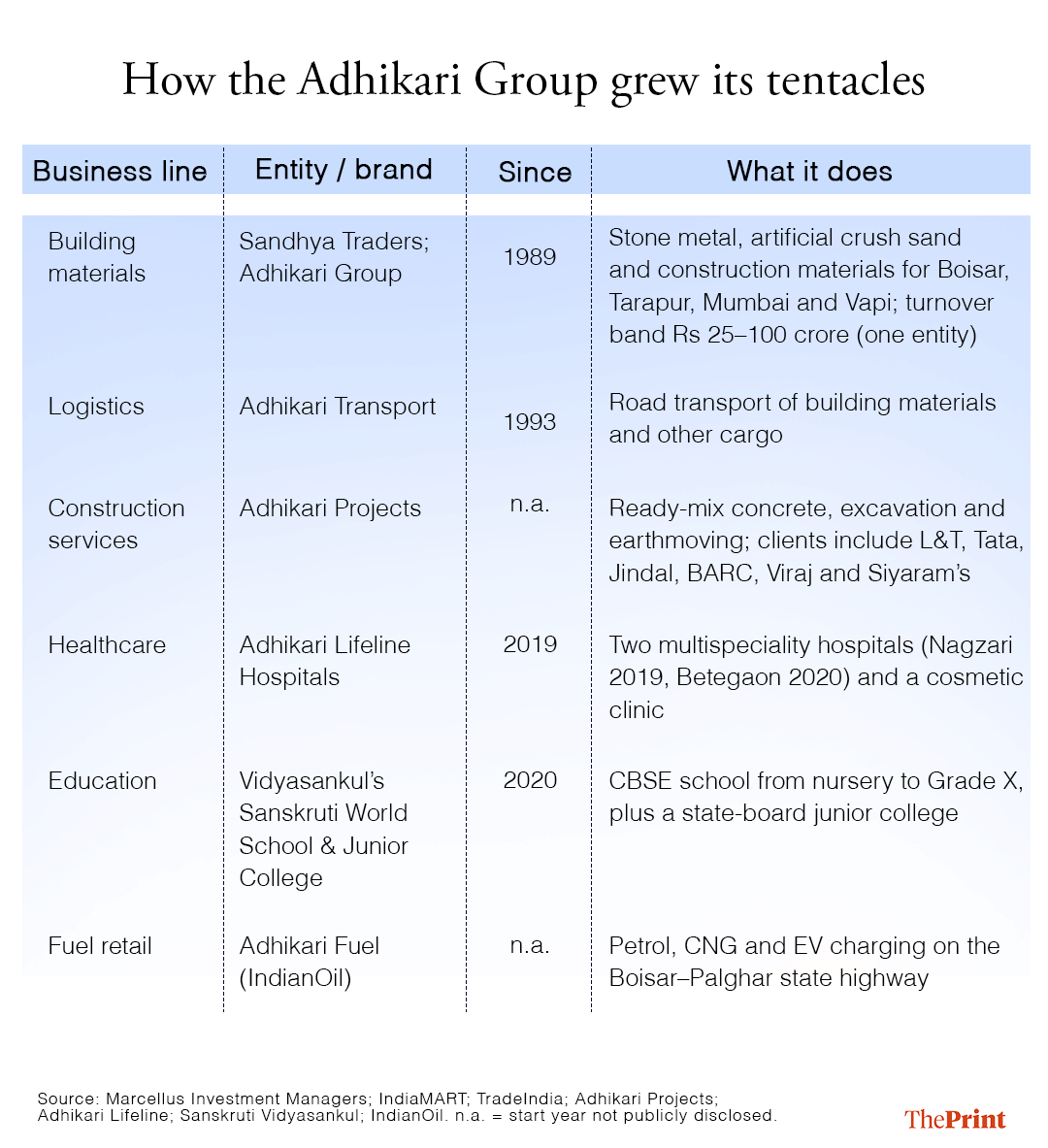
Over time, the Adhikaris have grown into multiple business lines, making them the quintessential ‘Octopus’ as described in Behold the Leviathan (2024). The logic of the octopus is worth spelling out, because it explains why this model is so hard for outsiders to replicate:
Each tentacle funds the next. The cash flows, land bank and equipment built up by supplying an industrial estate become the collateral and capital for the next venture. A family that already owns trucks, crushers and land is well placed to build a hospital or a school.
Local trust is the moat. National hospital and school chains have been slow to reach towns of Boisar’s size. A family whose name is already on the town’s trucks and construction sites starts with a reservoir of recognition and goodwill that any new entrant would find hard to accumulate in a short period of time.
The services they build are the ones the middle class prizes. Private healthcare and English-medium education are exactly what aspirational families in small-town India want for themselves and their children—categories that, as the authors argued in their earlier blog, could benefit as the middle class leans more heavily on the private sector for family healthcare and education. In the authors’ view, it is increasingly the local octopus, not a listed national chain and not the government, that provides them.
India: A million Adhikaris now
Boisar is not unusual. The Maharashtra Industrial Development Corporation alone has developed over 200 industrial areas across the state, and every industrial cluster, district headquarters and highway town in India has its own version of the Adhikaris.
There will be millions of such Adhikaris in the years to come—families who will have the means, the local power and the standing to propel the local economies forward.
As the middle class that powered India’s first three decades of liberalisation stagnates, and as a newly ascendant business class powers ahead, the complexion of consumption and investment is likely to change in India.
Nandita Rajhansa and Saurabh Mukherjea work for Marcellus Investment Managers. The views and opinions expressed in this material are those of the authors and do not necessarily reflect official policy.
(Edited by Ajeet Tiwari)
Also Read: Tech in US created a narrow elite of billionaires. India’s story is different