


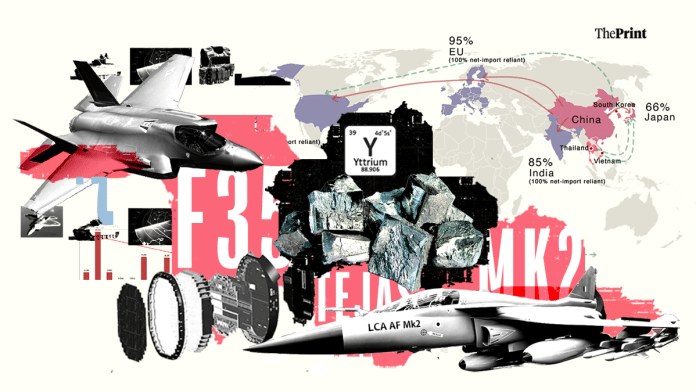
Hong Kong: China’s efforts to restrict the supply of rare-earth minerals used in weapons systems and advanced electronics, in retaliation for Donald Trump’s tariffs on Chinese goods, have had repercussions well beyond the US. The US tariffs, which peaked at 145 percent in April 2025, prompted Beijing to tighten controls over strategic mineral exports, exposing the vulnerabilities of other countries, including Japan.
A recent Financial Times report warned that Japan could be just months away from running out of yttrium, a critical rare-earth element used in the manufacture and maintenance of jet engines, lasers and guidance systems.
US defence supply chains rely on Japanese components that contain yttrium, making disruptions to Japanese supplies a potential vulnerability for American defence manufacturing as well. China’s leverage stems from its dominance of the rare-earth value chain—while it accounts for approximately 60–70 percent of global mine production, its share of separation and refining is around 90 percent.
Earlier this year, China imposed export controls on 20 Japanese companies, restricting their access to seven rare-earth elements and associated materials on its dual-use export control list. These measures further tightened the supply restrictions introduced in 2025 following Washington’s decision to raise tariffs on Chinese imports.
Since the introduction of these restrictions, yttrium supplies to Japan and the US have become increasingly erratic, with shipments declining and prolonged gaps between deliveries. The resulting uncertainty has driven international spot prices to $1,150 per kilogram—more than 127 times the domestic Chinese market price, according to Argus, a market intelligence platform.
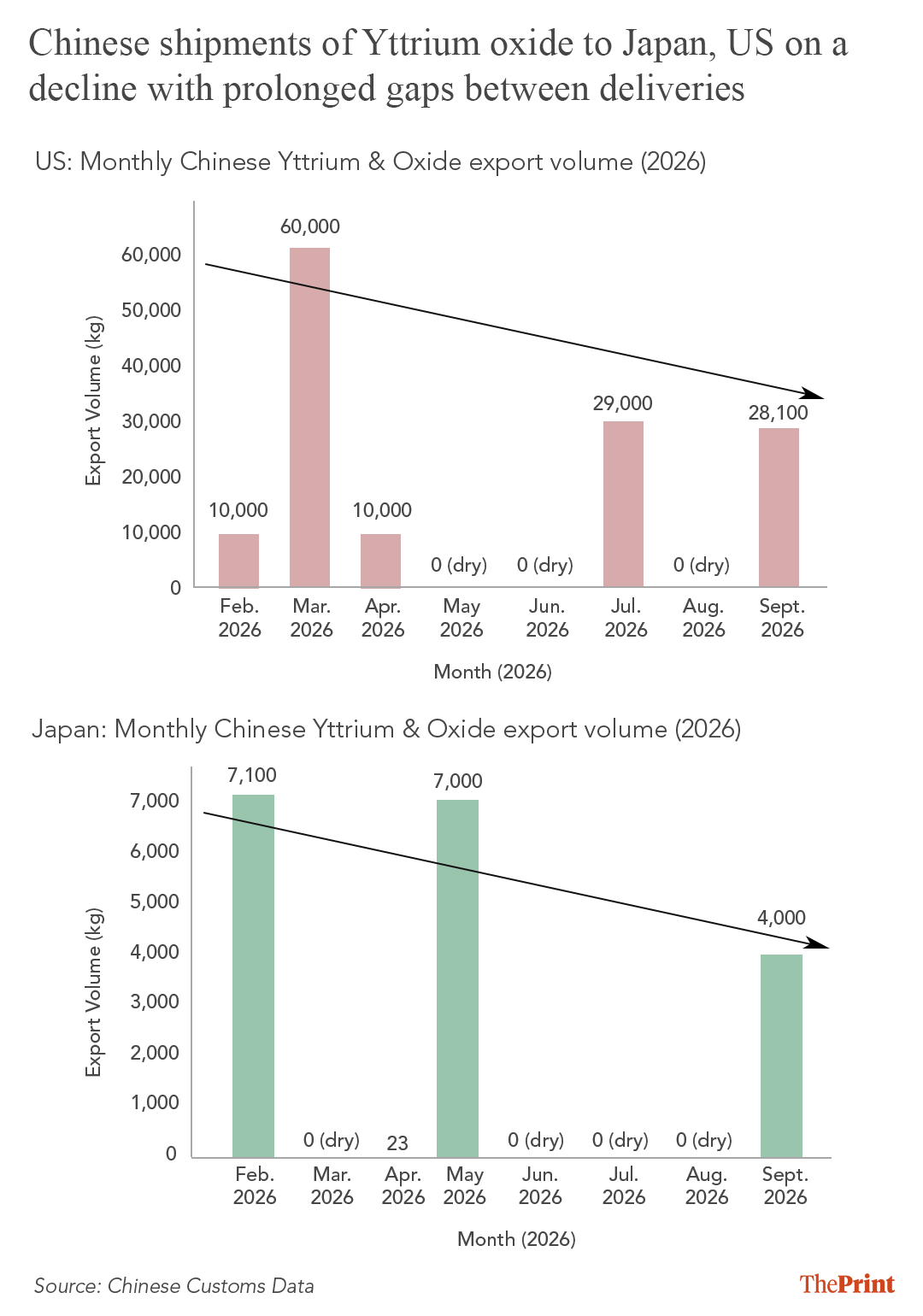
In response, countries with strategic defence manufacturing interests, including Japan, the US, India and the EU, are attempting to diversify their yttrium supply chains by sourcing from countries such as Vietnam, Thailand and South Korea. However, these alternative suppliers continue to account for an insignificant share of the global market compared with China.
Also Read: US image offers rare look at China’s secret spaceplane. What is it doing in orbit?
Yttrium’s strategic significance in defence manufacturing
Yttrium is a soft, silvery metal with important applications in defence manufacturing, particularly in the production and maintenance of jet engines used in advanced fighter aircraft, including the US’s F-35 and India’s Tejas Mk2. It is also used in laser and guidance systems.
Modern jet engines operate at extremely high temperatures, exceeding 1,600°C and surpassing the melting points of the nickel-based superalloys they are made of. Yttrium-based thermal barrier coatings protect the metal components from the extreme heat, ensuring their structural integrity and extending their operational life.
Yttrium is particularly difficult to replace because available alternatives offer inferior performance. Materials such as calcium oxide and magnesium oxide can provide thermal insulation but offer lower toughness to the thermal coatings. Alternative coatings are therefore more susceptible to wear, cracking and degradation, potentially increasing maintenance requirements and reducing engine efficiency.
Beyond jet engines, yttrium has applications in laser and guidance systems that support precision targeting and threat detection during active combat and tactical engagements. These include laser rangefinders, laser-guided ammunition and laser warning systems. Yttrium’s ability to handle heat very efficiently prevents laser beams from distorting, ensuring pinpointed accuracy, which makes them irreplaceable in guiding systems as well.
Global dependence on China
The exposure of major economies to China’s rare-earth processing dominance is reflected in their import dependence. According to World Bank trade data for 2025, the US and the European Union source more than 70 percent of their imports of yttrium-based products from China.
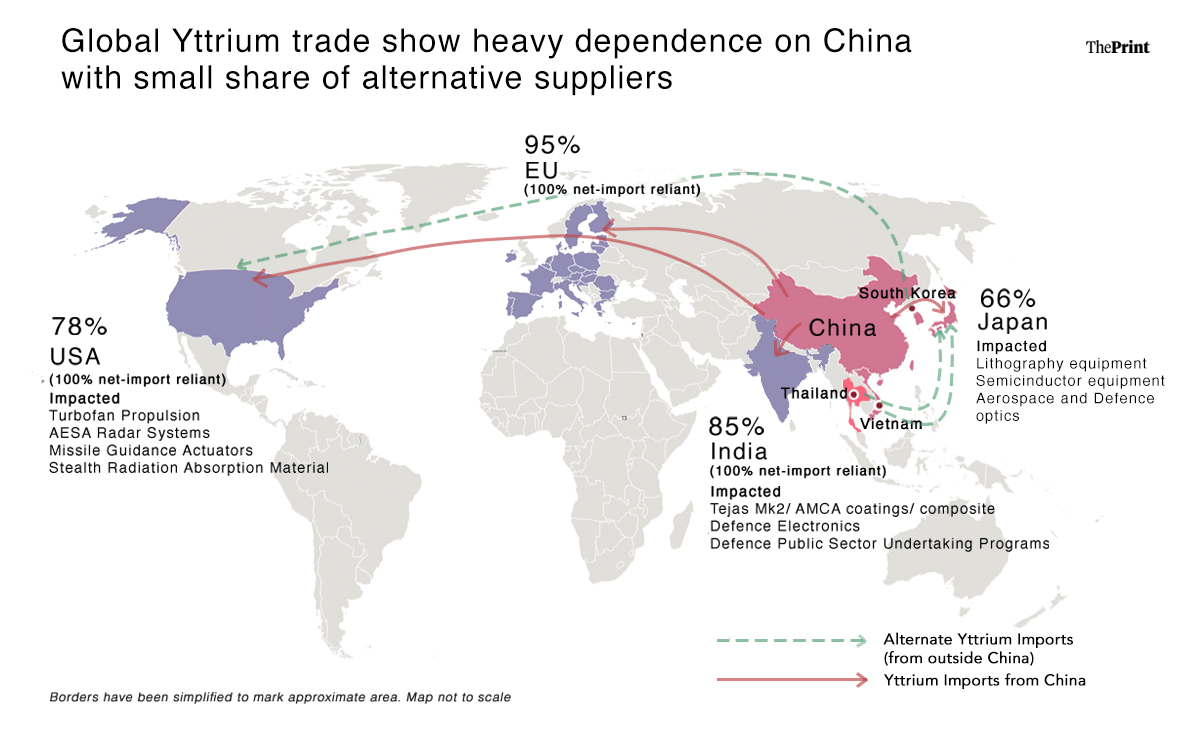
The US remains entirely dependent on imports for its yttrium requirements, according to the US Geological Survey (USGS). World Bank data also shows that China accounts for approximately 93 percent of US yttrium imports on a three-year average basis (2023–2025).
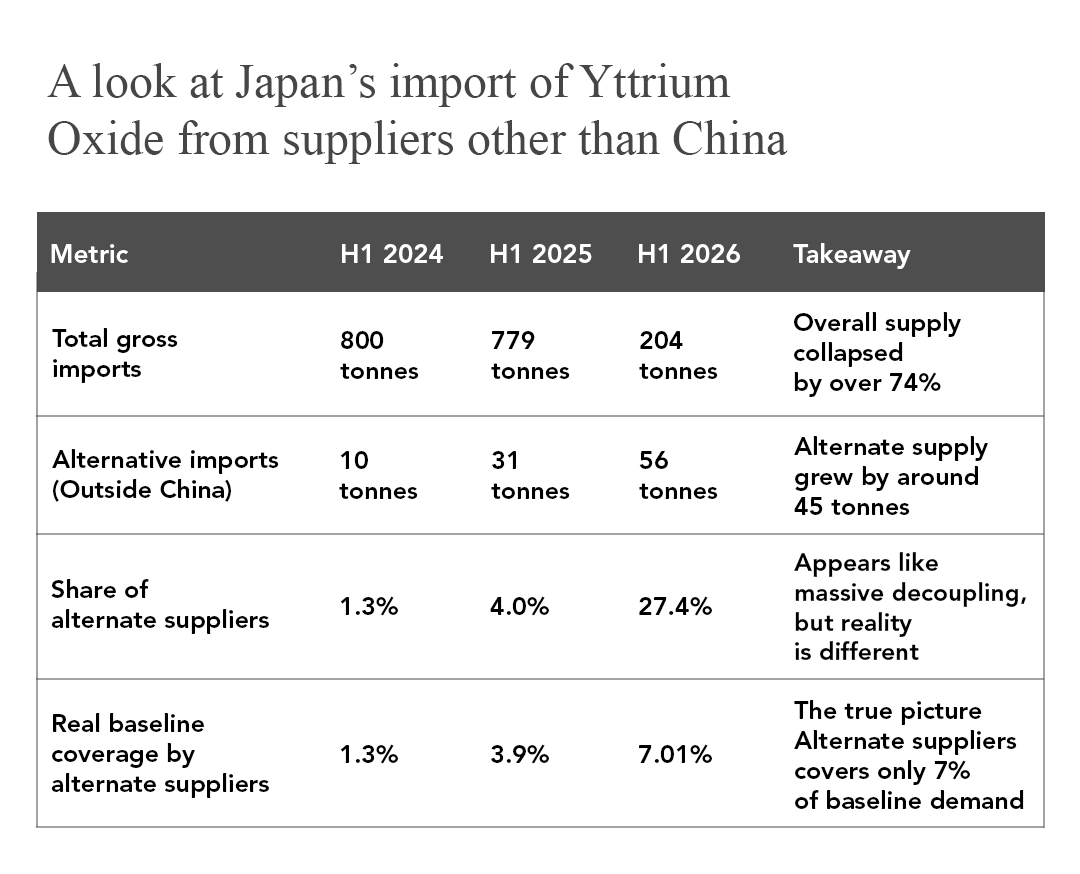
Japan has a relatively lower direct import dependence on China, at approximately 66 percent, supplementing its supplies through countries such as Vietnam and Thailand. However, a closer examination of Japanese customs data suggests that the share of alternatives appears high because the net imports have gone down. Compared with its 2024 baseline demand, alternative suppliers outside China meet only around 7 percent of Japan’s requirements. The decline in China’s share therefore reflects a contraction in overall imports rather than a meaningful expansion of alternative supply.
India faces a similar vulnerability. It lacks commercial-scale refining capabilities for high-purity yttrium (99.999 percent) and imports approximately 82 percent of its requirements from China. The actual dependence could be higher as World Bank data identifies the US as India’s second-largest trading partner in the broader category of rare-earth metals, scandium and yttrium, despite the US not being a producer or exporter of yttrium.
The implications are particularly significant for India’s defence aviation ambitions. Under the Atmanirbhar Bharat initiative, flagship fighter programmes such as the Tejas Mk2 and AMCA Mk1 (Advanced Medium Combat Aircraft) are expected to rely on US-based General Electric F414 engines, whose yttrium requirements depend on Chinese supply. As India pursues the development of indigenous engines for the AMCA Mk2, diversifying mineral supplies and establishing sovereign midstream processing capabilities will become increasingly important.
What underpins China’s dominance?
China’s dominance of the yttrium value chain rests primarily on midstream processing rather than mining. Yttrium is relatively abundant in the Earth’s crust, with significant resources found in countries including Australia, India, China, Russia, the US and Vietnam. China’s strategic advantage lies in its ability to separate and refine the element to purities as high as 99.999 percent, which is necessary for military-grade applications.
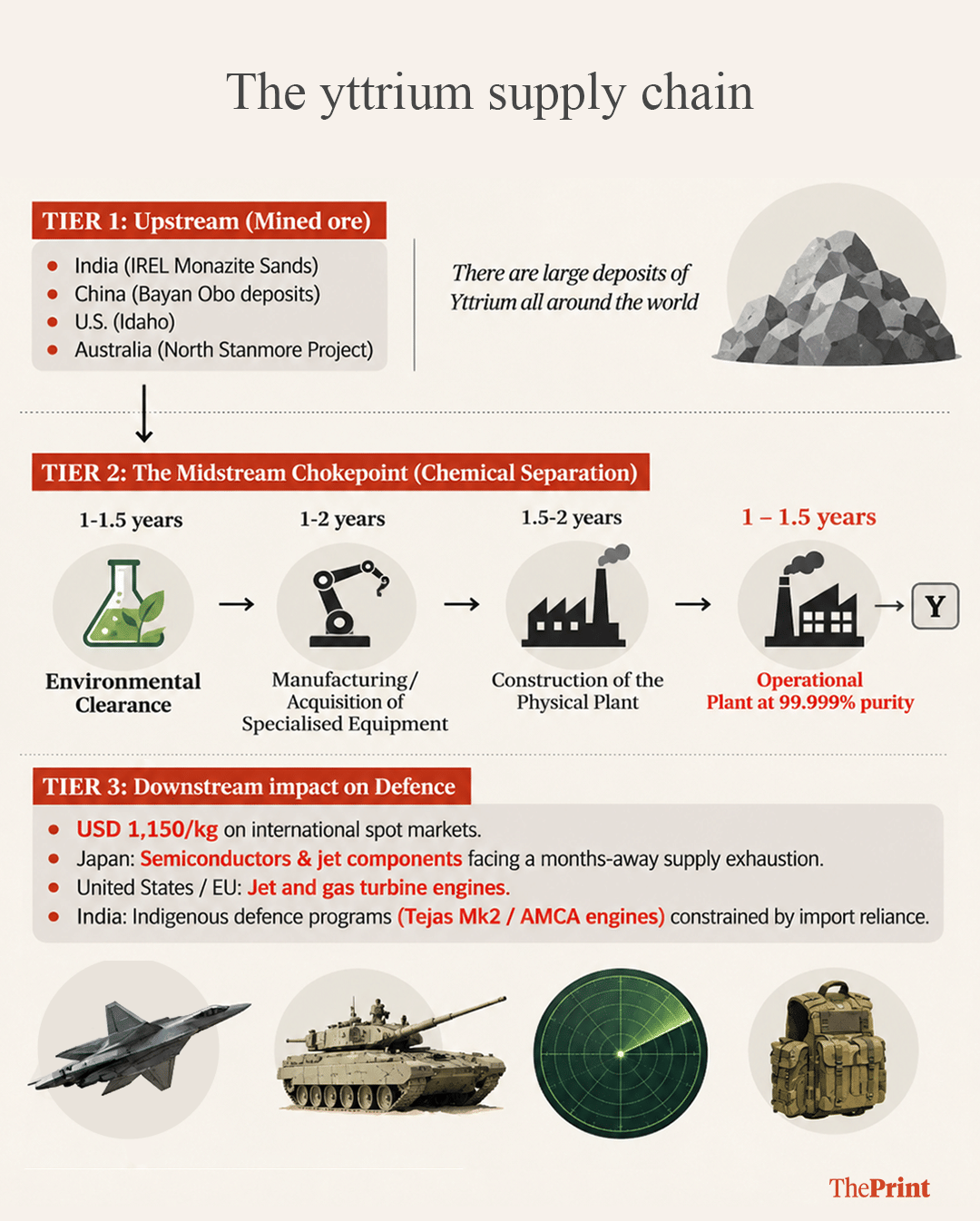
Yttrium refining is technically demanding and involves hundreds of sequential processing stages. Unlike many other rare-earth elements, yttrium shares similar chemical properties with heavier rare earths such as holmium and dysprosium. It also occurs in complex mineral deposits, including xenotime and monazite, making its separation particularly challenging.
Achieving high-purity yttrium requires additional processing stages. Over several decades, China has developed industrial-scale refining capacity capable of supplying more than 90–95 percent of global yttrium requirements. This position reflects sustained state-supported investment across multiple industries, alongside large-scale mining and processing that historically carried substantial environmental costs. Replicating this capacity elsewhere is therefore not simply a matter of deploying capital; it requires the development of an entire industrial ecosystem.
Building alternative midstream separation capacity is a complex and time-intensive undertaking. Establishing a rare-earth refining facility can take approximately four to seven years, from initial site selection to commercial operations at the required quality and scale. This includes environmental clearances for hazardous chemical processing, the procurement or manufacture of specialised equipment, plant construction and the commissioning of chemical processes to achieve 99.999 percent purity consistently.
Even this estimate may be optimistic. In the US, permitting alone for refining projects can take seven to ten years. The subsequent commissioning and ramp-up of chemical processes to produce commercial-grade, high-purity yttrium at industrial scale can take several additional years.
Countries such as Malaysia and Vietnam are emerging as alternative processing and supply centres, while Australian rare-earth mining company Lynas has demonstrated the potential to develop non-Chinese capacity. However, these developments remain insufficient to challenge China’s dominance at scale.
Beyond yttrium: The wider geopolitical contest
Yttrium is not an isolated supply-chain vulnerability. It represents one front in an increasingly multidimensional US-China economic and technological confrontation, in which control over critical minerals, advanced technologies and industrial inputs has become an instrument of national security and geopolitical leverage.
High-level diplomatic engagements, including the September meeting between US President Donald Trump and Chinese President Xi Jinping, may offer temporary relief. However, underlying tensions persist. Beijing continues to administer export licensing requirements for strategic minerals such as gallium, germanium and yttrium, while considering further restrictions on sensitive technologies and heavy industrial equipment. Washington, meanwhile, is tightening controls on advanced AI hardware and Chinese technology platforms, including DeepSeek, while pursuing legislative oversight through initiatives such as the AI Overwatch Act.
The broader trajectory suggests that supply-chain restrictions and regulatory barriers will remain central features of the economic relationship between the two powers. Consequently, several questions remain critical and unanswered: whether export controls can escalate into a real-world operational halt; how many months’ worth of inventory should countries maintain to safeguard critical defence programmes; and whether sovereign nations should prioritise defence technologies such as missile guidance and precision optical sensors, which can deliver disproportionate strategic advantages from relatively small quantities of high-purity materials.
(Edited by Chingkheinganbi Mayengbam)
Also Read: China Plus One strategy has failed. India couldn’t catch up, say Chinese commentators