



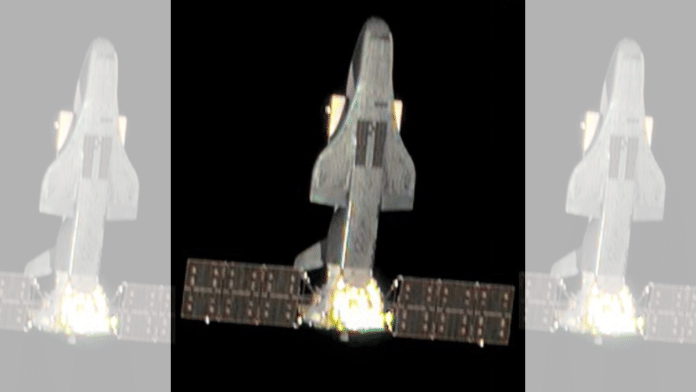
New Delhi: For years, China has kept the activities of its secretive spaceplane under wraps, offering little more than brief official statements about its missions. Now, a newly released US intelligence report has offered a rare glimpse of the spacecraft in orbit, using a high-resolution satellite image that captures details Beijing has not publicly explained.
The image, included in a US Defense Intelligence Agency report published on 26 October, shows a winged, shuttle-like vehicle with its payload bay doors open and another spacecraft attached to its rear section. It was captured in 2024 by a satellite operated by Vantor, formerly known as Maxar Technologies, from a distance of around 90 kilometres.
The spacecraft is widely believed to be China’s Shenlong, or “Divine Dragon”, an uncrewed vehicle designed to travel into orbit and return to Earth. Beijing has disclosed few details about its missions, leaving researchers to piece together its activities from satellite-tracking data and observations.
So what can the photograph tell us, and why are space experts paying attention?
What is China’s spaceplane?
Unlike conventional satellites, which generally remain in orbit, a spaceplane combines features of a spacecraft and an aircraft. It is launched into space aboard a rocket, operates in orbit and can return to Earth by gliding towards a runway.
The ability to reuse the vehicle could reduce the cost of repeated missions and allow equipment to be recovered, examined and tested on the ground. It could also enable experiments that would be difficult or expensive to conduct using conventional satellites.
China launched its first experimental reusable spacecraft in September 2020. Its second mission lasted 276 days, while the third, launched in December 2023, ended in September 2024 after about nine months in orbit. A fourth mission began in February 2026. Chinese state media has described the programme as a test of reusable spacecraft technology intended to support the peaceful use of space, without disclosing the specific experiments being conducted.
The US operates a comparable uncrewed vehicle, the X-37B, which is used for classified experiments and technology testing. Both programmes illustrate the growing interest in spacecraft that can stay in orbit for extended periods before returning to Earth.
Also Read: Spain built a high-speed rail giant. Has maintenance lagged behind?
What does the new photograph reveal?
The image provides a clearer view of the Chinese vehicle’s wings, tail and open payload bay. Most notably, another spacecraft can be seen attached to its rear section, with its own solar arrays deployed. The photograph does not identify that spacecraft or explain the purpose of the connection.
The open payload bay is significant because it suggests the vehicle can accommodate equipment or objects that might be deployed during a mission. Previous tracking observations have recorded the spaceplane releasing smaller objects into orbit.
Such objects could be experimental satellites or other hardware. Without information from Chinese authorities, however, their precise identities and functions remain uncertain.
The photograph is also a reminder of how commercial satellites are changing intelligence gathering. Spacecraft originally designed to image the Earth can sometimes observe other objects in orbit, offering views that were previously available only through indirect tracking or low-resolution ground-based observations.
Why are its movements in orbit important?
One of the most closely watched capabilities is known as rendezvous and proximity operations, or RPO. This involves one spacecraft manoeuvring close to another, potentially matching its orbit, inspecting it or making physical contact.
These operations have legitimate civilian applications. A spacecraft capable of approaching another satellite could inspect damage, assist with repairs, refuel it or help remove defunct equipment from orbit. Such capabilities could eventually extend the useful life of expensive satellites and reduce space debris.
But the same technology has military implications. A spacecraft that can approach another object could potentially inspect its sensors, interfere with its operation or position itself close enough to create a security concern.
China’s spaceplane has previously released objects and conducted manoeuvres that researchers interpret as possible proximity operations. The US intelligence report and independent tracking observations add to the evidence that such activities are an important part of the programme. They do not, however, prove that the spacecraft is designed to attack satellites.
Is it a space weapon?
The distinction between a spacecraft with military applications and a weapon is important. The Shenlong programme’s secrecy makes it difficult to establish the full range of its capabilities, but the photograph alone cannot show whether the vehicle carries weapons or is conducting a military mission.
Reusable spaceplanes can be used to test sensors, communications equipment, materials and other technologies in orbit. They can also deploy experimental satellites and retrieve hardware for examination. Some of those activities could support military operations without making the vehicle itself an offensive weapon.
The US military’s X-37B operates under similar secrecy, with officials releasing only limited details about its experiments. Both countries therefore face the same transparency problem: activities described as technology testing can have civilian and military applications, and outsiders often cannot determine their precise purpose.
What does this mean for the space race?
The photograph arrives as the US and China expand their capabilities in space, where satellites support communications, navigation, intelligence gathering and military operations on Earth.
The ability to manoeuvre near another spacecraft is becoming increasingly important because it could help countries protect their own satellites while also creating new ways to threaten those operated by rivals. These capabilities have implications for the security of space infrastructure, even without the use of conventional weapons.
For now, the photograph offers evidence of a sophisticated reusable spacecraft and a possible interaction with another object in orbit. It does not resolve the central question of what China is testing.
The significance of Shenlong lies not simply in its resemblance to the American X-37B, but in what reusable spacecraft and close-orbit manoeuvres could eventually allow their operators to do. Until more details emerge, its exact mission, and whether its capabilities are intended primarily for experimentation, satellite servicing or military purposes, remains an open question.