



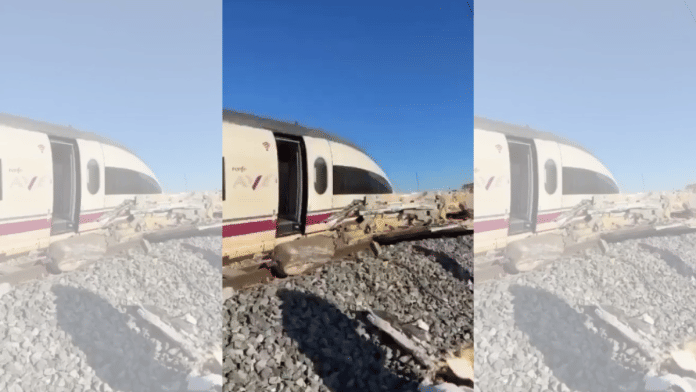
New Delhi: Spain’s railway ambition has been built around speed, scale and modernisation. Since the launch of its first high-speed line between Madrid and Seville in 1992, the country has developed a network of roughly 4,000 kilometres, connecting major cities with trains travelling at speeds of up to 300 kmph.
But the fatal collision near Urda, in Toledo province, on 28 October has renewed scrutiny of a less visible part of the railway system: the infrastructure and equipment that must work reliably every day. At least 68 people were reported dead after a Renfe-operated train struck a stationary Iryo service. Officials said a failure involving the LZB train-control system was followed by an instruction allowing a train to resume normal running. Investigators are examining the sequence of events.
The crash does not, by itself, prove that inadequate maintenance caused the failure. But it has brought an existing question into sharper focus: has Spain’s push to expand its high-speed network received more attention than the upkeep of the infrastructure already in place?
The price of building a high-speed network
Spain’s investment strategy helped transform rail travel between its major cities. High-speed services offered an alternative to domestic flights, while the country developed expertise in railway engineering, construction and operations.
Yet building new lines and maintaining existing ones are different financial commitments. New infrastructure creates visible milestones—new routes, stations and shorter journey times. Maintenance involves replacing worn components, inspecting equipment, updating signalling systems and repairing faults, often without producing an obvious improvement for passengers.
Reuters reported in January that Spain spent an average of around €1.5 billion annually on its high-speed network between 2018 and 2022. However, only about 16% of that spending went towards maintenance, renewals and upgrades, according to European Commission data cited by the news agency. The comparable share was 34-39% in France, Germany and Italy.
The figures point to a difference in spending priorities, not necessarily proof that Spain’s railways are less safe. The countries have different network sizes, operating conditions and investment needs. Still, the comparison raises questions about whether maintenance spending has been sufficient for a network of Spain’s scale.
Also Read: How do high-speed trains collide? 5 crashes reveal where safety systems fail
Signalling is as important as the tracks
Railway safety depends on much more than the physical condition of the rails. Signalling systems track train movements, regulate access to sections of the line and help ensure that trains remain safely separated.
The Madrid-Seville line where the latest collision occurred uses the German-designed LZB system, which continuously monitors train speed and transmits movement instructions to the driver. Other safeguards include ASFA, which alerts drivers to signals and can trigger automatic braking in certain circumstances, alongside train-detection and traffic-management systems. Spain is also modernising parts of its network with the European Rail Traffic Management System, or ERTMS.
These technologies require regular inspection, software and hardware updates, testing and repairs. A fault that brings trains to a halt is not necessarily evidence of poor maintenance: stopping traffic can be the correct safety response. The critical question is whether the system and the operating procedures prevent trains from moving again until the line is confirmed safe.
Spain’s infrastructure manager, Adif, announced a €78.1 million contract in November 2025 for specialised maintenance of signalling and traffic-management equipment across the railway network. The work includes preventive maintenance, continuous monitoring, periodic servicing and urgent repairs.
Can Spain balance expansion with upkeep?
Passenger demand has risen sharply. Nearly 40 million people used Spain’s high-speed trains in 2024, almost double the 2019 figure, Reuters reported. More traffic means greater demands on infrastructure, maintenance teams and the systems responsible for managing train movements.
The challenge is not necessarily to stop building new lines, but to ensure that investment in expansion does not come at the expense of existing assets. That means predictable maintenance budgets, timely replacement of ageing equipment, independent safety audits and train-control systems designed to default to safe conditions when faults occur.
The investigation into the Toledo collision will need to establish whether maintenance, signalling technology, operating procedures or a combination of factors contributed to the crash. Until then, attributing it to underinvestment would be premature.
But the broader policy question remains. Spain has demonstrated that it can build a vast high-speed network. The test now is whether its investment priorities can sustain the technology, track and safety systems on which that network depends.