



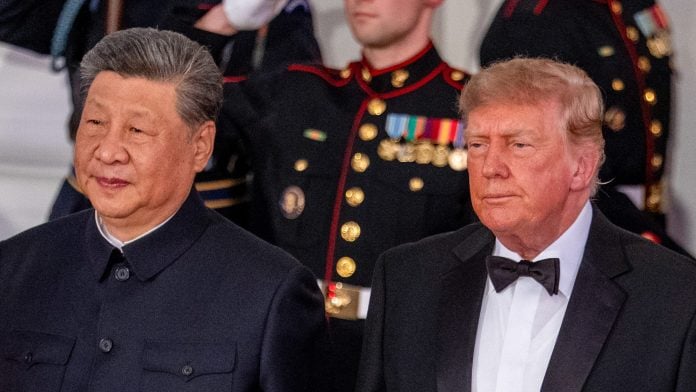
Donald Trump’s fete for China’s Xi Jinping has been heavy on pageantry and platitudes but light on substantive announcements, with the events shadowed by the US president’s preoccupation with construction projects and personal grievances.
Through Thursday evening in Washington, the most significant news tied to the gathering was announced before it even began, when Treasury Secretary Scott Bessent said just as Xi’s plane landed that the two sides had extended a trade truce for another two months.
Anticipated agreements on tariff cuts and a new line of communication on artificial intelligence have yet to be announced, and Chinese stocks in Hong Kong declined, suggesting traders saw a lack of progress. The day was capped off by a state dinner featuring a three-course menu, attended by American tech and financial titans.
Trump gifted Xi a statue of a bald eagle — a national symbol of the US — and declared he and Xi have “never gotten along better.” He then appeared to venture off-script, inviting dinner guests to tour the construction site of his White House ballroom. Xi offered a gauzy history of US-China ties in his dinner toast that papered over historic tensions.
It’s not as if the two leaders lacked contentious issues to iron out. In the months before the summit, China has been accused of undercutting the US at home and abroad.
Trump alleged in a July prime-time address that China carried out the “largest compromise of election data in history.” Weapons inspectors discovered evidence that Iran-backed Houthi militants have used components shipped from China to manufacture weapons in Yemen. China continues to buy Iranian crude and is holding F-35 stealth aircraft parts shipped to Hong Kong under unclear circumstances.
But throughout the day, Trump repeatedly cast Xi as a friend rather than the US’s foremost geopolitical rival despite their nations’ intensifying competition on AI and divides over trade.
Kicking off three hours of events at the White House, Trump hailed his “truly great friendship” with Xi, saying “there’s much we can achieve.” Still, expectations were low going into the summit that it would produce breakthroughs on major disagreements.
Xi was less effusive, focusing on policy objectives, including pushing Trump to consider more collaboration to ensure AI remains “under human control.” Trump has dismissed the notion that AI poses a threat.
“China keeps its door wide open, welcomes American companies wanting to invest and do business there. We hope Chinese companies are treated fairly here in the United States,” Xi said.
The Chinese leader also prodded Trump to change Washington’s longstanding position on Taiwan, according to Beijing. The White House has yet to release its own official description of the meeting.
The summit thus far has been a gift to Xi, as he received a warm welcome from a US president who thus far has struggled to regain leverage since the two countries’ trade war last year. The two leaders are scheduled to have tea and tour the National Archives on Friday before Xi’s departure.
Also on display at the White House were myriad controversies and distractions that have marked Trump’s second year back in power.
No major US television network aired live footage of the leaders meeting. Typically, such a summit would dominate the airwaves, but networks have mostly declined to broadcast video of Trump since the president banned cable channels CNN, MS NOW and online outlet Politico from the White House.
Reporters from those outlets were reinstated under a federal judge’s order after they filed a lawsuit alleging the ban violated their constitutional rights.
The TV-obsessed president groused about the blackout on social media, accusing the outlets of declining to air footage of the “magnificent” summit because “they didn’t want credit to be given to ‘TRUMP.’” Among those not broadcasting footage was Trump-friendly Fox News.
Trump also mocked his predecessor Joe Biden in front of Xi while showing him gold-framed photos of past presidents that he had installed on the historic White House colonnade. In place of Biden’s photo is an autopen. Critics called the move inappropriate.
After their meeting, Trump showed Xi the stone helipad he had installed on the South Lawn and said Xi “loves good granite.” He even brought the Chinese leader inside the presidential helicopter. During an afternoon gap in the schedule, construction crews’ heavy machinery clanged in the distance as they worked on the ballroom.
The contrast to Xi’s last state visit, in 2015, was stark. Then-President Barack Obama held a press conference with Xi, at which he painstakingly described their agenda. The American leader said that included a “frank discussion” on human rights.
Trump made no mention of that topic on Thursday and ignored journalists’ shouted questions about jailed Hong Kong democracy activist Jimmy Lai.
In Trump’s first term, his team worked on plans to address allegations of Chinese intellectual property theft and far-reaching trade agreements involving a broader swath of issues than the current truce.
Trump blamed China for the spread of Covid-19 in 2020 and called it the “China virus.” This week, he praised Xi for the red-carpet treatment he received in Beijing in May and has offered him the same in Washington.
Some of Trump’s fellow Republicans criticized the president’s approach, saying it undercuts the promises he made during his 2024 campaign to get tough on China.
“The president campaigned on an anti-China policy,” said North Carolina Senator Thom Tillis. “You go look at those MAGA rallies and look at everybody cheering when he said he’s going to take it to China.”
–With assistance from Jeff Mason, Hadriana Lowenkron, Nectar Gan and Jonathan Tamari
This report is auto generated from the Bloomberg news service. ThePrint holds no responsibility for its content.
Also read: Xi unlikely to take along any CEOs to US summit with Trump