


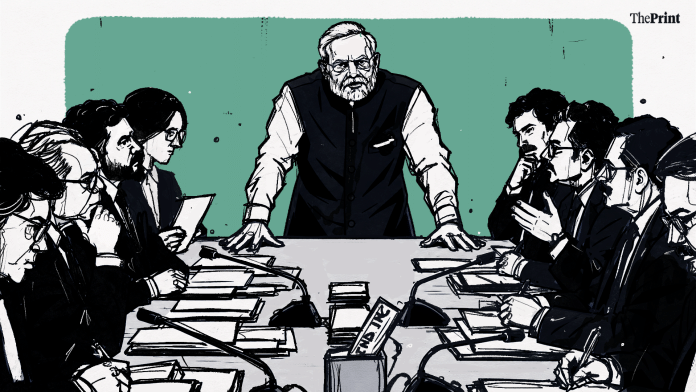
The most apt description for Prime Minister Narendra Modi’s mass admonition of corporate India at the FICCI AGM is that it was a cri de coeur.
I use this even as I’m reminded of the late and venerable D.N. Singh, my first news editor at The Indian Express in 1977. He had banned ‘foreign’ words in our writing. English is foreign enough for all of us, he’d say.
In this case, however, a cry from the heart doesn’t fully capture where the Prime Minister was coming from. The dictionary tells us that a cri de coeur is more profound. It’s a ‘passionate, heartfelt appeal, protest, even an outcry’. The Prime Minister spoke in anger, frustration, helplessness even. What more can I do to get you guys moving? It was way more fraught than a mere cry from the heart.
It’s a bit like a general failing to implore his troops to assault a hill despite a thousand war cries, words of inspiration, even a dash of ‘spirit’. Since we started with a bit of French, that ‘spirit’ reference is from the Duke of Wellington at the Battle of Waterloo.
While his original line, as recorded in history, was less dramatic, Christopher Plummer, playing Wellington in the 1970 film Waterloo, tells the Duchess of Richmond, who wants to know where his troops get their inspiration to fight: “Gin is the spirit of their patriotism.” I’m avoiding the full quote because the Prime Minister certainly didn’t want to call corporate India ‘scum, beggars and scoundrels,’ as Wellington called his troops. It’s just that his frustration is as profound.
What’s the spirit that a government can offer entrepreneurship? It can be many things: deregulation, minimum government, fair market supervision, fiscal discipline, freedom from licensing and investment restrictions. And certainly, the gin-equivalent of this ‘spiritual’ package would be tax cuts.
One big cause of Modi’s frustration is corporate India’s unwillingness to pass this benefit on through raises, hiring or investment. This hasn’t happened even as corporate profits have risen. These troops are unwilling, either too scared to assault that hill, or simply too comfortable in safety and pocketing the tax breaks. Let’s read some of Modi’s words to FICCI.
“In 2014, the basic corporate tax rate was 30 percent. We reduced it to 22 percent. Today, there’s no income tax on earnings up to Rs 12 lakh in India.” And then, he turns the knife.
“I know you won’t clap, because however much one gives, your appetite never seems to be satisfied (aap ka pet nahin bharta). Did you increase the salaries of your employees? Did you increase the number of employees? No. The attitude remains: ‘Modi ji, you do it, we will see’.”
Also Read: India needs more Jamnagars. Anti-business, knee-jerk anti-Americanism hurt national interest
While India Inc. was left licking its wounded pride, the Congress quickly latched on to the Prime Minister’s words. Isn’t this what we’ve been saying all along, it hit back. Jairam Ramesh was first out of the blocks. “For the first time in 12 years, a nervous and rattled PM has pulled up the captains of industry…(who) must have been taken aback and shocked.” In an elaborate post on X, he blamed not businesses but the government for this stall. He blamed it on crony capitalism, regulatory capture, “an atmosphere of fear and intimidation”, and the unleashing of “investigative agencies”. He concluded by suggesting the Prime Minister look inwards. Rahul Gandhi, on his speaking tour in the US, also said, ‘we told you so’.
It’s not my place here to hold forth on the state of the economy. But we know corporate India hasn’t been investing, expanding and hiring, at least nowhere near what seven percent-plus growth would indicate. Startups are rising, but largely there’s an entrepreneurship freeze. Much of the growth comes from government spending, especially in heavy infrastructure.
If corporate India looks so risk-averse, this isn’t a sudden development. The mood has been festering for years. Some complain of a lack of demand, others say regulation is asphyxiating. Still too many forms need to be filled for too many small things, even something as virtuous as exports. Because, I suppose, the RBI wants to track every dollar that comes in. And of course, everything in triplicate please.
The government may have loosened policies here and there, but the bureaucratic grip is tighter than before.
A quick quiz, and no Googling. Can you name the ministers of Mines, Pharmaceuticals and Steel? I mention these three because the Prime Minister highlighted corporate India’s failures specifically in these areas. Why do we export raw materials like iron ore, have so much bauxite, yet import finished steel and specialised aluminium alloys? How come, despite robust pharma exports, we remain dependent on China for APIs, or active pharmaceutical ingredients? With key ministers too lightweight or distracted by party work, and power centralised in the PMO, which is obviously far too overburdened to attend to everything, discretion devolves to the bureaucracies. Corporate India is resigned to this.
It’s buying peace in the manner it knows best: Distributing some of the spoils in a way that’s entirely legal and above board, but also revealing. Check out the number of retiring secretaries, especially in the Ministry of Finance, finding sinecures on the Boards of influential companies and as chairpersons of almost all significant private sector banks and the recently listed stock market titan NSE (National Stock Exchange).
The more the Modi government thinks it’s reforming—and reforming it is—the more it does so in a way that passes power into the hands of the bureaucracy. Corporate India buys peace with them in advance, merely by dropping hints. Here’s the paradox. This is a super-strong government with a very weak implementation spine. As a result, what’s decentralised at the top gathers in the middle.
Also Read: The Vishwaguru delusion, mine vs yours, is ruining our view of the world
A strong government isn’t immune to policy confusion. On the contrary, it can be prone to flip-flop-flips given its overwhelming power. Long Term Capital Gains (LTCG) is a big discussion point now. Count how many changes this government has brought in. The same goes for taxes on dividends.
Since 1991, successive finance ministers have said that the essence of a reformed economy lies in moderate, predictable taxes. You most certainly can’t say the same about this government, which also taxes individuals at almost twice the rate of corporations. It’s also been breathtaking in its use of sovereign power. A striking example is the retrospective changes it made to sovereign gold bonds to suit itself and cover for those brilliant people who floated these without hedging for gold prices. The message is an old one. In India, the government, the almighty Sarkar-e-Hind, can never be wrong.
Corporate India has a lot to answer for, but for some, the chappal is on the government’s foot. On copper and aluminium imports, two of the largest projects have been shut under activist pressure. If this government has failed to move on these, it can’t blame India Inc.
Sadly, corporate India knows this, but nobody would dare speak up. They whisper dark things on the sidelines. But in front of an angry Prime Minister, or the Finance Minister who has been delivering the same admonitions for two years, they sit silent and contrite, like schoolkids whose homework the dog ate.
This isn’t just a Modi-era phenomenon. At the 2007 CII AGM, then Prime Minister Manmohan Singh had chided corporate leaders for paying themselves too much. The irony is that the mood and message then were opposite to now. Sunil Mittal, then CII chief, responded by pledging ‘a significant part of his salary bonus’ to charity.
I wrote then, and repeated in a 2013 column, that corporate India has to grow the spine to tell the Prime Minister he didn’t fix their wages. He should leave them alone if they paid their taxes honestly. Of course, no such thing happened. Corporate India also swallowed that retrograde idea of near-mandatory CSR.
Even at FICCI, and in the corporate and financial universe, too many good people have too many important points to make. But nobody would dare. Corporate India is waiting for its next Rahul Bajaj. Or preferably a few of them.
Also Read: India’s top airline just handed sarkar the keys. That’s IndiGo’s real ‘crime’