


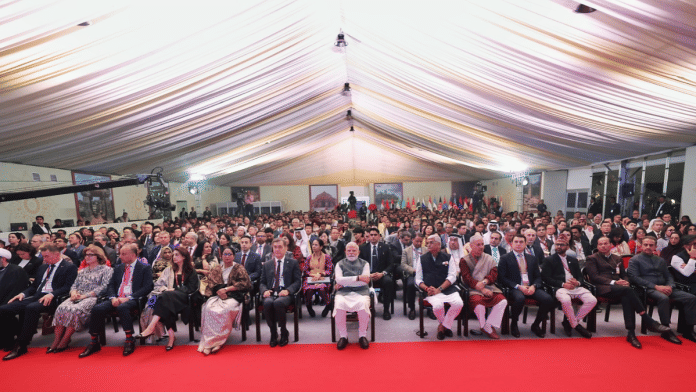
New Delhi: Prime Minister Narendra Modi said Friday that “mutual trust is born when we feel something is shared between us”. He said this while opening the first Shanghai Cooperation Organisation (SCO) Civilisational Dialogue Forum at Purana Qila in Delhi.
Earlier the same day, Pakistan’s Climate Change Minister Musadik Masood Malik, the first Pakistani federal minister to visit India after Operation Sindoor, said: “I think all of our relationships will improve.”
“The need today is to focus on what is shared between us,” Modi said. “At a time when discussion of war and unrest dominates the world, we in India are holding a dialogue on civilisational connect. The strongest guarantee for global peace is cultural connect.”
He said, “Empires have changed the maps of the world, but civilisational dialogues have changed the world’s ideas.” The forum, he added, “is not just a ceremonial platform” and “can become a platform that gives direction to the world”.
Speaking to reporters at Purana Qila, Malik said: “The region is in flux, as you know. The plates underneath geopolitics are shifting very fast.” Asked about India’s concerns over cross-border terrorism, he said: “I think tomorrow, once I give my statement, we’ll have a lot of conversations.” He is scheduled to address the forum Saturday.
Asked about bilateral talks, Malik called the forum a “multilateral” event and said, “There are no bilateral matters here.” He said culture “has a very key role to play” in dialogue between the two countries. “Singularity only requires a monologue. Dialogue is about diversity,” he said.
Chargé d’Affaires Saad Warraich received Malik at the airport. Ambassador Farhat Ayesha, Director General for SCO affairs at Pakistan’s Foreign Ministry, is travelling with him. Malik will meet SCO representatives on the sidelines and visit the Pakistan High Commission. Pakistani media, citing diplomatic sources, said no meeting between Malik and Modi has been scheduled.
India had invited Pakistan’s Minister for National Heritage and Culture, Aurangzeb Khan Khichi. Islamabad nominated Malik instead. When it announced the nomination on 14 November, Pakistan’s Foreign Ministry said it remained committed to “promoting dialogue among civilisations and fostering people-to-people contacts” within the SCO framework.
The last Pakistani minister to visit India was Bilawal Bhutto Zardari, who came to Goa for an SCO foreign ministers’ meeting in May 2023. Ties have stayed strained since the military conflict of May 2025. Diplomatic and trade restrictions and reciprocal airspace bans remain in place, and neither side has announced talks.
External Affairs Minister S. Jaishankar travelled to Islamabad for an SCO meeting in October 2024. Pakistan chairs the SCO Heads of State Council for 2026–27 and will host the summit in Islamabad next year.
Last week, Union Minister for Culture Gajendra Singh Shekhawat said Pakistan’s civilisational and cultural evolution was “not different from us”. In Jammu and Kashmir, PDP MLA Aga Syed Muntazir Mehdi welcomed Malik’s visit. He said India and Pakistan’s issues “cannot be resolved through non-engagement or by maintaining mutual hostility”.
Modi spent much of his speech on speaking about trade and learning across the region. He said the Indus Valley civilisation traded with Mesopotamia about 5,000 years ago. Buddhist ideas, he said, reached China through Gandhara, now in Pakistan, and Central Asia, with Kucha and Dunhuang as centres along the route. He named Faxian, Xuanzang and Yijing, who came to India from China, and Kumarajiva, born in Kucha, who translated Buddhist texts into Chinese.
The PM also said the ‘Panchatantra’ was adapted into Persian and then Arabic text as ‘Kalila wa-Dimna’. The ‘Ramayana’ took root in Cambodia as the ‘Reamker’. Brahmagupta’s ideas reached Baghdad, where scholars such as al-Khwarizmi took mathematics forward. He linked Central Asia’s ‘maqam’ to India’s raga tradition and said the gardens of Samarkand and Herat shaped the charbagh style in India.
Modi proposed that SCO countries cooperate on digitising and translating old manuscripts and take up joint research on their shared history. He said AI could speed up the translation of works that exist in only a few languages.
He also suggested joint exhibitions by museums, exchange programmes for scholars and researchers, and heritage circuits linking the Silk Route and Buddhist sites. He called for joint cultural festivals and artists’ exchanges, and said young artists, writers and filmmakers should carry the shared heritage to a new generation.
“Today, people of the same countries where our ancestors had to travel for months can connect in seconds,” he said.
He ended with the Vedic verse Sangachhadhvam samvadadhvam (“let us walk together, let us speak together”) and with Vasudhaiva Kutumbakam. “In India, we accept diversity, we celebrate diversity,” he said.
Modi proposed the forum at the SCO summit in Tianjin in September 2025. Shekhawat said 15 of the 25 invited countries had confirmed, including China, Iran, Saudi Arabia and Türkey. The forum is organised by the Culture and External Affairs ministries. It has four themes: Cultural expression; art and architecture; language and literature; and religious and philosophical traditions. It runs until 22 November.
(Edited by Viny Mishra)
Also read: Pakistan minister on rare visit to India for regional SCO forum