



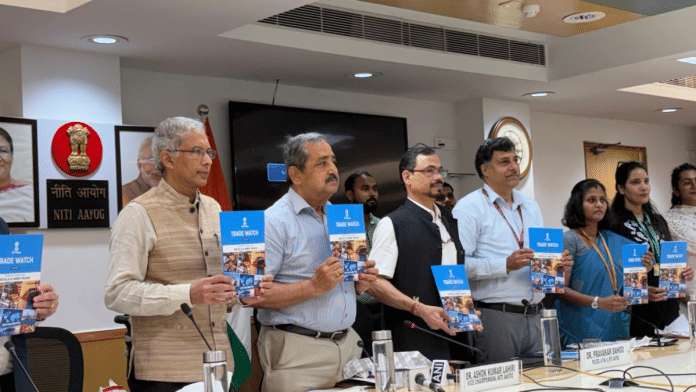
New Delhi: India’s metals exports remain concentrated in traditional segments such as iron and steel, even as global demand is shifting towards copper, nickel and other critical minerals, limiting the country’s share in a nearly $2-trillion global market, according to the NITI Aayog’s latest Trade Watch Quarterly released Wednesday.
The report said global imports of metals and ores rose from $1.2 trillion in 2015 to about $2 trillion in 2025, but India’s share of exports in these segments rose only marginally— from 1.7 percent to 1.8 percent (from $21.8 billion to $36.8 billion).
India’s metals exports are concentrated in iron and steel, articles of iron and steel and aluminium, which together account for about 78 percent of metal exports in 2025.
However, the report noted an “apparent mismatch with global demand”.
Global demand is increasingly moving towards non-ferrous and technology-intensive metals, while India’s export presence remains limited in these segments.
“India’s exports value remains relatively small in several high-value non-ferrous metals, including nickel, tin and copper products, highlighting opportunities for greater value addition and diversification into emerging metal value chains,” the report said.
Copper is a key example. Global imports of copper and articles stood at $268.6 billion in 2025, but India exported only $2.9 billion, giving it a 1.1 percent share of global demand.
Aluminium is one area where India has made progress. Its exports grew from $2.7 billion in 2015 to $6.8 billion in 2025, with its share of global aluminium demand increasing from 1.7 percent to 2.6 percent.
Another exception is lead, where India accounted for 12.1 percent of global lead demand, helped by its recycling ecosystem.
India’s mining sector also lags several major mineral-producing economies. Its contribution to overall Gross Value Added (GVA) declined from 3 percent in 2014-15 to 1.8 percent in 2025-26. This compares with 2.4 percent in China, 2.9 percent in Brazil and 11.8 percent in Indonesia, the report said.
Among international markets, China dominates most metal categories, supported by mining, refining and manufacturing capacity. Germany has built a strong position in precision-engineered metal products, while South Korea is a major exporter of steel and zinc.
Indonesia has captured 22.2 percent of global nickel exports and 20.1 percent of tin exports, helped by restrictions on unprocessed ore exports and investment in smelting, refining and battery-material value chains.
India, in contrast, generally accounts for only 1-4 percent of global exports across most base-metal categories, except lead and zinc.
Also read: MSME sector must go green to stay competitive, says NITI Aayog report
Import dependence deepens
India’s imports of metals and ores nearly doubled from $32.2 billion in 2015 to $60.5 billion in 2025 as domestic demand from infrastructure, engineering and manufacturing industries rose.
Iron and steel accounted for the largest share, with 32.1 percent of the metal import basket, followed by copper at 23.1 percent, aluminium at 19.2 percent and articles of iron and steel at 11 percent.
The imports of copper grew from $3.2 billion in 2015 to $11.8 billion in 2025, recording 13.9 percent annualised growth. India depends on imported copper ores and concentrates to meet 96 percent of demand, while domestic availability satisfies only about 4 percent.
The dependence is sharper for critical minerals. India is 100 percent import-dependent on nickel, cobalt and lithium. In 2025, China supplied 26.2 percent of India’s nickel imports and 34.3 percent of lithium carbonate imports.
The cumulative FDI equity inflows into mining stood at only $3.5 billion between 2000 and 2025, less than 0.5 percent of India’s total long-term cumulative foreign equity inflows.
“This suggests that India’s geological potential has not yet been fully translated into sustained international investment,” the report stated.
NITI’s recommendations
The report called for better geological data and more support for mineral exploration, faster auctions and operationalisation of lapsed mineral blocks, and simpler mining and forest clearances.
It also recommended cutting logistics and export-finance costs, making renewable power more accessible to industry and improving systems to help steel exporters meet European Union carbon-border requirements.
For critical minerals, it called for greater domestic processing and recycling, while also encouraging companies to secure supplies overseas. The report also recommended stronger rules of origin under Free Trade Agreements and targeted measures when imports hurt domestic capacity.
(Edited by Ajeet Tiwari)
Also read: India should look beyond generics if it wants bigger share of global pharma pie, says NITI Aayog