





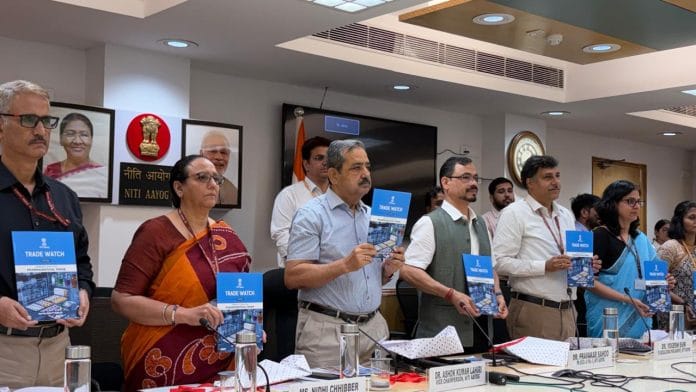


New Delhi: India is known as the pharmacy of the world, but it has to move beyond low-priced generic medicines and expand into high-value pharmaceutical products. The country has to do this if it wants to engage in a larger share of the pharmaceutical market globally, NITI Aayog Vice Chairman Ashok Lahiri said Tuesday while releasing the eighth edition of the Trade Watch Quarterly report (Q4 FY2025-26).
‘In low-value pharmaceutical products, we are doing very well. In terms of quantity, we are also doing very well, but we need to move up the value chain, and we need to produce much more value because that is where money comes,’ Lahiri pointed out.
The report highlighted a thematic analysis of pharmaceutical trade, noting that India’s pharmaceutical industry is growing as a strategic pillar of the economy, contributing over 1.7 per cent to gross domestic product (GDP), 7.2 per cent of manufacturing gross value added (GVA), and supporting around 27 lakh jobs.
In 2025, India exported pharmaceutical and active pharmaceutical ingredient (API) products worth nearly $35.8 billion. The report pointed out India’s global share in pharmaceutical and API exports remains modest at 2.8 per cent, even as global pharmaceutical and API demand is estimated at around $1.3 trillion in 2025, including $261.2 billion worth of APIs.
This gap shows a significant reach for expansion of Indian exports amid rising global demand for medicines, biologics and specialised therapeutics.
‘India’s comparative advantage remains concentrated in formulations, particularly retail medicaments and generic drugs, where it remains highly competitive even in regulated markets such as the United States and Europe,’ the report said.
From the global view, retail medicines and formulated drugs accounted for 55.6 per cent of pharmaceutical demand, valued at $571.5 billion in 2025. India’s exports in this category stood at only $22.6 billion, accounting for 4 per cent of global demand.
However, NITI Aayog noted that global pharmaceutical industry is drastically moving towards high-value products where India’s presence remains limited.
‘The global pharmaceutical landscape has exponentially shifted towards high-value segments such as biologics, vaccines, immunologicals, and advanced therapeutics, where India’s export presence remains limited,’ the report stated.
The gap is hugely noticeable in the blood products, vaccines and immunologicals, which has emerged as the fastest-growing pharmaceutical category globally.
But India’s exports in this segment remained just $2.2 billion, translating into a 0.6 per cent share of global demand, estimated at $390.2 billion in 2025, as the report highlighted the country’s high dependence on imported pharmaceutical inputs from China primarily.
‘In Active Pharmaceutical Ingredients (APIs), India has strengthened its position in several specialised chemical intermediates and antibiotics, but continues to face dependence on imported raw materials and intermediates, particularly from China,’ report said.
The top five API categories account for 84 per cent of India’s imports, with China supplying between 66 per cent and 86 percent of these products in 2025, the report noted.
The NITI Aayog also pointed out the challenges related to research and development (R&D) spending in the sector. While India’s patent filings have risen eightfold from 440 in 2013 to 3,576 in 2023, the country’s pharmaceutical industry lags behind its global competitors in research spending.
‘Indian pharma companies invest approximately 7 per cent of net sales in R&D, compared to the 15–20 per cent spent by global companies,’ Reported by NITI Aayog.
It also noted that access to developed markets persists a key challenge for Indian pharmaceutical exporters.
‘Lengthy product registration processes, duplicative inspections, stringent documentation requirements, and limited recognition of foreign regulatory approvals increase compliance costs and delay market entry,’ the report stated.
What NITI Aayog recommends?
NITI Aayog recommended for the country the next phase of growth in pharmaceutical industry must come from high-value products rather than volume-driven generic medicines.
The report noted by saying ‘Looking ahead, the sustained expansion of India’s pharmaceutical sector will pivot decisively upon scaling up strategic investments in frontier research and development (R&D), complex biologics, and advanced therapeutics.’
The federal think tank suggested that increasing investments in research and development, strengthening collaboration between industry and academic institutions, and creating a more transparent regulatory framework.
It also called for fixed timelines for the patent opposition and grant process.
‘Restrict pre-grant oppositions to a defined period (e.g., 6–12 months from publication) and prescribe clear timelines for admissibility decisions and disposal of oppositions,’ it said.
For future trade agreements, NITI Aayog proposed that a standardized pharmaceutical chapter be included during negotiations as a template focusing on regulatory predictability, intellectual property cooperation, product registration and related issues.
‘A model chapter would help ensure greater consistency in negotiations, strengthen market access outcomes, and systematically address non-tariff barriers affecting pharmaceutical trade,’ the report stated.
Adding to this, NITI Aayog called for Eco-Friendly manufacturing through the establishment of bulk drug parks with waste treatment facilities, zero-liquid-discharge systems and solvent recovery infrastructure.
The report said these measures would enhance efficiency and help domestic manufacturers meet the stringent sustainability requirements of global markets.
(Edited by Harini Ts)
Also Read: Overlap in Centre’s MSME schemes affecting outcomes—NITI Aayog; offers course-correction roadmap