



New Delhi: In May, when Vijay’s TVK government assumed power in Tamil Nadu, the new Chief Minister was inheriting an economy with substantial productive capacity, yet one with fiscal foundations that were subtly eroding.
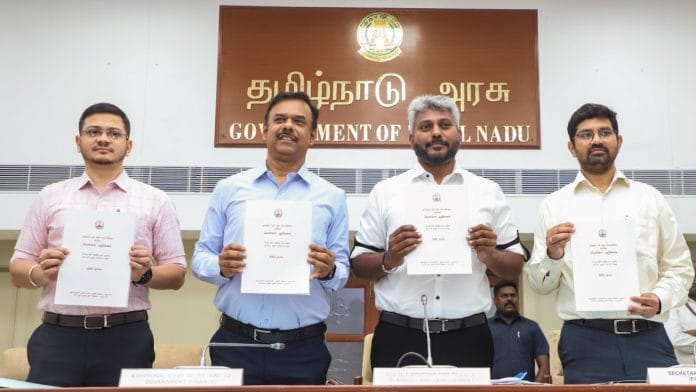
The white paper issued by Finance Minister N. Marie Wilson on 16 June has provided official data confirming this fiscal decline.
The figures are more severe than most analysts anticipated, and in at least one aspect, they are more alarming than the headline statistics indicate.
This document does not arrive unexpectedly; rather, it serves as confirmation.
Also Read: 146 new legislators, one crash course: Tamil Nadu’s TVK govt prepares rookie MLAs for assembly debut
The debt that wasn’t one number
The headline figure of the white paper, indicating Rs 10 lakh crore in outstanding State debt as of 31 March, 2026, has received significant attention. However, this figure should not be the primary focus of analysis.
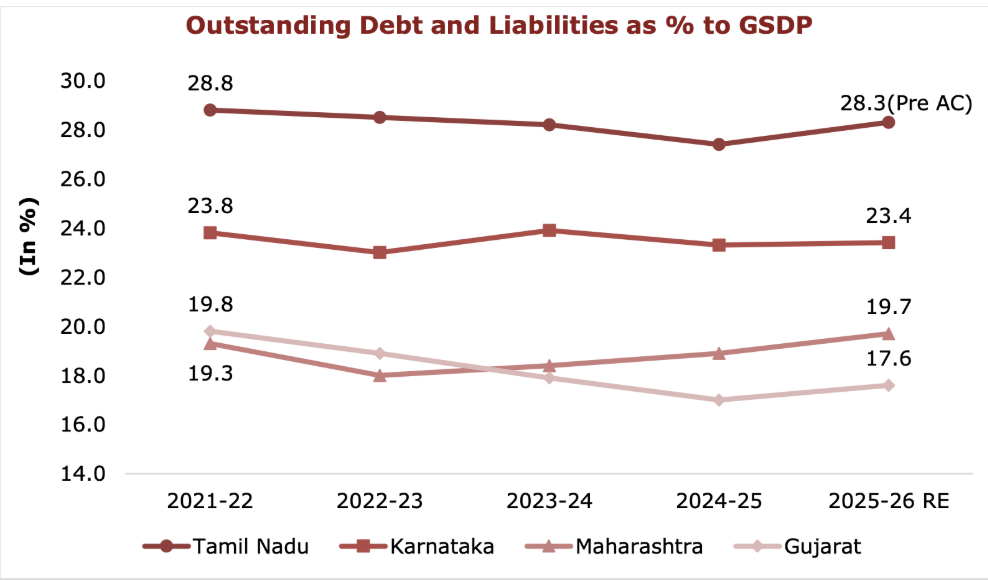
A more insightful starting point is Outstanding Debt and Liabilities as a percentage of GSDP in a comparison of peer states from 2021-22 to 2025-26. This figure reveals that Tamil Nadu’s debt-to-GSDP ratio remains at 28.3 percent, the highest among the four peer states, while Karnataka, Maharashtra, and Gujarat have utilised the post-Covid recovery period to consolidate their positions. In contrast, Tamil Nadu has not made similar progress.
The per-capita aspect presents an even more pronounced picture.
A child born in Tamil Nadu in 2025-26 inherits a per-capita liability of Rs 1,28,934, which represents an increase from Rs 77,819 in 2021-22. This rise of Rs 51,115 per resident over five years is the highest among the peer group throughout the period.
In addition to the State’s direct borrowings, there exists a larger fiscal exposure that the white paper documents on record but has not been adequately highlighted. When the debt of public sector undertakings (PSUs), including those in power, transport, and civil supplies, is consolidated, the total fiscal exposure escalates to Rs 13.18 lakh crore.
These are not merely off-balance-sheet items; they represent obligations that the State will ultimately be required to fulfil.
When interest becomes the budget
The comparison between interest payments and capital expenditure, from 2011-12 to 2025-26, serves as the analytical focal point of the document. In the fiscal year 2017-18, interest payments surpassed capital expenditure for the first time and have remained higher each subsequent year. By 2025-26, the annual interest payments are projected to reach Rs 67,050 crore, exceeding capital expenditure by approximately one-third. Interest payments now account for 22.8 percent of total revenue receipts and 34.8 percent of the State’s own tax revenue.
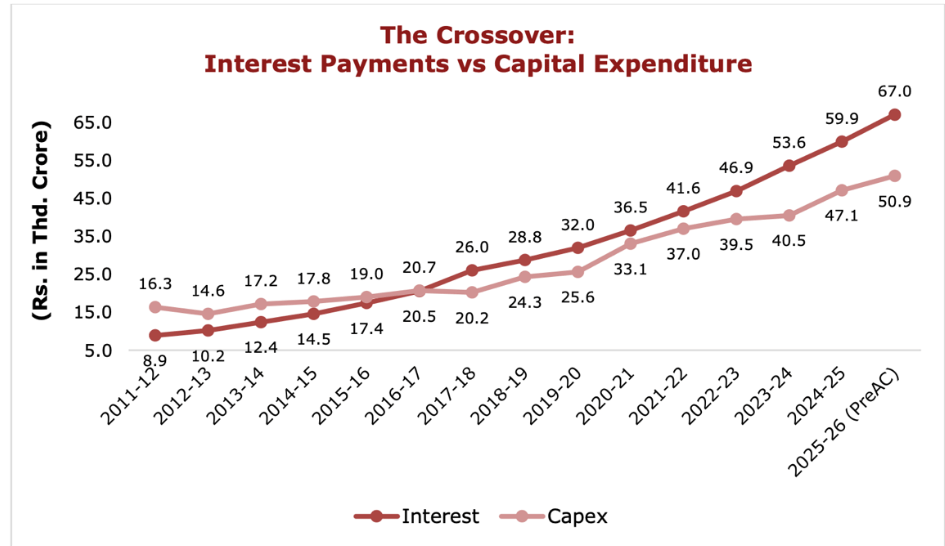
This situation has tangible implications. When debt is used to finance assets, interest payments represent the cost of investment. Conversely, when debt finances consumption, interest payments become a recurring cost that compounds annually, thereby limiting other expenditures. Capital expenditure, constituting 11.8 percent of total expenditure, is the lowest among peer states. Aggregate debt figures tend to obscure that Tamil Nadu is allocating more resources to servicing past debts than to future development.
The own-tax collapse
The most critical finding, which has been largely overlooked in the initial analyses, is the decline in Tamil Nadu’s revenue effort. Reduction in the own-tax-to-GSDP ratio from 5.93 percent to 5.45 percent marks the lowest level in two decades and the most significant decrease among peer states during the same period. Tamil Nadu, previously one of India’s leading revenue mobilisers, has not only declined but has fallen behind states it should be using as benchmarks.
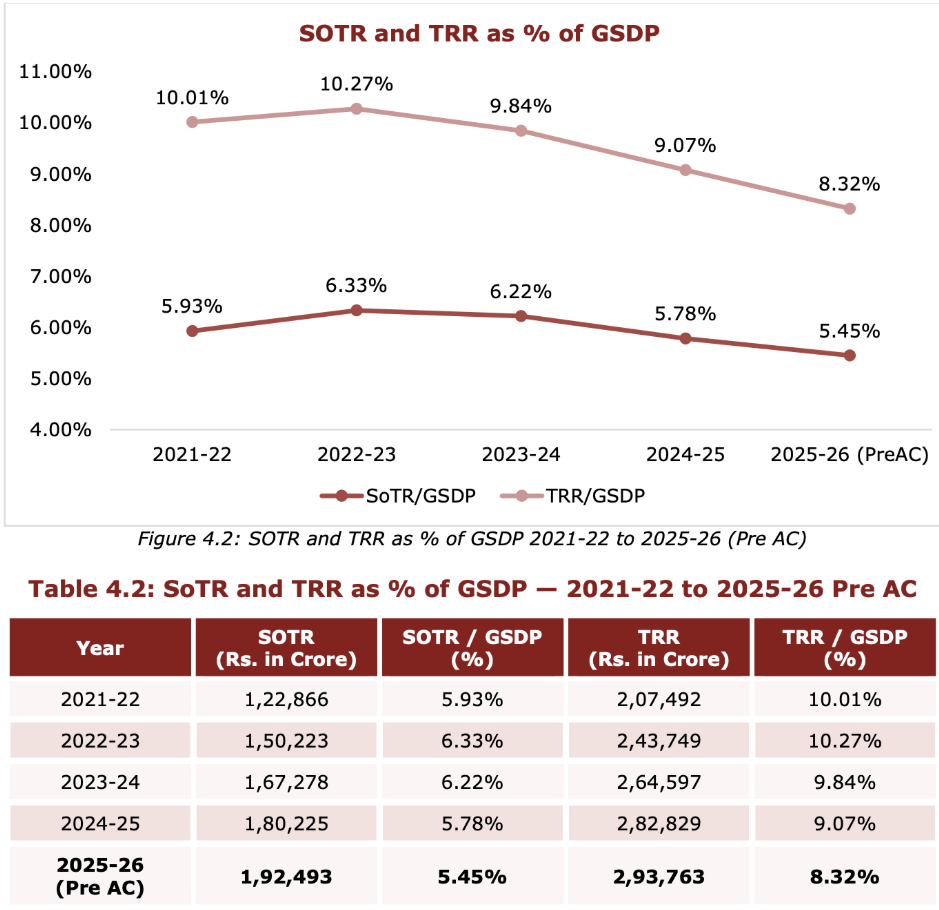
The white paper attributes this decline not to structural economic weaknesses but to administrative deterioration and systemic leakages in areas such as commercial taxes, stamps and registration, excise, and mining. This distinction is crucial. A compromised productive structure necessitates industrial policy interventions, whereas a deficient revenue administration requires enforcement measures.
The Finance Minister’s projection, that addressing these leakages could generate nearly Rs 20,000 crore in additional revenue this financial year, represents the sole optimistic signal of the document.
The TVK government’s initial focus on revenue administration is, therefore, an appropriate strategic decision.
The subsidy trap
Tamil Nadu’s committed expenditure, encompassing salaries, pensions, and interest, increased from Rs 1.25 lakh crore to Rs 1.89 lakh crore during the review period, thereby raising its share of revenue receipts from 60 percent to 64 percent. In contrast, peer states maintain this ratio below 50 percent.
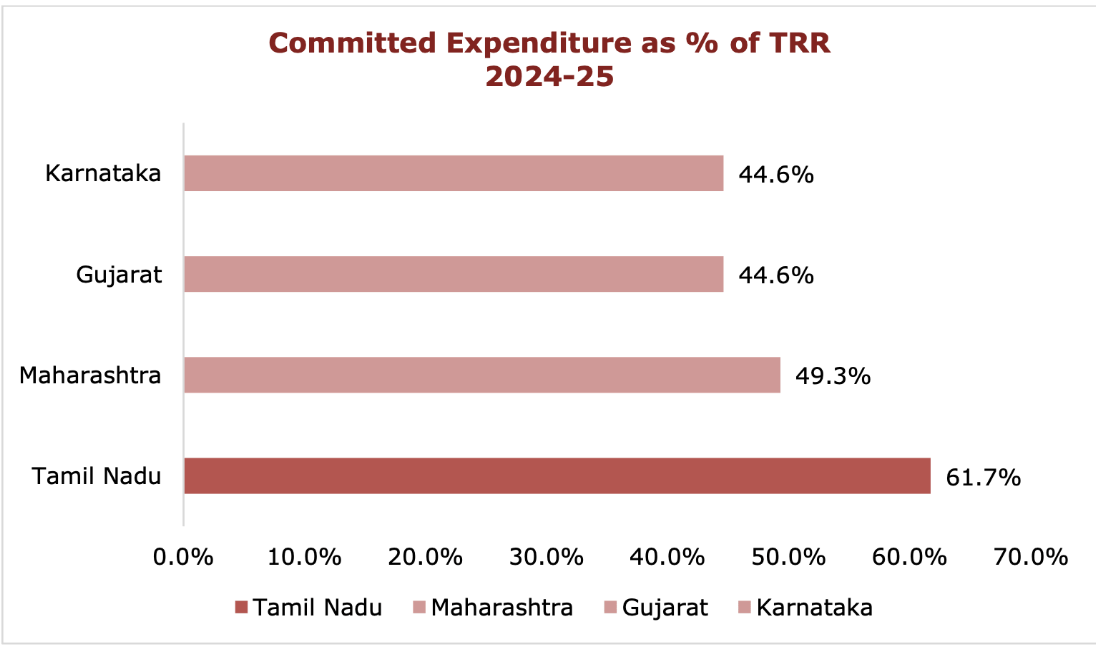
In May, ThePrint identified the expansion of subsidies as an emerging fiscal risk for TVK; The structural pre-commitment issue is already established, even before the introduction of any new welfare schemes.
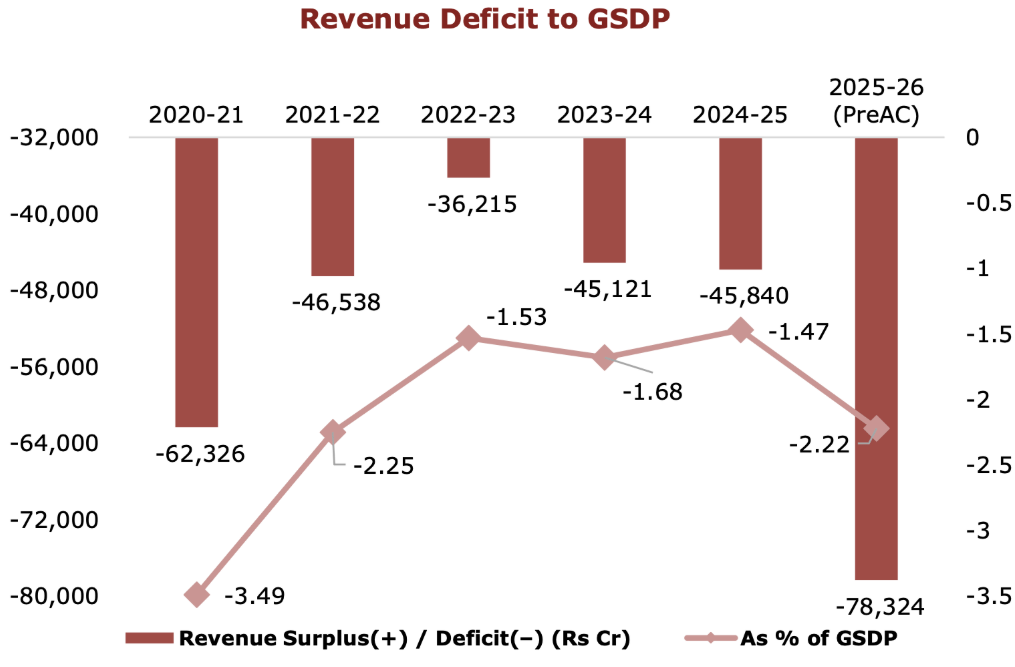
There’s also the revenue deficit of Rs 78,324 crore in 2025-26, which represents 2.22 percent of GSDP, highest recorded in absolute terms, surpassing even the COVID year of 2020-21.
The State is resorting to borrowing to finance current consumption. The TVK platform has provided minimal indication of a reversal in welfare commitments, and no such reversal has been signalled.
The critical question remains whether productive capital expenditure can increase alongside welfare commitments, or if the growing subsidy pressure will impede the infrastructure investment that has been fundamental to Tamil Nadu’s economic success.
None of this undermines the structural advantage ThePrint identified in May. Tamil Nadu’s manufacturing sector, consistently contributing between 22 and 25 percent of GSVA, provides a productive foundation that Kerala and West Bengal cannot replicate. This sector generates tax buoyancy, attracts private investment, and establishes forward linkages to support sustained long-term growth. As a result, the fiscal flexibility available to the TVK government is significantly greater than that inherited by the UDF or BJP in their respective states.
However, an industrial base does not constitute a fiscal strategy; it merely provides fiscal flexibility. The manner in which the TVK government utilises this flexibility, whether by enhancing revenue efforts, restructuring PSU balance sheets, and safeguarding capital expenditure, will determine whether Tamil Nadu’s fiscal position stabilises or continues to deteriorate across all indicators.
The white paper candidly states that rectification will require sustained efforts in revenue mobilisation, expenditure management, PSU reform, and debt management, extending beyond a single budget cycle. That is an appropriate framework. The question is no longer whether Tamil Nadu faces a fiscal challenge; the white paper has confirmed this.
(Edited by Amrtansh Arora)
Also Read: Vijay is set to destroy the old, dominant Dravidianism of Tamil Nadu politics
Nothing to worry. All is well. According to a research officer at Chennai centre of China studies, debt is a sign of growth. Tamil Nadu will become a fully ‘grown’ state soon.