






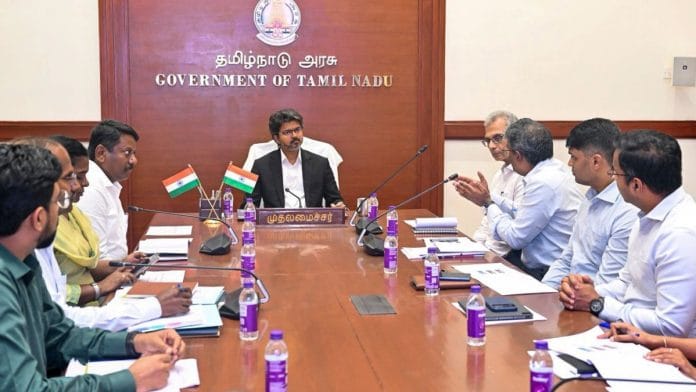


C Vijay Joseph has ushered in what many analysts describe as neo-Dravidian ideology in Tamil Nadu. The century-old Dravidian concept is under siege.
A 27-month-old Tamil Vettri Kazhagam (TVK) has pierced the political dominance of two giants that have towered over Tamil Nadu for the past 72 years—the DMK and the AIADMK. Vijay did it by capitalising on Gen Z’s anti-DMK sentiment and opposition to “Mannar Aatchi”.
Can the sixth or seventh generation of Dravidian leadership stop this further deterioration?
In simple terms, can Udhayanidhi Stalin, representing the latest generation of the DMK, counter the Vijay “tsunami” and the fanfare surrounding a “neo-Dravidian era”, sugar-coated with references to five towering leaders who brought reforms for crores of downtrodden Tamils?
This is a clear indication of a change in track—from the main line to a loop line. Such generational shifts revolve around a new thought process.
In the coming 10 to 15 years, TVK is likely to remain relevant in Tamil Nadu politics. Vijay will try to systematically destabilise the DMK, AIADMK, and district-level caste parties such as PMK, VCK, and NTK. If speculation about BJP leader K Annamalai launching a separate party proves true, it could emerge as a major threat to TVK, apart from Udhayanidhi.
Vijay and TVK are not directly picking a fight with Dravidian ideology. Instead, they are invoking the names of five leaders to shape what I call “Neo-Dravidian Vijayism”.
These leaders are K Kamaraj, EV Ramasamy ‘Periyar’, Velu Nachiyar, Anjalai Ammal, and BR Ambedkar.
While launching TVK in October 2024, Vijay spoke about the party’s anti-caste and secular political ideology. He stated that the party would not separate Dravidian nationalism from Tamil nationalism. “They are the two eyes of this soil,” he said.
Also read: Vijay will rewrite Tamil Nadu politics. Get ready for long-term dominance
How will TVK rewrite Dravidian identity?
My analysis is that leaders from the film world steadily contributed to the fading of the traditional Dravidian model. It is also a story of how Dravidian ideology splintered over half a century.
The Dravidian movement’s parent organisation gave birth to several offshoots—DK, DMK, AIADMK, MDMK, DMDK, and AMMK.
Cinema heroes in Tamil Nadu successfully converted their fan bases into political vote banks and, in the process, led them away from the hardcore Dravidian concept.
They kept alive the torch of social justice and self-respect, and ensured reservations remained as high as 69 per cent for the downtrodden. But they also altered the movement’s course. At times, the Dravidian stock derailed.
In 1972, MG Ramachandran introduced a major twist by proving that a Dravidian leader could also be a devout believer in God. He launched the AIADMK on 17 October 1972 and became Chief Minister in 1977.
Jayalalithaa, another cinema star, entered politics and became Chief Minister in 1991. Her rise gave a 180-degree turn to the Dravidian trajectory. Her charisma sustained her political dominance for six terms until 2016.
In between, another film personality, Vijayakanth, launched the DMDK on 14 September 2005. He attempted, in some measure, to halt the erosion of Dravidian culture.
Now, C Vijay Joseph has taken on MK Stalin’s DMK and challenged seven decades of Dravidian political dominance.
Vijay has offered fresh interpretations of the social justice legacies of Periyar and Ambedkar, ushering in “Vijayism”.
TVK’s accommodation of Brahmins is a significant departure. Vijay appears to have taken a cue from Jayalalithaa, a Vadakalai Iyengar who successfully headed a Dravidian party.
He has given Brahmins ministerial representation, including the sensitive Hindu Religious and Charitable Endowments portfolio. He has also entrusted eight Dalits with important ministries.
How did Dravidianism get diverted?
First, Gen Z. Second, Artificial Intelligence. Third, dynastic control over Dravidian identity. Fourth, corruption allegations. Fifth, the failure of ageing leaders to attract youth into the self-respect movement.
Over the past two decades, challenges to the sustainability of the Dravidian stock have intensified. Digitisation, Artificial Intelligence, virtual reality, and other technological shifts have transformed the aspirations of the youth. Tamil Nadu has entered a new era in which Gen Z increasingly shapes political discourse, whether for better or worse.
Generation Z is generally defined as people born between 1997 and 2012. In 2026, they are roughly between 20 and 30 years old.
In 1916, Tamil Nadu witnessed the rise of the Justice Party (officially known as South Indian Liberal Federation), which evolved from a social movement into a dominant political force after the mid-1960s.
Periyar championed anti-upper-caste politics, state autonomy, women’s empowerment, and at times even separatist ideas. The Dravidian movement entered a new phase in 1967 when CN Annadurai softened some of the Justice Party’s core doctrines and adopted a more pragmatic path to political power.
C Rajagopalachari, a Brahmin and right-wing leader, foresaw the rise of the DMK and aligned with it to help dislodge the Congress. That alliance enabled the Dravidian movement to taste political power. From 1967 onward, Dravidian politics began moving away from some of its original ideological positions while enjoying the benefits of governance.
That marked the first step in the fading of hardline Dravidianism.
Karunanidhi then emerged as the central figure of the movement. Public discontent over alleged corruption and family dominance eventually created space for MGR, who launched the AIADMK in 1972 and dropped atheism from the Dravidian political framework.
MGR swept Tamil Nadu and became the unchallenged leader of a new Dravidian model.
The political developments of 1972 and 1989 may now be witnessing a parallel in 2026.
Today, no towering leader is visible who can regroup the various Dravidian splinter organisations under a single banner and halt the further fading of the Justice Party and Periyar legacy.
That legacy is certainly entering a danger zone. The attraction of digitisation, Gen Z aspirations, and Artificial Intelligence is steadily pulling younger generations away from traditional ideological movements.
TVK leader Vijay seems to be on the path to occupy the vacuum in the social justice space by promoting a “Neo-Dravidian Vijayism”.
R Rajagopalan is a veteran journalist and a political analyst. He tweets @RAJAGOPALAN1951. Views are personal.
(Edited by Prashant Dixit)
Good on him.