






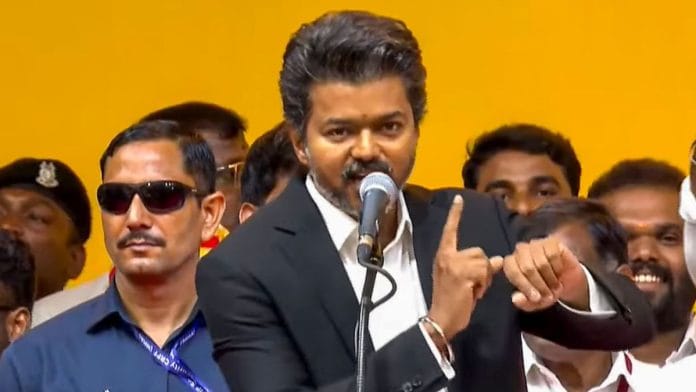


C Joseph Vijay is playing the long game. He has started his tenure as Tamil Nadu’s Chief Minister well, and everything suggests he could remain in power for at least two terms, if not more.
Vijay will prove his relevance in Tamil Nadu politics and establish the mettle of Tamilaga Vettri Kazhagam (TVK). The ‘whistle’ symbol, which overshadowed the DMK’s Rising Sun symbol, may remain politically powerful for the next ten years.
The Tamil Nadu poll results reflect young voters’ anger against what they saw as the scam-ridden misrule of the MK Stalin government.
TVK secured close to 35 per cent vote share. Nearly one-third of Tamil Nadu voters appeared disillusioned with the DMK government. The DMK failed to win a single seat in 11 districts. AIADMK failed to make an impact in nine districts. At the same time, TVK’s victory was not a complete tsunami either, since it failed to win in eight districts.
The backbones of the DMK and AIADMK have been shaken. Unless a political miracle occurs, both parties will struggle to revive themselves over the next five years. Tamil Nadu has undergone a generational political shift.
Vijay will now have to consolidate this victory in the civic polls expected by December 2026.
In just 27 months, he transformed his cinema fan clubs into a political movement called “Vijayism”. The TVK leader comes across as a deep, calm and composed personality. He has given Tamil Nadu political freedom from the dominance of the two Dravidian parties: the DMK and AIADMK. Just as 2014 saw the rise of the slogan “Congress-mukt Bharat”, 2026 may be remembered by Vijay supporters as the beginning of a “Kazhagam-mukt Tamil Nadu”.
Vijay borrowed a famous phrase once used by Jayalalithaa to describe the DMK as a “maligned force”. He was also smart to ensure that three Brahmins entered the Assembly, with one becoming a minister. This sent a signal to the upper-caste group, causing some upper-caste votes to shift away from the BJP and Congress.
In the run-up to the 2029 Lok Sabha election, Vijay currently has no major challenger in Tamil Nadu politics.
Also read: Why Tamil Nadu 2026 election is going to produce a hung Assembly
DMK confusion and the new opposition space
Tamil Nadu voters elected 108 TVK MLAs, allowing the party to cross the halfway mark. But before Vijay was sworn in as Chief Minister, several alternative political formulas were floated.
One proposal involved DMK support for AIADMK leader Edappadi K Palaniswami as Chief Minister. Political feelers were reportedly exchanged, but the move failed.
Another proposal suggested Viduthalai Chiruthaigal Katchi leader Thol Thirumavalavan as a compromise chief ministerial candidate. But that idea also faded quickly.
Ultimately, Vijay had to make repeated visits to Lok Bhavan to convince Governor Rajendra Arlekar before finally receiving the invitation to form the government.
At one stage, Vijay was reportedly so frustrated by political manoeuvring that he even considered asking all 108 MLAs to resign and force a re-election.
Interestingly, even before the election, I had predicted in my earlier column in ThePrint that the Tamil Nadu verdict could produce a hung Assembly because of the deep fragmentation in the state’s political mood. The post-result manoeuvring by rival parties and the last-minute search for alternative chief ministerial formulas showed how close Tamil Nadu came to political uncertainty.
Why did Stalin suddenly say that TVK won because of Instagram and social media influence? If that was the case, why did the DMK rely so heavily on political consultants and survey agencies to read public mood and manage media strategy?
Sabarisan Vedamurthy, founder of the political consultancy PEN and Stalin’s son-in-law, later said it was an “oversimplification” to blame the strategy unit alone for the DMK’s defeat.
At the same time, DMK Parliamentary Party leader Kanimozhi said the party should strengthen itself enough to win independently in the future instead of depending entirely on alliances. Her letter to Lok Sabha Speaker Om Birla seeking separate seating for the DMK benches was also seen as a sign of political distancing from the Congress.
Also read: ‘Jana Nayagan’ projects Vijay as the future CM of Tamil Nadu. That’s the problem
The next 100 days of Vijay
The next three months — the political equivalent of the first hundred days in Tamil cinema language — will be crucial for Vijay. He will have to settle down as Chief Minister and politically neutralise attempts by rivals to destabilise him.
He now faces the Tamil Nadu Assembly, where he will put many of his poll promises into practice through his first budget.
He may take tough decisions against some senior DMK leaders facing corruption allegations. He has already received political momentum from developments such as the Enforcement Directorate seeking prosecution against DMK minister Senthil Balaji. Balaji also remains under the CBI scanner in connection with the Karur stampede in which 41 people lost their lives.
At the same time, Vijay seems to understand that confrontation with the central government will not help him politically in the long run. His political approach has been measured and strategic. He wants to work with the system and secure long-term political space for TVK.
Vijay is expected to meet Prime Minister Narendra Modi this month. Besides Modi, he is also expected to pay courtesy calls on President Droupadi Murmu, Vice-President CP Radhakrishnan, Home Minister Amit Shah, Finance Minister Nirmala Sitharaman and possibly Sonia Gandhi as well.
Modi may advise Vijay on Tamil Nadu’s fiscal situation and on how the state economy has been handled over the years. With nearly 25 years in politics, first as Chief Minister of Gujarat and then as Prime Minister, Modi may also share political lessons with the new Tamil Nadu Chief Minister.
Vijay’s meetings with businesspersons also suggest that he wants to push economic growth and development to the forefront of his government’s agenda. He has shown the ability to survive political pressure and hit back strongly against opponents. He carefully planned the launch of TVK and successfully translated his cinema-style popularity into a political movement.
But his rise was also accompanied by controversies. The Karur stampede cast a shadow over his political campaign. Opponents also targeted his personal life and relationship with his wife Sangeetha. Even his latest film Jana Nayagan remains unreleased. And on polling day, a sudden bus transport strike stranded lakhs of young voters across the state.
Also read: Tamil Nadu politics is fracturing. Vijay entry can shake things up
What kind of leader will Vijay become?
Whichever way one looks at Tamil Nadu’s evolving political situation, Vijay faces difficult tasks ahead. He must maintain balance between Left parties, Congress and splinter groups emerging from AIADMK.
Vijay has the image of PV Narasimha Rao in the way he quietly observes situations before reacting. But once he settles into office, he may evolve into a more assertive leader like PM Modi.
Vijay wants to bring major changes to Tamil Nadu and transform the state into one that competes economically with Maharashtra and Gujarat.
His decision to skip Congress leader and Kerala Chief Minister D Satheesan’s swearing-in ceremony signalled careful political balancing. Moreover, he is still trying to understand how the BJP will view TVK in the coming years.
At the same time, Vijay wants the path open to move closer to the INDIA bloc in the future. TVK may eventually support the projection of Rahul Gandhi as the Opposition’s prime ministerial face in 2029.
Before that, Vijay faces another major political question. In 2027, will TVK support a Tamil Nadu leader as a successor to President Droupadi Murmu?
Having accepted Congress support and inducted two Congress ministers into his government, Vijay will also have to remain politically alert.
He should not become a replica of Arvind Kejriwal. His supporters instead want him to emerge as the MGR or Jayalalithaa of 2026.
R Rajagopalan is a veteran journalist and a political analyst. He tweets @RAJAGOPALAN1951. Views are personal.
(Edited by Prashant Dixit)
This writer is blatantly biased and at the same time completely confused.. He knows nothing about TN and political scenario of the state. And it is evident that he draws inferences from WhatsApp. Vijays party s name is Tamilaga vetri kazhagam. If they want TN to be Kazhagam mukt TN…it’s suicidal ain’t it?