





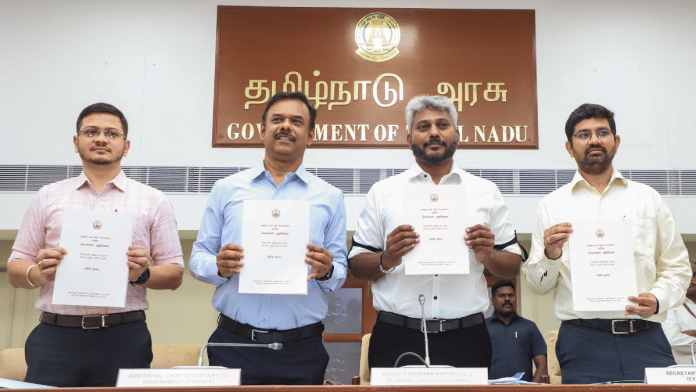

Chennai: The TVK government in Tamil Nadu on Tuesday released a White Paper on the state’s fiscal management in the five post-COVID years of 2021-22 to 2025-26, showing the fiscal deficit widened, liabilities increased and the per capita debt burden doubled to more than Rs 1.28 lakh under the DMK rule.
Correcting the “trajectory will require a long, gruelling effort”, says the document—titled White Paper On The Fiscal Management of Tamil Nadu: An Examination of Public Finances, 2021-22 to 2025-26—released by Finance Minister N. Marie Wilson at a press conference.
Issuing a white paper on the state’s finances was among the first announcements made by Chief Minister C. Joseph Vijay upon assuming office last month.
Wilson said the document presents a transparent, evidence-based account of the state’s public finances and does not shy away from uncomfortable conclusions.
The findings point out that policy and administrative choices made over the period under review added to the state’s debt.
The DMK dismissed the document as an excuse by the TVK to not implement its pre-poll promises. “The timing of this White Paper is to divert attention from the worsening law and order situation,” DMK spokesperson Saravanan Annadurai said.
The paper highlighted that the state’s outstanding liabilities nearly doubled from Rs 5.13 lakh crore at the end of 2020-21 to approximately Rs 10 lakh crore by 2025-26.
Responding to this, Annadurai said, “What they are omitting to mention, or the fact that they are not deliberately highlighting, is that the GSDP of the state has also grown from Rs 20 lakh crore to Rs 40 lakh crore. When you look at that parameter, you should not look at absolute numbers.
“You should look at that with reference to the GSDP, the percentage. The percentage is still within the percentage recommended by the 15th Finance Commission,” he told ANI on Tuesday.
The report states that per capita liability now stands at around Rs 1,28,934.
“Tamil Nadu now carries among the highest per capita liability figures of the large States. In 2021-22, Tamil Nadu’s per capita liability stood at Rs 77,819— already the highest among the peer group—and has risen to Rs 1,28,934 in 2025-26, a Rs 51,115 increase per resident in five years. A child born in Tamil Nadu in 2025-26 carries a per capita debt burden which is far higher than in peer group States,” says the White Paper.
By contrast, Karnataka’s per capita liability stands at Rs 1,11,375, Gujarat’s at Rs 70,798, and Maharashtra’s at Rs 77,569 in 2025-26.
The revenue deficit reached a record Rs 78,324 crore in 2025-26, equivalent to 2.22 percent of GSDP. This figure surpasses the COVID-affected 2020-21 level and rose from Rs 46,538 crore in 2021-22, according to the White Paper.
The White Paper characterises this deficit as structural, as the State’s Own Tax Revenue (SoTR) as a percentage of GSDP declined from 5.93 percent in 2021-22 to 5.45 percent in 2025-26, the lowest in the state’s history.
The report pointed out that the interest payments have risen sharply from Rs 41,564 crore in 2021-22 to Rs 67,050 crore in 2025-26. These payments consume about 22.8 percent of Total Revenue Receipts and over 34.8 percent of the state’s own-tax revenue.
The paper indicates that for the first time, interest outlays exceed capital expenditure signaling that the state is spending more on servicing past debt than on building future assets.
The White Paper argues that the three benchmark states—Karnataka, Maharashtra and Gujarat—treated the post-COVID economic recovery as an opportunity to bring their debt-to-GSDP ratios down, but Tamil Nadu did not.
While Gujarat has consolidated to a debt-to-GSDP ratio of 17.6 percent and Maharashtra to 19.7 per cent, Tamil Nadu’s ratio has remained in the 27–29 percent range throughout the period, standing at 28.3 per cent in 2025-26.
The paper stated that the committed expenditure in the form of salaries, pensions, and interest has climbed to 64.4 percent of Total Revenue Receipts, up from 60.4 percent, while the capital expenditure fell to 1.44 percent of GSDP. Outstanding government guarantees nearly tripled to Rs 1.79 lakh crore.
Also Read: At NITI Aayog, Vijay lays out TN development agenda—raises NEET, funds, youth skills & infra demands
Fiscal deficit
The fiscal deficit has remained above the 3 percent ceiling prescribed under the Tamil Nadu Fiscal Responsibility Act in every year of the post-COVID period. It stood at Rs 1,33208 crore or about 3.77 percent of GSDP in 2025-26. It is the highest level on record in the state so far, according to the White Paper.
During the post-COVID period, the deficit showed only modest narrowing in the middle years before widening again. Before the pandemic, up to 2019-20, Tamil Nadu generally managed fiscal deficits closer to or under 3 percent, though pressures were building.
The 2020-21 COVID year saw a sharp spike to around 4.91 percent due to emergency spending and relaxed norms on expenditure. The paper highlights that post-2021 recovery failed to restore prudence, leading to the current elevated levels.
The 2021 White Paper
The 2021 White Paper, presented by then newly sworn-in DMK government, highlighted fiscal stress inherited from the prior AIADMK regime, including high debt, revenue shortfalls, and power sector losses amid the COVID crisis.
It cited a revenue deficit of around Rs 61,320 crore and a fiscal deficit exceeding 4 percent in the financial year 2021, saying the new government was taking over a challenging situation with promises of reform.
Five years later, the current White Paper argues that conditions have deteriorated further with several metrics including debt stock nearly doubling, the absolute revenue deficit hitting new highs, and own-tax effort dipping.
The paper attributes ongoing issues largely to policy choices, revenue leakages, and administrative challenges while acknowledging the one-time nature of the pandemic shock.
The White Paper’s assessment of the coming financial year is optimistic with state Own Tax Revenue projected to grow at 19 percent, but the actual growth rate in the preceding two years was just 6.8 and 7.7 percent, respectively.
The White Paper calls this “clearly unrealistic” and estimates that even with an optimistic 12 percent growth assumption, the revenue has been over-projected by around Rs 14,000 crore.
The Interim Budget projects a revenue deficit of Rs 48,696 crore for 2026-27. The White Paper’s business-as-usual reckoning puts it at roughly Rs 90,500 crore, which is nearly double. Similarly, the budgeted fiscal deficit of Rs 1.22 lakh crore is expected to surge to around Rs 1.64 lakh crore.
The document states, “The situation is very bleak, in the short run this year, and also in the medium run in the next five years.”
It adds, however, that the situation is not hopeless, pointing to revenue leakages and corruption in tax-collecting departments as areas where gains can be made without changing tax rates, and to procurement reforms that could reduce expenditure.
The document also calls for disciplined revenue mobilisation, expenditure rationalisation, PSU reforms, and corruption-free governance.
(Edited by Ajeet Tiwari)
Also Read: Vijay is set to destroy the old, dominant Dravidianism of Tamil Nadu politics