







Penukonda, Andhra Pradesh: For decades, the NH-44 Penukonda stretch connecting the tech capitals of Hyderabad and Bengaluru was little more than a stop for refuelling and a cup of tea at a tin-roofed stall.
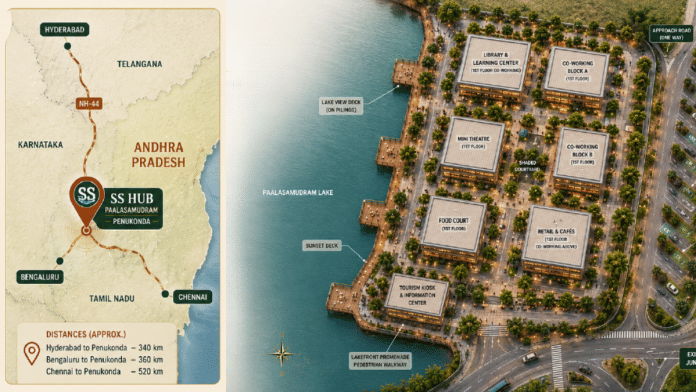
But now the Andhra Pradesh government is looking to transform this portion of the NH-44 highway, flanked by thorny trees, by developing what it says is the country’s first government-led co-working space in Palasamudram village in Penukonda mandal.
The proposed SS Hub, which combines modern corporate workspaces with the area’s natural landscape, will come up near the scenic 120-acre Palasamudram Lake in Sri Sathya Sai district next to a major national training hub on the Bengaluru-Hyderabad expressway.
The government has prepared a blueprint for a lakeside co-working complex to serve a fast-growing industrial corridor. The initiative also aims to reduce the migration of skilled youth by creating opportunities for them closer to home through a start-up ecosystem.
The SS Hub, estimated to cost Rs 10 crore, is part of the state’s Neighbourhood Work Space (NWS) policy, which aims to develop shared, professionally managed infrastructure to reduce setup costs and ensure reliable connectivity.
Under the policy, the SS Hub plans to nurture a start-up and entrepreneurial ecosystem through a structured mix of financial subsidies, collaborative infrastructure, and market integration.
According to the government’s NWS policy, many individual workers and small businesses face high costs to set up professional workspaces, including expenses for furniture, IT equipment, and internet connectivity.
“Often, they lack access to basic office infrastructure like high-speed internet, dedicated desks, and meeting rooms. Without a shared, professional environment, opportunities for collaboration, networking, and skill development are also limited,” it says.
The NWS policy aims to address these gaps.
“To lower entry barriers, district youth and regional start-ups will receive free or nominal co-working access for their first three months,” a district official said.
A. Shyam Prasad, collector of Sri Sathya Sai District, told ThePrint that in addition to Kia and 25 ancillary automobile units already in the area, six large government-led and private defence establishments are coming up in the district.
Penukonda has already established itself as a growing logistics and manufacturing hub.
Penukonda, the historic town that served as the secondary capital and strategic military stronghold of the Vijayanagara empire after the fall of Hampi, has been the South Korean automobile giant Kia Motors’ India manufacturing headquarters for a while now.
Anchored by Kia, which set up its manufacturing plant in 2017, the area has not only drawn an ecosystem of specialised auto-component suppliers but also rapidly transformed the rugged, rocky terrain into an automobile township.
“When we found that our students graduating from different technical courses were choosing to stay and find employment in these companies, we saw a need for creating a co-working space,” said Prasad.
The six defence units, combined with Bharat Electronics Ltd’s upcoming facility in Palasamudram, are expected to create more than 25,000 jobs in the region.
In addition, with three national highways connecting Bengaluru, Vijayawada and Chennai coming up, many infrastructure firms have expressed interest in developing the space.
“So far, the Kia ecosystem requires its engineers and floor staff to work on its shop floor and assembly areas. But with defence industries and hospitality companies setting up shop, we see the need for enclosed spaces to work from,” said Nagakumar, the Zonal Head of the Andhra Pradesh Industrial Infrastructure Corridor (APIIC).
He added that the government expects many employees to travel daily from Bengaluru to Penukonda, as it is expected to take a little over an hour to drive from the Bengaluru airport to Palasamudram once the expressway is ready.
Also Read: India’s Silicon Beach: As Bengaluru sputters, a new IT haven is taking shape on Karnataka’s coast
Lakeside project
Given its unique location between a rapidly expanding industrial zone and a major transport corridor, district authorities said that the project will combine the Andhra Pradesh chief minister’s focus on “ease of living” with the “ease of doing business”.
The new lakeside development’s masterplan outlines an integrated campus that will combine modern working spaces and collaborative conference rooms with retail zones and vibrant dining arenas.
“We will create premium lake-view decks, offering professionals an inspiring environment to create, innovate, and network. But what would really set this government initiative apart from standard commercial real estate projects is its deliberate focus on local youth and grassroots entrepreneurs,” said Shyam Prasad.
While the co-working spaces would offer professional networking opportunities for people with technical qualifications, the government is keen for the SS Hub to act as an incubator for the district’s homegrown talent.
The government has already started a small training facility for students and local youth in Kadiri, a town and revenue division an hour from Penukonda.
Besides training students for competitive exams, the district administration is also teaching them how to run businesses, officials said.
“One of our students who is a graduate is already running a cafeteria and earning a lakh a month. We are also exploring the idea of growing mulberry farms for our students who have completed their PG course in sericulture,” said Dr S. Smitha, principal of the STSN Government Degree College.
With the government institution being the only one offering a postgraduate programme in sericulture, graduates have relocated to Bengaluru for employment at the Central Silk Institute and the Silk Board in Bengaluru.
“To lower the barrier to entry for early-stage innovators, the hub’s self-sustaining operating model includes a powerful mechanism: local youth and district startups will receive entirely free or highly subsidised co-working access for their first three months of operations,” a district official involved in the hub’s planning told ThePrint.
“This crucial runway allows local digital nomads, freelancers and small businesses to launch, collaborate and scale their ideas without the crippling burden of upfront overhead costs,” the official added.
He said the larger goal was to ensure rural entrepreneurs were equipped to “draw business to themselves by plugging into economic networks rather than relocating to urban areas”.
Branding opportunities
The state government is looking to bring brands such as Third Wave Coffee and California Burrito to set up shop at the co-working hub.
A ‘Community Marketplace’ will also be developed for regional artisans, local self-help groups (SHGs) and regional entrepreneurs to sell their products.
The district administration hopes to draw highway traffic to Penukonda, which lies between the historical and cultural towns of Lepakshi and Dharmavaram, known for their handicrafts, leather lampshades and silk sarees, and bring business to the surrounding villages.
The state is also inviting the corporate sector to participate through a structured Corporate Social Responsibility (CSR) and sponsorship programme.
The government plans to provide naming rights and logo placement opportunities for seven blocks through CSR and brand sponsorship agreements.
Akin to city metro rail corporations, which sell station co-branding and naming rights to companies to generate non-fare revenue, SS Hub blocks include the library, a co-working block, an EV charging plaza, an artisan market, a lakefront deck and a children’s zone.
The project will be developed in three phases, with the first expected to begin in mid-2027, the collector said.
He added that the government was appointing the Industries Department as the absolute nodal agency to oversee all planning, fast-tracked approvals, and cross-departmental coordination to streamline implementation.
(Edited by Sugita Katyal)