



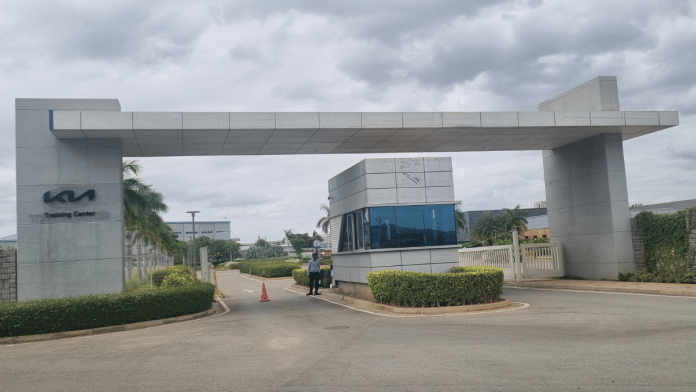
Penukonda, Andhra Pradesh: Situated in Andhra Pradesh’s Sri Sathya Sai district, Penukonda, the historic town that served as the secondary capital and strategic military stronghold of the Vijayanagara empire after the fall of Hampi, has been the South Korean automobile giant Kia Motors’ India manufacturing headquarters for a while now. More than 800 cars roll out on a given day, heading across India and the world.
Amid these architectural remnants, circumferenced by Sri Krishnadevaraya’s fort to the right and the Big Granite Hill (Penukonda in Telugu) to its left, stands Kia Motors and the 25 ancillary units in nearly 1,100 acres of the Gudipalli and Ammavarupalli Industrial Park (AIP).
Anchored by Kia which set up its manufacturing plant in 2017, the area has not only drawn an ecosystem of specialised auto-component suppliers but also rapidly transformed the rugged, rocky terrain into an automobile township.
Towering assembly plants and expansive metal-sheet warehouses feature tens of orange and yellow robotic arms moving in perfect, fluid choreography as workers watch over the Seltos, Sonnet, and Karens step onto multi-car carrier trucks, forklifts, and automated guided vehicles (AGVs).
But this automobile township is not just a powerhouse of heavy industries. Amidst the robotic synchronicity and the sea of new vehicles, at Penukonda, entire communities, both Indian and Korean, have built their lives around the cars.
It is where the layered, vertical, Korean Hangul script blends with the graceful, looping, and circular appearance of the Telugu script. It’s where the fiery aroma of Rayalaseema spice fuses seamlessly with fermenting Kimchi and Guksu and Myeon (Korean noodles) and steaming hot dosas get loaded on food trucks for eat-on-the-go workers.
Some other unmissable cultural imports include the K-Beauty phenomenon where brightly lit cosmetic stores such as Seolful and Seoul Centre have become every tourist’s hotspot and K-Pop album postcards that hang at these store entrances.
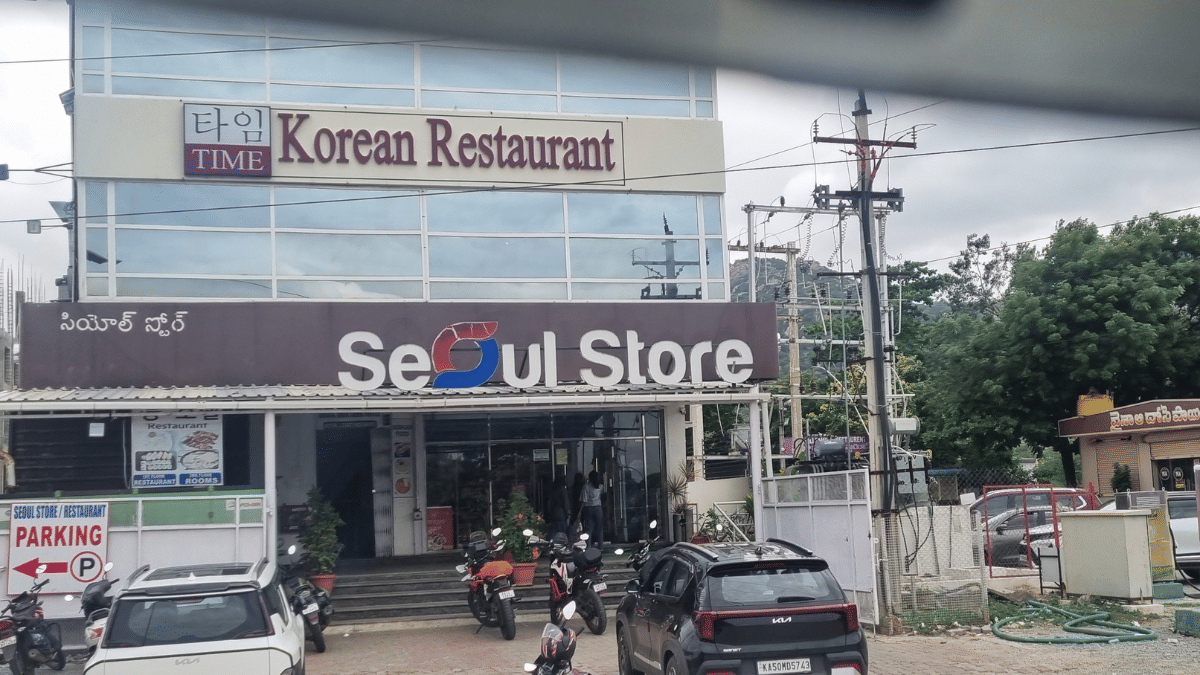
That Rajesh Akula and his friend Kiran Adipalli, in their early twenties, who ferry locals in their autos, dream of owning a Kia car shows how deeply the Korean major’s arrival has impacted them. While they still cannot distinguish the difference between North and South Korea, it is Korea, not the US, that is their new “foreign” hype.
Penukonda, which was earlier part of Anantapur district, is on its way to transform gradually into a vibrant ‘Little Korea’, mirroring Singapore’s iconic ‘Little India’.
As South Korean engineers and executives rub shoulders with local youth, specialised Ro-Ro trucks line roads that were once dotted by tractors, creating a unique cultural oasis where high-tech automotive precision meets deep East Asian heritage. Kia’s arrival has almost rewired the soul of rural Andhra.
The economic pivot: local entrepreneurs
For the native business communities of Penukonda, Puttaparthi, and Anantapur, the presence of these factories came as an economic lottery ticket, rewriting the rules of local business.
Rangula Keshaviah, the owner of a three-storey building, used to live in Settipalle, a small village off the Penukonda main road. As the demand for housing for tens of thousands of workers increased, he decided to rent his building and move to Puttaparthi.
“Here, in Puttaparthi, I can get a house on rent for less than Rs 15,000. Although my family of eight members initially complained about moving away from our village, we are now living better with our rental income of Rs 45,000,” he told ThePrint.
Keshavaiah’s modus operandi has been tested successfully by scores of villagers with land and houses in and around Penukonda. People from Mavaturu, Munimadugu, and Settipalle have taken to supplying household goods, gas cylinders, and other essentials required by the blue-collar and white-collar workers in these factories.
B Raghavulu, whose family used to work at one of the granite quarries in the Gorantla mandal, has now become a vendor for Sungwoo Hitech AP, which manufactures high-tensile automobile body parts and structural assemblies for Kia.
“It took me a few years to learn the ropes and understand how the supply chain and stocking for essentials work. But repeated trips to Anantapur and Bangalore have helped me establish wholesale vendor relationships. I am now earning steadily,” Raghavulu said, looking at his hands that once handled machines to slice black granite slabs.
Tirupati Reddy, a building contractor who undertakes work for the government, said he was tasked with housing 5,000 people overnight. And unlike other parts of Andhra Pradesh and India, where the demand for farmland is met with protest and rejection, farmers who were growing two crops have abandoned dryland agriculture to become vendors.
Reddy’s wife runs an Indo-Korean stationery-cum-clothing store, selling wares for the women who work at these factories.
To house the incoming wave of expatriates and senior employees, a dedicated 12.6-acre Korean township was carved out along the highway. The residential core comprises 16 complexes housing over 82 modern residential buildings. Fully manicured landscapes, self-contained community centers, and recreation parks dot the highway, where wild shrubs once stood.
Local developers such as Tirupati Reddy also helped transform entire apartment complexes into specialised expat housing. He hired property managers who in turn hired Korean-speaking facilitators and put up marketing signs written entirely in Korean script to help families settle seamlessly.
Picture this: Kia alone employs 12,800 people, with at least a fourth of them being women. “From pins to uniforms, and Kawai (cute in Korean) office stationery, I have learned to stock what the Koreans and Indians working in these factories prefer,” says Shyamala Reddy, who buys supplies from YoungOnion, a website that stocks only Korean products, or Kesar Stationery in Chennai that stocks Korean stationery and merchandise.
Sanitation fixtures and smart home panels, noticeably shipped directly from South Korean brands like Daelim Bath, are stacked in neat cardboard boxes in the store next door.
Hundreds of such stories make for the astonishing economic makeovers in this region where locals have completely pivoted their livelihoods alongside Indian engineers who now navigate fluent corporate Korean.
A.Shyam Prasad, collector and district magistrate of Sri Sathya Sai District, described why he anticipates a four-fold increase in housing requirement in the coming years.
“Six defence projects are coming up over the next couple of years in our district. With defence being a highly technically skilled field, I anticipate a housing and hospitality boom here,” he told ThePrint.
With three key highways to Chennai, Bengaluru and Vijayawada passing through the district, he says land prices and quality of living are expected to skyrocket.
“We are already readying ourselves for a big economic overhaul of our district. Our government is spending more than Rs 30,000 crore for irrigation projects and drinking water facilities in the state to revitalise the step-wells and reservoirs,” the collector said.
From roadways to water and sanitation, the district administration wants to ensure the sites are industry-ready. While historically dependent on localised step-wells, modern Penukonda relies heavily on the Gollapalli reservoir, which channels vital water resources from the Krishna and Godavari rivers via the Handri-Neeva Sujala Sravanthi (HNSS) canal system to sustain the dry region.
Puttaparthi and Penukonda are under 150 km from Bengaluru, just off NH 44, making these towns an ideal location for setting up industries. Currently, Kia’s cars are being exported from the Chennai Port. But once the Penukonda-Vijayawada highway is made and the under-construction rail overbridge is ready, the factory-line of cars will be ready to be shipped from ports in Andhra.
Also Read: Why pro-investor AP, Telangana missed ‘top performers’ tag by a mile in NITI Aayog’s IFI rankings
Corporate faces of the fusion
Off the streets and town squares, the 1,100-acre automobile park and the Kia Township for senior employees are naturally fortified by the formidable hills.
The 25 ancillary units established to support the Kia India manufacturing plant in Penukonda employ an estimated 5,000 to 6,000 workers. While this figure represents direct employment within the supplier network, combined with the core Kia facility (which employs over 12,000 workers directly and via contractors), the auto cluster has significantly driven the region’s economy.
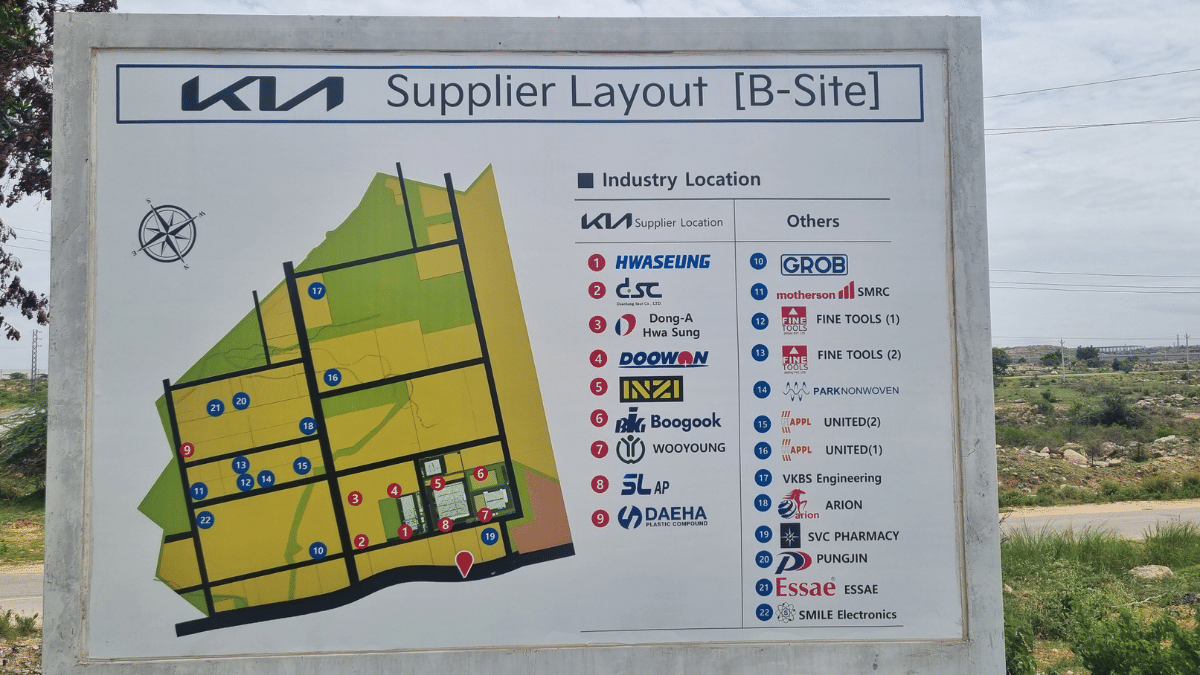
For Subhanjali Reddy, an employee at Faurecia Interior Systems, and her husband Pawan Kalyan Reddy, who works at Doowon Climate Control, their lives revolve around the Kia cluster.
As an engineering graduate, she moved to Tirupati after her wedding and was doing odd jobs. “Since the factories came up at Kia, I wanted to work closer to my parents, who also needed help with their poultry business.”
Subhanjali works at Faurecia, which assembles premium passenger cabin instrument panels and dashboards for Kia and Hyundai Mobis. Her husband, who is at Doowoo, works on the shop floor as a Supervisor, helping in the assembly line manufacturing of passenger comfort systems including HVAC modules and air conditioning lines.
For the nearly 20,000 on-site employees, Kia and the 25 industries, which have become the nucleus of their lives, and for Penukonda, a rigorous training programme was designed to sensitise them to industry work culture.
DG Sudeendra, CEO of Fine Tools India, which hires 500 people at their factory, told ThePrint that he had to train workers “from scratch”.
“From time sensitivity to dressing sense and communication to developing the required skill sets, it was almost a Pygmalion-like transformation that we have achieved in the past five to eight years.”
During the initial years of Kia’s operations, these plants were outnumbered by Koreans. Kia and its ancillary units could not have waited for the locals to be trained, Suddendran said. So, the factories depended on workers and engineers from Tamil Nadu, where the workforce was trained and had experience working in Nissan, Ford, and Hyundai factories.
In the years thereafter, the Andhra Pradesh government established ITI and Diploma centres at Anantapur and Penukonda to ensure there was higher productivity and better skills for the local youths.
Local villagers who had exposure to the Koreans, were also sensitised about their customs and culture. Reports by locals indicate that early cultural friction did lead to minor controversies regarding exclusive entry at certain expat guest houses, but local administrative interventions smoothed over relations.
To iron out such differences, Rajiv, the Human Resources Head of Sungwoo Hitech, who has been with the firm since its inception, has been at the forefront of many training programmes.
Along with his peers and counterparts in the cluster, he has helped the nearly 20,000 employees merge Indian and Korean culture seamlessly. “A unique class of Indian professionals has emerged—they have masterfully integrated into the disciplined South Korean corporate culture. If Telugu is their baseline language, we have helped them pick up corporate English in six months and conversational Korean in three months,” he told ThePrint.
To help many more employees break the language barrier, the government directed the Sri Krishnadevaraya University (SKU) in Anantapur to run a professional course in Korean. In collaboration with the Andhra Pradesh State Skill Development Corporation (APSSDC), SKU introduced low-cost, certificate-based Korean language training programmes. Priced accessibly at around Rs 3,000 for a three-month course, these basic and intermediate modules have never had to advertise hard for admissions.
The momentum generated by SKU corporate training has also fed into other regional institutions, such as the RDT Professional School of Foreign Languages in Anantapur, which prepares local youth for standard examinations like TOPIK (Test of Proficiency in Korean).
Pradeep Kumar, a Quality Control Inspector at one of the ancillary units, said that learning Korean was not just a hobby, but a career escalator.
“It helped me read instruction manuals easily since I also took the extended programme in reading the Hangul script. I was able to explain a complex mechanical anomaly on the shop floor using precise Korean technical terms,” he said.
“It earned instant respect from my seniors but also a few trips to Seoul to meet with the company seniors during a family trip.”
Also Read: 15 airports by 2031 & more: Andhra’s grand roadmap to become a strategic aviation hub of the South
Cultural hiccups
Yet, behind the scenes of this large-scale employment, sits an uncomfortable behavioural pattern. Kia and Korea are more than just language and automobile mechanics. HR managers such as Rajiv have said they have had to be “painfully patient” to help employees at different levels internalise a philosophy emphasising speed, hyper-efficiency, and strict punctuality.
For a meeting scheduled at 9 am, employees were told that being present at 8:50 was kosher. Deeply influenced by Confucian values, K-Work culture is characterised by traditional corporate environments that prioritise seniority and collective harmony.
The HR managers explain that massive family-owned conglomerates such as Kia, Samsung, and Hyundai, which have built the modern industrial landscape in Korea, place equal emphasis on personal bonding and work-life balance.
“By 6 pm, you hear the words ‘Pali Pali’ means ‘hurry, hurry’. We are all encouraged to step out of the factories. For a brief while, as we await the massive fleet of corporate buses rolling out of the Penukonda industrial zone, we share the evening breeze and a smoke,” shares Srinivas Reddy, an HR manager at an ancillary.
However, this transformation led by the multi-billion dollar handshake in 2017 did not happen overnight or in isolation.
In the near decade that Kia has entered India, the local impact of this automotive oasis stretches far beyond food, housing, and industry. “It has helped reduce the geopolitical distance between East Asia and India,” says Prasad, the IAS officer.
The economic legacy has many stakeholders—the Andhra Pradesh government, the enterprising locals, the enthusiastic youth, and finally Kia and its ancillaries, he adds. “It has almost become a ready template for other states to follow.”
The government is already aiming to replicate the self-contained micro-ecosystem model in other parts of Andhra Pradesh. With the state being India’s fifth largest automobile market, Nellore and the districts nearby are being readied for global car manufacturers to set up their industry.
Today, nearly five centuries after Krishnadevaraya’s rule, when Penukonda was a profound cultural melting pot seamlessly blending Dravidian, Indo-Islamic, and Jain cultures, and fostering a multilingual environment, the town is home to Telugu workers and South Korean engineers who collaborate side-by-side daily.
This is an updated version of the report.
(Edited by Tony Rai)