





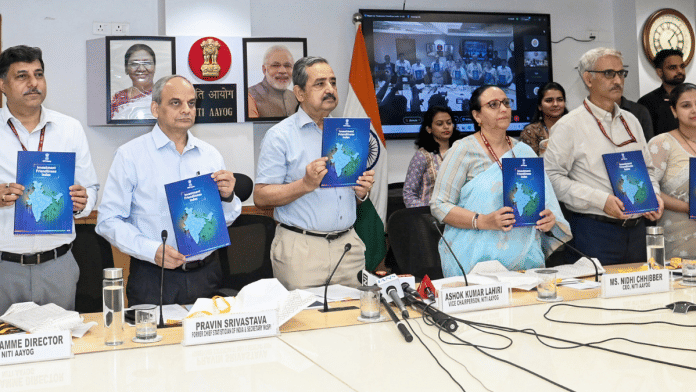


Hyderabad: Despite their strong position in India’s business landscape, Telangana and Andhra Pradesh have missed out on the highest “Top Performers” investment rating in the NITI Aayog’s maiden Investment Friendliness Index (IFI) 2026.
Both Telugu states have been tagged “Frontrunners” in the IFI rankings released last week, which highlights a stark contrast between the states’ immense industrial potential and their on-the-ground operational performance.
Andhra ranks eighth among the large states, and Telangana 13th in the same category, their performances stymied by hidden structural bottlenecks, poor finances, sudden institutional vulnerabilities and a widening policy-implementation gap, the report revealed.
The Investment Friendliness Index was developed to understand how well Indian states are positioned to attract investments. The index covers all 28 states and eight union territories (UTs) and evaluates what makes a state attractive for investors, as well as the challenges investors face.
The index focuses on eight pillars: infrastructure, business climate, resources, government policy, regulatory ease, institutional environment, financial health, and environmental resilience.
The index uses a 100-point scale and serves as a benchmark for states to improve their investment environment. The IFI rated states that performed well with scores above 50, while states that reported specific structural anomalies received scores below 50.
Andhra Pradesh got a score of 48.7 and Telangana 47.3. The five states categorised as ‘Top Performers’ were Gujarat, Maharashtra, Tamil Nadu, Goa, and Odisha.
Based on the scores, states were grouped into four categories: Top performers, frontrunners, emerging performers, and aspiring states.
“Based on this index, states can gain valuable insights into how they perform on parameters critical to investors, allowing them to identify areas of strength and weakness. Additionally, the index will enable states to learn from their peers’ best practices, fostering a culture of continuous improvement,” says the report.
Also Read: How Andhra’s drought-prone Anantapur district became a hub for industry and investment
Andhra Pradesh: What worked, what didn’t
While Andhra Pradesh shines as India’s top destination for proposed investment intent, the report details a critical anomaly in its fiscal health, noting that elevated debt profiles “signal a heavy reliance on borrowing, potentially undermining the long-term capacity to fund public services and infrastructure”.
Consequently, this fiscal strain triggers a severe implementation gap, as “persistent fiscal deficits can signal a heavy reliance on borrowing, potentially undermining the long-term capacity to deliver promised incentives”, says the report.
AP’s extensive coastline and deep-water ports (led by Visakhapatnam), its flagship industrial corridors, and its robust warehousing and cold-chain infrastructure elevate its overall score. The report highlighted that investors praised the state’s baseline policy frameworks, clear land banks, and rapid initial execution timelines.
Another feather in its cap is its strong digital infrastructure, evident in the highest digital transactions per capita (approximately 18, compared with the average of just 4.8 among the larger states).
But the state faces infrastructure issues outside major corridors, with poor interior road quality and weak last-mile connectivity between generic industrial parks and main transport nodes, the report noted.
“Andhra Pradesh’s score is driven by its performance in infrastructure, highest digital transactions per capita across all states and UTs, and the resources pillar, with further improvement to the score weighed down by a below-average score in the financial health pillar,” the IFI concluded on Andhra’s performance.
While the state investment secretary was unavailable for comment on AP’s performance, Veera Sekhar Reddy, the official spokesperson for YSR Congress Party, said the Naidu government’s claims of record investments and massive employment generation stand exposed by this report.
“AP, which ranked Numer # 1 in the Ease of Doing Business Index under former CM YS Jagan Mohan Reddy, has slipped to the eighth place under the Chandrababu Naidu-led government, proving that its industrial claims are nothing more than publicity,” Reddy said.
The Telangana story
Meanwhile, Telangana boasts premium talent and rapid approvals via TS-iPASS (an online system to track investments), but its momentum crashes in the Institutional Environment pillar, where it ranks lowest among large states.
The index specifically warns of a sharp spike in white-collar crime risks, revealing that the state’s investment climate is severely threatened by a surge in “economic offences, such as forgery and fraud,” alongside rising rates of cybercrime.
The report noted that Telangana excelled in providing an environment of regulatory ease and a conducive business climate. With an industrial land footprint nearly three times the average for large states, and an engineering and STEM enrollment twice the national average, the state has been commended for offering a premium talent pool.
High investor satisfaction was noted regarding overall policy stability and the efficiency of its commercial court system.
Also, unlike Gujarat or Andhra, which feature decentralised industrial nodes, Telangana’s growth remains heavily concentrated around Hyderabad. “This leaves its broader interior infrastructure, peripheral logistics network, and rural connectivity lagging behind the top-tier states,” the report noted.
Sravan Dasoju, the national spokesperson for the Bharat Rashtra Samithi, said, “If the cybercrime rates are as alarming, then companies such as Amazon who are setting up data centres will be worried. These high cybercrime rates were also flagged by the National Crime Bureau. The government needs to address this as a top priority, which could otherwise derail future investments.”
“The IFI’s framework was developed after the Union Budget 2025–26 was announced to strengthen the spirit of competitive and cooperative federalism by promoting reforms and fostering a conducive investment ecosystem across States,” a release by the PIB stated.
Stating that the NITI Aayog’s index moves away from simple investment announcements to focus heavily on continuous, ground-level governance and fiscal stability, the IFI observed that “States are not just implementers; they are active competitors for private capital, and evidence shows that proactive states capture a disproportionately large share of investments.”
(Edited by Ajeet Tiwari)