



Hyderabad: It was once regarded as one of India’s most chronically drought-prone and economically backward districts. But today, Anantapur in Andhra Pradesh is on course to become a major hub for industry and agriculture in India because of wide-ranging administrative reforms and private investment.
Aggressive measures taken by the district administration—from digitising land records and modernising the traditional handloom and weaving sectors to empowering locals through upskilling initiatives—have transformed Anantapur into the economic engine of the arid and rocky Rayalaseema region.
With cumulative investments exceeding Rs 50,000 crore since Andhra Pradesh’s bifurcation in 2014, the region has helped the state become an economic powerhouse, generating tens of thousands of jobs, according to data on the India Investment Grid Portal, a Centre-monitored platform offering global investors a comprehensive database of India’s best opportunities.
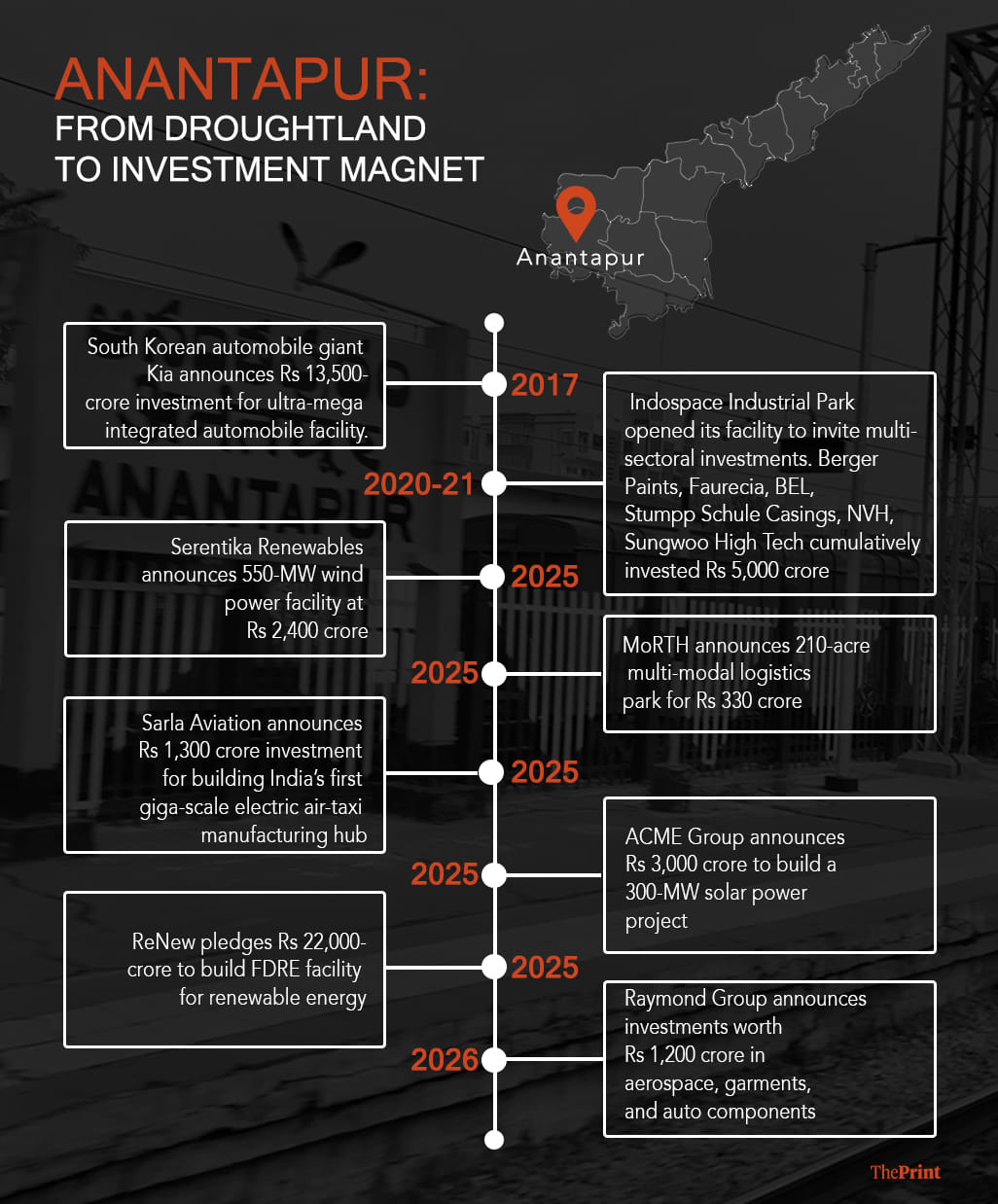
South Korean automobile giant Kia Motors’ investment of Rs 13,500 crore in Anantapur led the flow of foreign direct investment (FDI) in the state in 2017.
But since 2024, Chief Minister Chandrababu Naidu’s second term has seen a spurt in investments across various sectors, from energy to defence.
“We have planned to prioritise the Anantapur -Kurnool corridor as a core industrial development zone, focusing on large-scale manufacturing, textiles, aerospace, and renewable energy. Our aim is to actively transform the drought-prone Rayalaseema region through focused activity to enhance economic growth and better people’s lives,” Andhra Pradesh Industries Minister TG Bharath told ThePrint on key strategic initiatives for the region.
Also Read: What is a flying taxi? Andhra Pradesh’s ‘Sky Factory’ can change commuting in India
Kia investment opens gate for more
Kia’s investment set up Anantapur as the hub of all automotive and ancillary industries, spurring further investments worth Rs 4,790 crore by firms such as the Raymond Group, Faurecia, and NDR Auto Components.
One of the more significant investments was by renewable energy firm ReNew, which paved the way for companies in the clean energy sector.
ReNew, India’s first renewable energy firm to be listed on US stock exchange NASDAQ, pledged an investment of Rs 22,000 crore to build one of India’s largest single-site renewable energy complexes in the district, integrating solar, wind and battery storage.
The scale of ReNew’s investment proposed in 2025 drew attention from investors across the country for being India’s largest single-location hybrid renewable energy complex at Anantapur. It promises to deliver a staggering 1,800 MW of solar, 1,000 MW of wind, and 2,000 MWh of battery storage.
Jeyasri A T/ThePrint
Sources in the Andhra Pradesh Economic Development Board (APEDB) told ThePrint that Andhra Pradesh pipped Tamil Nadu and Karnataka to invite ReNew.
“Our comprehensive new energy policy to further develop the district by luring a wave of sustainable energy capital to the region and setting new benchmarks for India’s clean energy ambitions helped ReNew pick Anantapur over other states,” said an APEDB official who did not want to be identified.
The region is also emerging as a significant cluster for aerospace, defence and urban air mobility, with many projects landing even in the newly carved Sathya Sai district in 2022.
The new district was created by splitting Anantapur—then Andhra Pradesh’s largest district—and merging the Dharmavaram, Penukonda, and Kadiri revenue divisions.
In his second term as chief minister after Andhra Pradesh was truncated, Chandrababu Naidu created a new aerospace and defence policy for the state, naming Anantapur as the industrial cluster for aerospace investments.
The ambitious Aerospace and Defence Policy 4.0 (2025–2030) and Space Policy 4.0 were released in 2025 to transform the state into a global manufacturing, and research and development hub. The state government is targeting up to Rs 1 lakh-crore in investments and aiming to create thousands of jobs across high-tech domains.
“My government’s new Aerospace and Defence Policy is designed to position Andhra Pradesh as a preferred destination for global investors in cutting-edge manufacturing, aiming at attracting Rs 50,000 crore to over Rs 1 lakh crore investments to create anything between 5,000 jobs and 30,000 jobs,” Naidu said at the policy launch.
“We will be customising incentives and providing land availability suitably for each industry segment to create world-class infrastructure. These factors will prove to be decisive in attracting big players in the aerospace ecosystem,” he added.
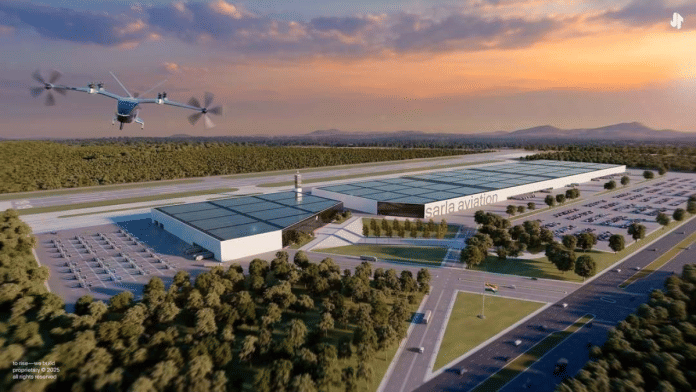
Proposed investments in Anantapur include Sarla Aviation’s Rs 1,300 crore for a 500-acre facility for manufacturing six-seater aircraft for emerging air-taxi services, and Bharat Electronics Ltd’s (BEL) unit across 900 acres to support defence and ammunition manufacturing.
Land reforms lay the groundwork
But Anita Ramachandran, former collector and district magistrate of Anantapur between 2008 and 2011, says Anantapur’s story cannot be limited to industry alone.
The IAS officer, currently in the Women and Child Welfare department in Telangana, who championed land reforms in the state, said Anantapur also implemented a revenue records initiative that digitised land records, resolved pending land disputes and created digital libraries at the village level.
“For five years, we undertook a rigorous exercise by the revenue department. We went from village to village to ensure irregular landholdings were regularised and the Pahani (land record) held by the villagers matched the official land records. This paved the way for industrial zones to be created and for the vast potential of the region to be tapped,” she told ThePrint.
A Pahani (also known as an Adangal) is a crucial agricultural land revenue record, primarily used in Karnataka and Andhra Pradesh to track land ownership, soil type, crops grown and irrigation details.
In the years after the state’s bifurcation, through drone mapping and digital property rights, rural land ownership became more transparent, empowering locals to leverage property assets for financial inclusion, the officer added.
The land reforms, coupled with at least a dozen micro-irrigation projects, transformed Anantapur’s agrarian economy. The district is now tagged as India’s premier fruit bowl, the current collector, Vinod Kumar, said.
The arid region that did little to support a second crop beyond groundnut and chillies has now become the focal point of a Rs 40,000-crore state initiative.
In 2025, Anantapur alone contributed to a fourth of India’s cultivation of bananas, mangoes, pomegranates, guavas and sapotas, with more than 80 percent of its produce exported to Latin America and Southeast Asia.
“We were once recording the second-lowest rainfall in the country after Jaisalmer. Anantapur is now making national headlines as the epicentre of Andhra Pradesh’s green revolution, green energy surge, helping the people take advantage of the economic progress in the region,” the collector added.
These changes prompted the Andhra Pradesh government to unveil a multi-crore action plan targeting specific horticulture projects worth over Rs 14,800 crore, of which Rs 9,000 crore is allocated as direct subsidies to farmers. The district has also been marked for an investment of Rs 30,000 crore for the Rayalaseema Horticulture Hub project.
Since nearly all of its produce find consumers overseas, Anantapur was chosen for south India’s first Kisan Rail project.
Officials said the new rail line helped bypass traditional, slower road transport and prevented 15 percent to 20 percent post-harvest losses. This direct express train rapidly transports perishable fruits—such as bananas, mangoes, and melons—to high-demand northern markets like New Delhi, and to ports on the eastern and western coasts of the Indian peninsula.
The district’s location at the intersection of the Chennai, Bengaluru and Hyderabad expressways adds to its logistical advantage, making it a strategic location for shipping and logistics firms to set up their warehouses and godowns.
“This evolution is driven by government subsidies, improved irrigation like the Handri-Neeva project, and a massive shift toward high-yield fruit and vegetable production,” said Potluri Bhaskara Rao, President of the AP Chambers.
“We created district-wide agricultural awareness camps, educating the farmers to shift from traditional, water-intensive crops to horticulture. This transition and increased agricultural productivity have notably boosted the district’s per capita income,” he added.
(Edited by Sugita Katyal)
Also Read: What’s driving Andhra Pradesh’s rise as go-to investment hub, and why its neighbours are bristling