



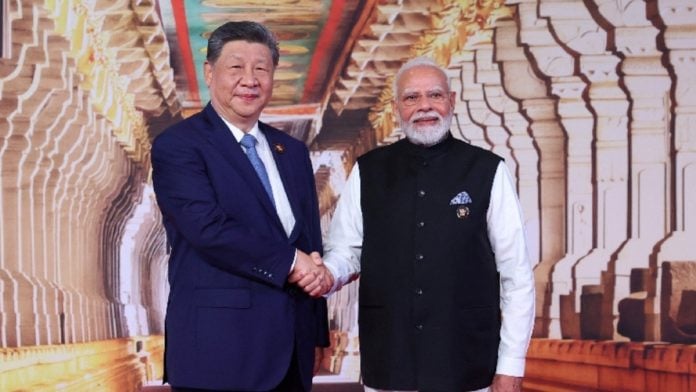

New Delhi: Prime Minister Narendra Modi underlined that India-China relations should be guided by mutual respect, mutual interest and mutual sensitivity to each other’s core concerns during his bilateral meeting with Chinese President Xi Jinping, said the Ministry of External Affairs (MEA) on Tuesday.
Speaking at a press briefing, MEA spokesperson Randhir Jaiswal said “several issues” were discussed during the meeting held on Saturday on the sidelines of the BRICS Leaders’ Summit. The Chinese readout on the meeting also highlighted that India’s position on Taiwan and Tibet “remain unchanged”.
“On the mentioning of certain issues in the Chinese declaration, I will say that several issues came up during the discussions, and we have kept you updated on those. The Prime Minister referred to Indian concerns and underlined that both sides should show sensitivity to each other’s core concerns and be guided by the three mutuals – mutual respect, mutual interest and mutual sensitivity,” Jaiswal said when asked about the Chinese readout.
Xi’s visit to India for the BRICS Summit marked his first in seven years and his first since the two militaries clashed in Eastern Ladakh in 2020.
During the meeting, Modi underlined that “peace and tranquility in the border areas remains an essential basis for the continued development of bilateral relations”. Both leaders affirmed that “differences should not become disputes”.
The 2020 clashes had triggered a political chill in ties, with India maintaining that other discussions could not proceed until peace returned to the affected areas along the Line of Actual Control (LAC).
In October 2024, India announced an agreement with China to disengage from the friction points along the LAC, paving the way for a calibrated thaw in ties.
The two countries have since resumed direct flights, while New Delhi has eased visa and business restrictions on Chinese nationals. Beijing resumed the Kailash Mansarovar Yatra in 2025 and held a second pilgrimage this summer.
“Xi and Indian Prime Minister Narendra Modi conducted a candid and in-depth exchange of views on strategic, long-term and directional issues concerning China-India relations,” Chinese Foreign Minister Wang Yi was reported as saying by state news agency Xinhua on Sunday. He said the most important consensus reached was that China and India should be partners.
Wang added that the two leaders “agreed to jointly maintain peace and tranquility in the border areas”. India has also offered support to Beijing for its BRICS chairship in 2027.
The thaw has extended to economic ties, with India easing some restrictions on Chinese investment imposed after the Galwan clashes. In March, the Union government eased certain investment restrictions on countries sharing a land border with India in select sectors.
India’s National Security Adviser Ajit Doval travelled to Beijing last month for talks with Wang under the Special Representative mechanism. The talks highlighted efforts towards an “early harvest” agreement between the two countries to demarcate the boundary in areas where there are no differences. The two sides also agreed to finalise terms of reference for two new expert groups under the Working Mechanism for Consultation and Coordination on India-China Border Affairs (WMCC).
Days before Xi’s arrival in India, the two militaries held a corps commander-level meeting in the Eastern Sector for the first time. The meeting was part of broader efforts by New Delhi and Beijing to maintain peace along the border.
(Edited by Chingkheinganbi Mayengbam)