



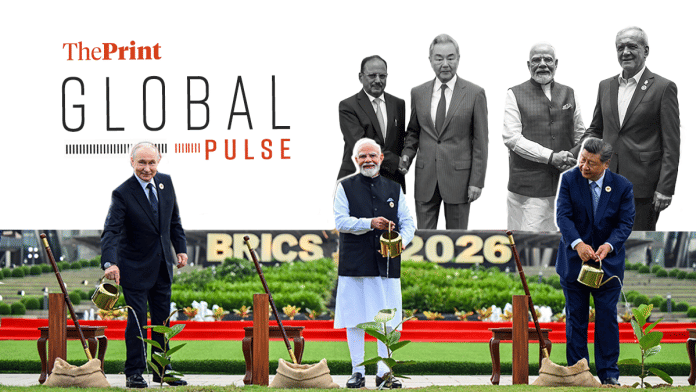
New Delhi: India hosted this year’s BRICS Summit in New Delhi over the weekend, with global media focusing on what the gathering’s agenda could mean for the grouping, its two Asian giants, and the US-Iran war.
David Pierson and Alex Travelli of The New York Times write that even as BRICS leaders demand a global voice, the summit settled for a “vague call for peace”. The NYT is referring to the statements made over the US-Iran war, which are significant because of Iran’s membership of the grouping.
“The group has been split by tensions between Iran and the United Arab Emirates, a U.S. security partner that has been targeted by thousands of Iranian ballistic missiles, cruise missiles and drones since the war started in February,” the report notes.
The tensions resulted in a joint statement from the group that called for “maximum restraint” in West Asia without calling out America or naming any other country. “They were able to get everyone to agree to a watered down statement,” Sarang Shidore, the director of the global south program at the Quincy Institute, told the NYT.
This year’s statement was also a marked departure from the 2025 Summit’s statement that squarely condemned a “12-day war against Iran”.
However, the report says that the group was far more unified in condemning America’s economic pressures. “The statement took indirect aim at the United States by raising concerns about tariffs and condemning the use of economic sanctions,” the report highlights.
On a related note, the NYT also reports on the much-anticipated ‘unified BRICS currency’ talk. However, for now, the leaders would settle for reducing Dollar’s sphere of influence.
“De-dollarisation, as the effort is known, would throw a lifeline to countries like Russia and Iran, which have struggled to pay for imported goods since the United States and other Western countries restricted their access to the dollar,” Pierson and Travelli writes.
And while the report says, citing economists, US President Donald Trump intends to preserve “dollar’s status as the world’s reserve currency”, linking banking systems more directly would help BRICS countries pay debts to one another without having to convert to dollars.
Even as the Summit took place at a grand convention centre and world leaders posed in front of a water feature to get group photograph, the setting could not “mask the BRICS group’s unwieldy internal divisions”—raising questions about the loose bloc’s ability to solve geopolitical crises like the war in the Middle East.
Michael Stott and Andres Schipani of the Financial Times also look at BRICS’ push for peace in West Asia. Chinese President Xi Jinping said that the 10-member group should act as peacemakers to stop a war that has “caused serious losses to people across the region”.
He added, as the report quotes, that the West Asia war “does not serve the common interests of the international community”.
It also notes that Iran’s embassy in New Delhi posted a picture of Pezeshkian sitting with the UAE representative, adding that the two had held talks. While the NYT reported that during the BRICS group photograph, the two stood as the opposite ends of the row.
“Despite being on opposing sides in the war, Iran and the UAE both agreed to the summit’s final declaration after an intense diplomatic effort by India to find language acceptable to both.”
The report also talks about the special attention Modi gave to the Iranian president. “India’s Prime Minister Narendra Modi went out of his way to welcome Pezeshkian at the summit, which offered a rare chance for the Iranian president to attend a major international forum. Modi held Pezeshkian’s hand, walked alongside him and smiled as they posed for cameras,” it says.
However, global media has also taken a keen interest in how the Summit impacted India-China ties. Zhang Xiaoyu, writing in the Global Times, looks at how the relationship between the two countries has progressed since the deadly 2020 clashes between their forces in Ladakh.
“China and India have not always agreed on every issue, yet they have continued to work together within BRICS even when bilateral ties were strained,” the column says.
The two countries, it notes, have helped build institutions rather than simply attending meetings. The author cites the establishment of the New Development Bank (NDB) with both Chinese and Indian officials having served in its leadership. “The bank’s project pipeline in energy, transport, water and urban infrastructure has given member states options beyond traditional lenders,” it says.
India and China, the column adds, have “treated BRICS as a venue for economic and financial coordination, not only communiqués”.
“Work on cross-border payments, linking national systems such as China’s CIPS and India’s UPI, and exploring interoperability of fast-payment rails and central-bank digital currencies, reflects a shared interest in cheaper, faster settlement among developing economies.”
The author also believes that BRICS has given the two countries a forum to have structured discussion on issues of global scale, from climate change to public health and counter-terrorism.
Lastly, the column argues that the two countries have also publicly signalled a show of support. China publicly supported India as the 2026 chair, and India has supported China as 2027 chair.
However, Sadanand Dhume argues that any India-China “rapprochement” is not in the cards in The Wall Street Journal.
“Both countries have good reasons to stabilize relations—including, in India’s case, consternation about President Trump’s erratic foreign policy—but there’s no magic reset button,” Dhume writes.
The issues that divide India and China, he writes, are too entrenched for a “genuine rapprochement”.
Citing former Indian ambassador to China Gautam Bambawale, Dhume says that any expectation of reset of ties, is “woefully premature”. Bambawale added that the 2020 clashes set India-China back by 10 steps. The latest cooperation, on the other hand, only moves their relationship 3 steps forward.
“The past two years have brought a partial improvement in Sino-Indian relations. In 2024 Prime Minister Narendra Modi met with Mr. Xi in Russia on the sidelines of the Brics summit,” the column says.
Other than that, the two countries have revived talks on border dispute with India’s National Security Advisor Ajit Doval meeting a Chinese representative in Beijing last month.
Dhume also tries to explain these recent engagements. Manoj Kewalramani, a China expert at Bangalore’s Takshashila Institution, told Dhume that India seems to have moved away from insisting on resolving the boundary dispute before progressing further.
“He says there is a quiet recognition in New Delhi that “the world has changed” and that “there is a power differential” between China and India,” the column says.
(Edited by Ajeet Tiwari)
Also read: Global media looks at India-China thaw ahead of BRICS & why India less vulnerable to bond sell-offs