



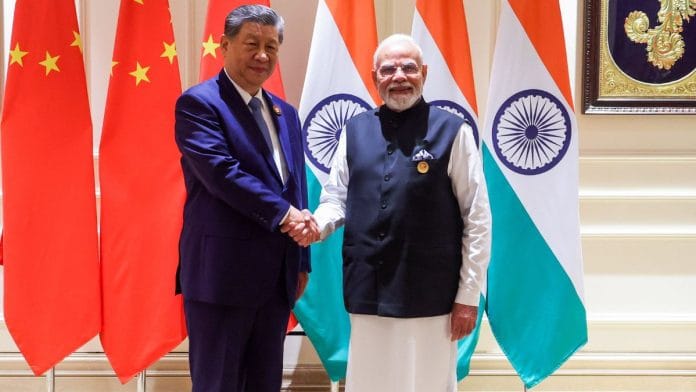

New Delhi: Prime Minister Narendra Modi and Chinese President Xi Jinping Saturday affirmed that both countries should take a strategic and long-term view of their ties and that “differences should not become disputes”.
Xi, visiting India after seven years, met Modi on the sidelines of the BRICS Summit in New Delhi, marking their first bilateral meeting since August 2025, when they met at the SCO Summit in Tianjin. It is also Xi’s first visit since the two countries clashed at Galwan in eastern Ladakh in 2020.
India asserted that “peace and tranquility in the border areas remains an essential basis for the continued development of bilateral relations.”
Modi also called on both sides to adhere to existing agreements and understandings governing the border. He said both sides must be guided by three mutuals—mutual respect, mutual sensitivity and mutual interest.
The two countries have been seeking to consolidate a gradual thaw in relations while managing disagreements over the LAC (Line of Actual Control), trade and market access.
“The two leaders expressed commitment to a fair, reasonable, and mutually acceptable resolution of the boundary question proceeding from the political perspective of their overall bilateral relations and the long-term interests of the two peoples”, a statement released by the Ministry of External Affairs (MEA) after the meeting said.
The discussions also touched on efforts to rebuild economic and people-to-people ties. The leaders welcomed progress in cultural exchanges and stressed the importance of expanding business links and mobility between the two countries.
On trade, they agreed on the need to address concerns on both sides, including India’s longstanding concerns over its structural trade deficit with China and supply-chain vulnerabilities. They also stressed the importance of more meaningful and predictable access to each other’s markets.
The economic discussions come as New Delhi has cautiously begun easing some restrictions on Chinese investment. In March, the Union government relaxed rules governing certain investments from countries that share a land border with India, including China. The changes were intended to facilitate investment while preserving safeguards against Chinese control of Indian companies.
For India, the economic opening remains selective, with security scrutiny of Chinese companies and investments continuing to be stringent. This reflects lingering distrust following military confrontations along the border.
The latest efforts to repair ties followed an agreement in October 2024 on patrolling arrangements in eastern Ladakh. The accord facilitated disengagement at the remaining friction points, including the Depsang Plains and Chushul, and opened the way for a broader diplomatic effort to stabilise relations.
After the two leaders met on the sidelines of the BRICS summit in Kazan in October 2024 — their first formal bilateral meeting since the 2020 Galwan clashes — the two governments restored direct air links, eased some visa restrictions and increased high-level political engagement.
On the day Xi left Beijing to attend this year’s BRICS summit, China Southern Airlines announced the resumption of regular passenger services on the Guangzhou-New Delhi route from 21 September after a six-year suspension.
However, the border dispute remains unresolved, with both countries continuing to maintain substantial military deployments along the LAC.
The two sides have also continued military-level talks to manage tensions along the frontier. In the first week of September, Indian and Chinese forces held two rounds of Corps Commander-level talks in the eastern sector, including a meeting on Monday, amid continuing tensions in the broader area around Taksing in Arunachal Pradesh.
Corps Commander-level negotiations were held in the western sector after the Galwan clash in 2020, but the recent discussions marked the first such meetings in the eastern sector.
(Edited by Chingkheinganbi Mayengbam)
Also Read: China’s economic dominance looms over BRICS. Beijing remains largest trading partner of every member