



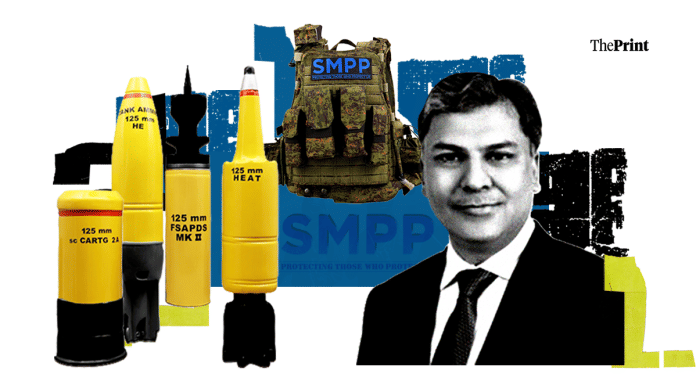
New Delhi: From a pulp-based packaging firm in Punjab’s Sangrur to a major supplier to India’s armed forces, SMPP’s transformation into a defence manufacturing company has been remarkable.
But following the arrest of its CEO in a corruption case involving a state-owned ammunition manufacturer, the company now faces the prospect of suspension and a possible ban on business with the defence ministry, its main customer.
Sources in the defence and security establishment told ThePrint that the defence ministry will follow due process in dealing with corruption-related allegations, adding that the Department of Defence Production (DDP) was seized of the matter.
On Tuesday, the CBI arrested Ashish Kansal, CEO and director of SMPP Limited, along with Anil Kumar, a senior executive director at state-owned Munitions India Limited (MIL), in connection with an alleged corruption case.
Suspension kicks in, ban could follow
Under the Defence Procurement Manual (DPM) 2025, the competent authority can suspend a company pending an inquiry under specified circumstances, including when a complaint is referred to an investigating agency or the defence ministry receives information about a criminal investigation. The ministry would examine the relevant records and the company’s response before deciding on further action. A proposed debarment across government departments is also subject to the applicable procedures and safeguards.
The competent authority would then decide whether the grounds warrant lifting the suspension or banning dealings with the company altogether.
The applicable provisions distinguish between interim suspension and a ban, which can have far-reaching consequences for a defence supplier. The final decision under the relevant suspension and banning provisions rests with the defence minister.
The order of suspension of business dealings is to be issued for a period the competent authority deems fit, though the period of suspension shall not ordinarily exceed one year. A review of the order or suspension of business dealings is to be undertaken within six months of the issue of such an order and before expiry of the period specified therein.
The suspension of an entity may be extended beyond the period of one year, on the order of the competent authority for subsequent periods of six months each.
The total period of suspension shall not exceed the maximum period of banning of business dealings for the same cause of action. An order of suspension of business dealings, however, shall result in immediate ineligibility of the entity from participating in future bids.
No RFP (request for proposal) is to be issued to such an entity. Further, any ongoing procurement, where L1 (lowest bidder) determination is yet to be done, is to move forward after excluding the bid involving an entity with which business dealings are suspended.
According to the process, banning of business dealings with an entity may be ordered by the competent authority on acceptance of misconduct by the entity or establishment of such misconduct by a competent court/tribunal/authority. Banning of business dealings with an entity can be ordered by the competent authority on receipt of information regarding filing of charge sheet in a court of law by CBI or any other investigating agency.
From packaging to defence manufacturing
SMPP was founded in 1985 by Dr Shiv Chand Kansal, a chemical engineer with a PhD from IIT Bombay. The company, originally incorporated as SM Pulp Packaging Private Limited, started out as a pulp-based packaging business.
Under the leadership of the Kansal family, it gradually moved into defence manufacturing, building capabilities in specialised materials and protection systems. In the 1990s, SMPP began manufacturing semi-combustible cartridge cases for 120 mm and 125 mm ammunition. This marked its entry into defence-related manufacturing and materials technology.
It subsequently obtained licences to manufacture bullet-resistant jackets, vehicle armour, and protective systems for aircraft and helicopters. It subsequently expanded its portfolio to include helmets, armour plates, shields and other protection equipment.
Its first major breakthrough in the Indian defence market came in 2018, when it secured a contract to supply 1,86,000 bullet-resistant jackets to the Army.
At the time, SMPP was a relatively little-known player in the defence sector. Its use of boron carbide ceramics, an extremely hard material used in advanced armour systems, helped reduce the weight of personal protection while providing multi-hit protection against hard steel-core rounds. But the contract also brought scrutiny.
During the trial phase, SMPP had used fabric and boron carbide plates sourced from the US. After securing the contract, it switched to Chinese material, triggering questions about the change and its cost implications. The Economic Times first reported on the issue in 2019. SMPP’s defence was that it made the change after obtaining necessary approvals from the Army. The company subsequently expanded its defence business, supplying different types of armour and protective equipment, including helmets, to the armed forces.
Also Read: Indian defence firm MKU to set up manufacturing plant in Morocco for electro-optics, armour
Ammunition & drones: an expanding portfolio
In 2021, SMPP incorporated SMPP Ammunition Private Limited as a subsidiary and set up a manufacturing plant at Nalagarh in Himachal Pradesh.
The subsidiary was subsequently issued an arms licence by the Department for Promotion of Industry and Internal Trade (DPIIT) to manufacture ammunition in several calibres, including 125 mm, 120 mm, 155 mm, 130 mm, 105 mm, 81 mm, 40 mm and 30 mm.
SMPP also expanded its overseas business, exporting products to more than 23 countries across Europe and Asia, according to the company.
It entered into a partnership with Rheinmetall Denel Munition, a joint venture between Germany’s Rheinmetall Waffe Munition GmbH (RWM) and South Africa’s state-owned Denel, for large-calibre ammunition. Rheinmetall, the German defence group, has separately faced restrictions on defence dealings in India following a corruption investigation by the CBI.
SMPP has also ventured into unmanned systems. In June this year, it delivered 106 jet-powered kamikaze drones under an emergency procurement programme of the Indian Army, as part of efforts to accelerate military modernisation following Operation Sindoor.
The drones, marketed as Peacekeeper and also known as Agniveg, are designed to operate in GPS-denied environments. They are reported to have a range of 180 km and a top speed of around 450 km per hour.
Sources in the defence and security establishment told ThePrint that the platform was originally developed by Belarusian company KB Indela, which partnered with SMPP.
Under the transfer-of-technology (ToT) arrangement, SMPP localised the warhead component of the drones. The understanding is that ToT would be phased, with further localisation, including manufacture of the jet engine, as order volumes increase. The defence manufacturer has also offered a next-generation version capable of reaching speeds of around 750 km per hour.
As far as SMPP’s future outlook is concerned, drones, protective gears and ammunition manufacturing would have remained the core areas.
Profits soar as business expands
SMPP’s financial performance has strengthened alongside its expansion into defence manufacturing.
Revenue rose to Rs 622.57 crore in FY2024-25 from Rs 376.92 crore in FY2021-22, an increase of 65 percent.
Net profit nearly doubled over the same period, rising from Rs 87.74 crore to Rs 174.61 crore.
The company’s reported growth in profits outpaced revenue growth, pointing to a significant improvement in its earnings over the period.
Its defence business, spanning personal protection, ammunition components and newer unmanned systems, has expanded considerably.
SMPP has also faced procurement-related scrutiny overseas.
The company, which established a joint venture in the Philippines, was blacklisted by the Philippine National Police (PNP) in September 2025 over alleged failure to fulfil contractual obligations relating to a contract for all-purpose vests. The disqualification was reported to run for one year, until September 2026. It remains unclear whether the blacklisting has since been lifted or extended.
(Edited by Amrtansh Arora)
Also Read: Defence ministry distances itself from Indian firm in eye of Estonia minister resignation scandal