





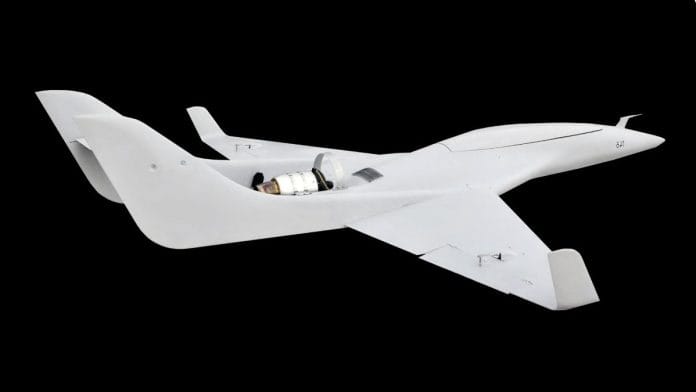

New Delhi: In a major boost to the country’s strike capability, the Indian Army has received 100 jet-powered kamikaze drones, capable of operating in GPS-denied battlespace, through a partnership between a Belarusian firm and an Indian one.
Delhi-based defence firm SMPP has delivered the Peacekeeper drones, also known as Agniveg, under emergency procurement by the Indian Army as part of a modernisation effort post Operation Sindoor.
The induction of these drones will play an important role in bridging the gap between short-range artillery strike and long-range missile strike capabilities of the Indian Army to take out enemy targets such as command centers, radar installations, logistics hubs etc.
Capable of hitting targets at 450 km/hour, the drone, which has a range of 180 km, was selected by the Indian Army following trials in Pokharan last year after Op Sindoor.
Sources in the defence and security establishment told ThePrint that the drone is originally a Belarusian one manufactured by a company called KB Indela which has partnered with SMPP.
Under the transfer of technology, SMPP has localised the munition part of the kamikaze drones with the understanding that there will be phased transfer of technology as numbers on order go up including manufacturing of the jet engine motor.
Sources said SMPP has also offered the next generation of the kamikaze drone which is capable of flying at 750 km/hour.
Of the total 106 delivered, 100 are strike drones whereas six of them are training Unmanned Aerial Vehicles (UAVs) which would be utilised to train future operators on this jet-powered drone system.
In a statement, SMPP said the delivery follows successful user trials in which the Peacekeeper (Agniveg) demonstrated a Circular Error Probable (CEP)—an indicator of a weapon system’s precision within a circle, centred around a target—of less than five metres showcasing an operational range of about 180 kilometres, while operating in a heavily jammed and spoofed environment.
“The performance highlights the system’s precision, reliability and ability to operate in contested battlefield conditions,” it added.
Drone warfare has emerged as the preferred choice when it comes to maintaining high-tempo battle operations with cost and risk being kept at minimal.
The SMPP, which was earlier developing and manufacturing anti-ballistic armor for soldiers and military vehicles, has now expanded its presence across precision strike capabilities, drone and counter-drone systems, large and medium calibre ammunition and next-generation battlefield technologies.
Nitesh Saxena is a TPSJ alum, currently interning with ThePrint.
(Edited by Gitanjali Das)
Also Read: The Op Sindoor lessons—not just how to fight wars, but also how not to