





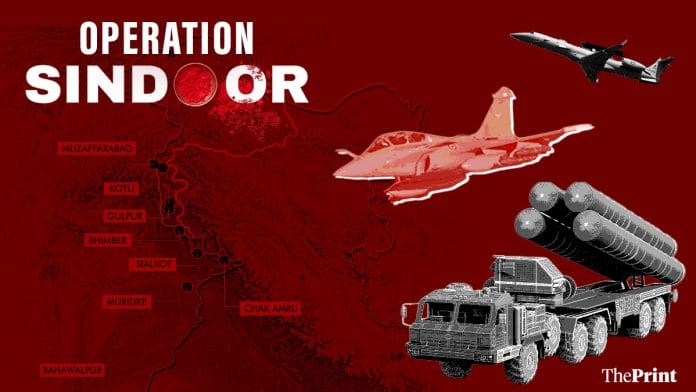


New Delhi: It has been one year since Operation Sindoor, an intense conflict that lasted all of 88 hours. Yet what unfolded in those 88 hours was not just another limited conflict between India and Pakistan, it was something far more consequential, a glimpse into the future of warfare in the subcontinent.
ThePrint spoke to multiple sources in the defence and security establishment who said that with Op Sindoor, something fundamental has shifted.
The sources explained that the shift was not limited to just how India and Pakistan conduct warfare, but also to how they consciously avoid war. Operation Sindoor opened the window into the very logic of war under a nuclear overhang, sources said.
Op Sindoor started with the aim of hitting not just terror camps in Pakistan Occupied Kashmir, but also to target the headquarters of terror groups which were considered safe in the heart of Pakistan—Punjab.
“Pakistan escalated with its military retaliation targeting Indian military assets and installations. Unlike any other war fought between the two sides, there was no crossing of the Line of Control or the IB by either side on tanks or foot. Despite this, the conflict was intense and eventually forced Pakistan to seek a ceasefire,” a source explained.
In a matter of 88 hours, the Indian Air Force had achieved air superiority over key sectors of Pakistani airspace, while the Indian Army had the upper hand in operations along the LoC.
The Pakistan Air Force was unable to sustain the operations it executed in the intervening night of 6-7 May, with India successfully activating suppression and destruction of enemy air defences.
Also read: India’s fourth S-400 system ready in Russia, undergoing final testing before delivery
From decisive battle to controlled escalation
For decades, the template of India–Pakistan conflict was familiar: Mass mobilisation, armoured thrusts with the Air Force in support of ground forces, until the 2019 Balakot operation.
Sources explained that though the historic template has not disappeared entirely from warfare, it has been decisively displaced from the centre of strategy.
What is emerging instead is a model defined by precision, speed and control, with escalation control in the matrix.
Sources explained that at the heart of this shift lies the rise of long-range, stand-off strike capability. Air-delivered systems such as BrahMos, SCALP, Rampage and SPICE 2000, alongside land-based assets like Pinaka, have redrawn the battlespace in the sub-continent.
Range now substitutes for mass movement of troops and armoured columns with effects being felt deep inside Pakistani territory without the visible crossing of borders that once defined escalation thresholds.
“Pakistan has always found itself in a geographical sweet spot that has enabled it to milk assistance for decades, but it lacks the depth it needs to have a credible safety point for anything, unlike India,” a source explained.
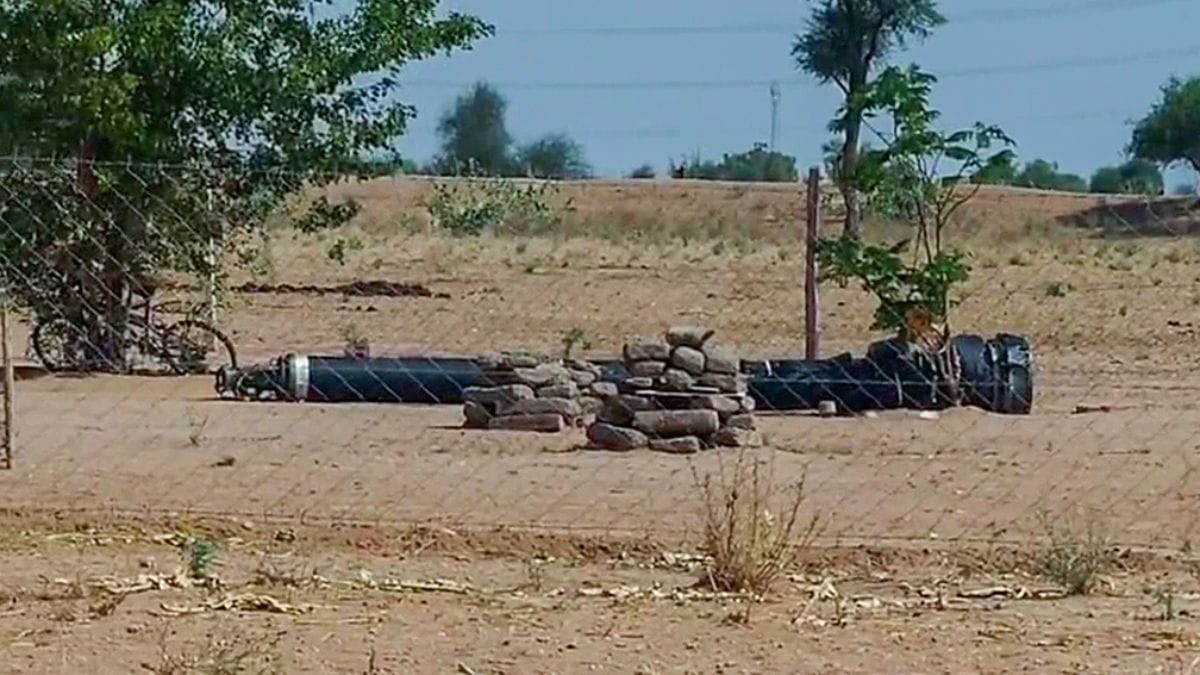
During the 88-hour conflict, the Indian military struck 11 Pakistani air bases and military facilities, including Bholari, Jacobabad (Shahbaz), Nur Khan, and Rafiqui air bases, resulting in significant damage to Pakistani air force infrastructure.
As military analyst John Spencer noted in a post on X, “The targets were distributed across Pakistan’s depth, from the north near Islamabad to central and southern airbases, designed to degrade command, control, and operational capacity simultaneously.
“In the north, Nur Khan Air Base, located near Islamabad and adjacent to Pakistan’s military leadership infrastructure, was struck, with at least one missile hitting a key command-and-control centre. Murid Air Base, the hub of Pakistan’s MALE drone fleet, saw multiple hangars and a drone control facility struck, targeting Pakistan’s unmanned strike capability at its source.”
In central Pakistan, Rahim Yar Khan Air Base sustained multiple impacts along its runway, disrupting sortie generation, while the adjacent civilian terminal, reportedly used to host a drone control centre, was also heavily damaged. Rafiqi Air Base was struck as part of the same wave, he said.
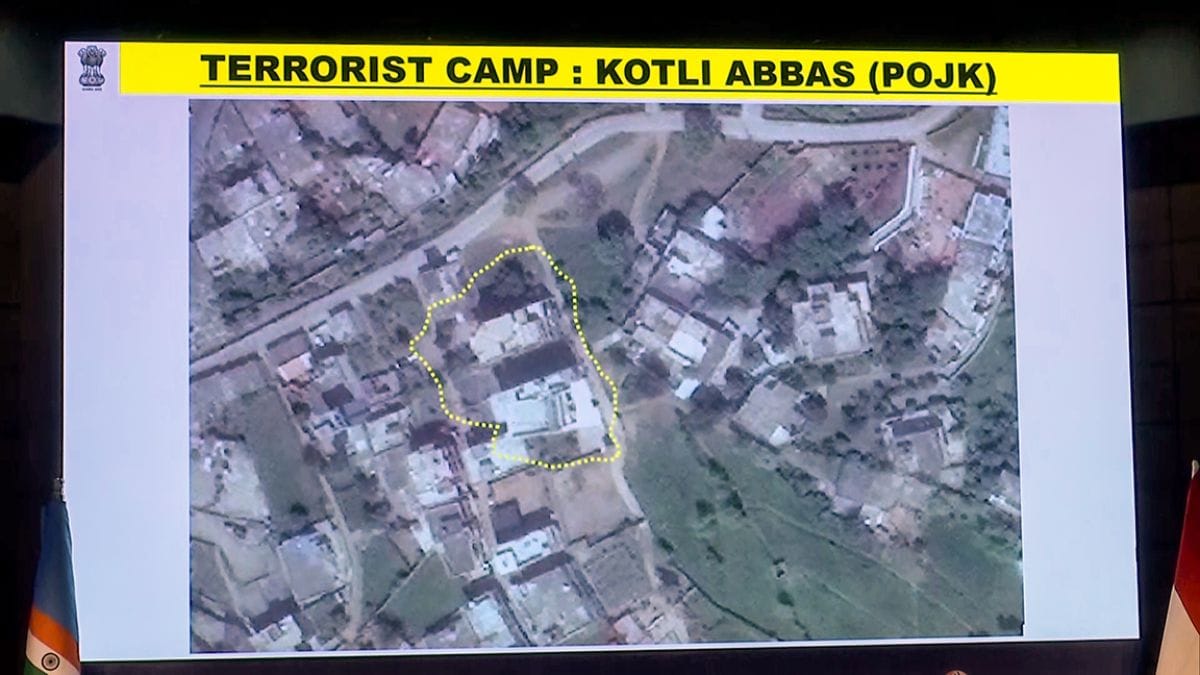
Spencer noted that in the south, Sukkur Air Base was targeted, with strikes hitting a drone hangar and radar infrastructure, extending the campaign’s reach across Pakistan’s full operational depth.
A second wave followed against Sargodha, Jacobabad, and Bholari, including facilities supporting fighter aircraft and airborne early warning platforms. These strikes were designed to degrade operational capacity at its source, he said.
Sources said that tanks and large formations are not obsolete but are no longer central. They anchor escalation credibility as they ensure the threat of full-scale war remains real while no longer being the first move.
Jointness: Invisible backbone of precision warfare
Sources said that what makes this model viable is not just weapons but how seamlessly the services operate together.
“Precision, speed, and escalation control are impossible without deep jointness. This is where jointness moves from slogan to necessity,” a source said, adding that in a compressed battlespace, targeting must be shared across services in real time, and air defence must be integrated, not layered in silos.
“ISR inputs must flow seamlessly across commands. Without jointness, C4ISR (Command, Control, Communications, Computers, Intelligence, Surveillance, and Reconnaissance) collapses into fragmentation. Without jointness, speed becomes confusion,” the source added.
When defence becomes offence
In this evolving framework, the idea that “defence is the first offence” acquires real meaning.
Integrated air defence systems, particularly platforms like S-400, are no longer passive shields. They are strategic instruments which have the ability to limit an adversary’s retaliatory options from the outset; they shape decision-making even before conflict begins.
Sources said that long-range air-to-air missiles are not just for offensive operations but also for defence, and hence there is a greater emphasis on the DRDO to come up with longer-range indigenous air-to-air missiles.
“Having a credible long-range air-to-air missiles ensures that the adversary is forced to operate deeper from its territory which will be true for both Indian fighters as well as the opponent, depending on who has the longer range,” another source said.
The compression of time: C4ISR
If earlier wars were decided by the side that could bring more firepower to bear, future contests will favour the side that can compress time.
The sensor-to-shooter loop is shrinking dramatically. Targets are increasingly pre-identified, validated, and locked in advance.
“Political directives are being shortened, operational friction reduced, and response windows narrowed to hours, if not minutes. But speed is a double-edged sword. It enhances responsiveness, but it also compresses deliberation,” a source said.
Compounding this transformation is the radical transparency of the modern battlespace.
“The proliferation of commercial satellites, open-source intelligence networks, and real-time digital dissemination means that military operations can no longer be concealed in the way they once were. The fog of war has thinned,” the source added.
It is learnt that during Op Sindoor, Pakistan was getting real-time information on the movement of Indian military assets.
Sources said that Op Sindoor has shown India’s lack of indigenous capability when it comes to satellite-based assets and this is an area which is getting a strong push.
Drones and persistent conflict
Op Sindoor also saw loitering munitions and drones in action, which are now lowering thresholds of conflict. “India first got its surveillance drones during the Kargil conflict. They had just started coming in. The loitering munitions used in Op Sindoor were inducted way back in 2012/13 but when they were bought, they were niche. Now they are the focus,” a source said.
The source added that drones and loitering munitions are cheaper and persistent, enabling continuous, low-intensity engagement below the threshold of full war.
“This creates a grey zone of sustained competition, where conflict is ongoing but controlled,” the source added.
Another lesson from Op Sindoor is the need for big industrial capacity to sustain the tempo of operations. “Stockpiles, production lines, and indigenous systems determine sustainability. Without scale, even the most precise strategy collapses under its own weight,” a source said.
The hardest phase: Conflict termination
Sources said that ongoing conflicts across the world show that termination is now the most complex phase.
“Every strike must be calibrated not just for impact but for exit. Clear political objectives, signalling coherence and controlled posture are essential. Without termination control, escalation becomes uncontrollable,” the sources said, explaining how Op Sindoor demonstrated this ability to the world.
The deeper lesson
The deeper lessons of Operation Sindoor are not just about new tools or tactics but a new way of thinking where victory is no longer territorial but behavioural.
“It lies in shaping adversary choices, maintaining escalation dominance, and applying force with precision and restraint. In this emerging paradigm, power is no longer measured by how much force can be unleashed. It is measured by how precisely it can be controlled,” a source explained.
Narrative warfare
Sources explained that the most important lesson of Op Sindoor is on the narrative of warfare and how it is a key element of the tactical and strategic operations.
“Narrative warfare is important not just for the foreign audience but also for own citizens and that of the adversary. Warfare is not just about a successful military operation at a tactical level but what others perceive it to be. In this fast moving world, information and battlespace shaping is not limited just to tactical manoeuvre but to narrative warfare,” the source said.
(Edited by Viny Mishra)
Also read: How Op Sindoor, West Asia war proved satellites are new instruments of war | Cut The Clutter
After three days of war, the socialist state realised the coffers are empty.