





Nobody takes permission to wash their hands. Every washroom, from a mall to a government school to a highway dhaba, has soap sitting by the sink, or at least a dispenser on the wall, and nobody thinks twice before using it.
Compare that to a sanitary pad. In most washrooms in this country, getting one still means asking somebody else for it, or searching for it in a bag, and even after all that chances are that you might not find one. The gap between these two objects has nothing to do with its cost or manufacturing capacity but rather with what the society has decided is normal enough to consider a basic necessity for all.
Soaps became common for all as germ theory won the argument that hygiene is a public health issue and not a personal failing. Meanwhile, menstruation has never been seen in the same way.
It is still considered private, awkward, and rarely discussed in a public sphere even though roughly half the population menstruates for a significant part of their lives. Treating a pad as a special request rather than a basic necessity is what makes this stigma set the terms for access for countless women in our country.
Moving on from the sigma, there are other dangers for it too. A girl who does not have a pad and is unable to find one will not wait until she gets home to find one. She will either use something that is unsafe for her or skips classes or at times might even not go to the school while she is menstruating.
Whatever outcome the person chooses will have a cost be it a public cost, absenteeism, health risk or even lost learning.
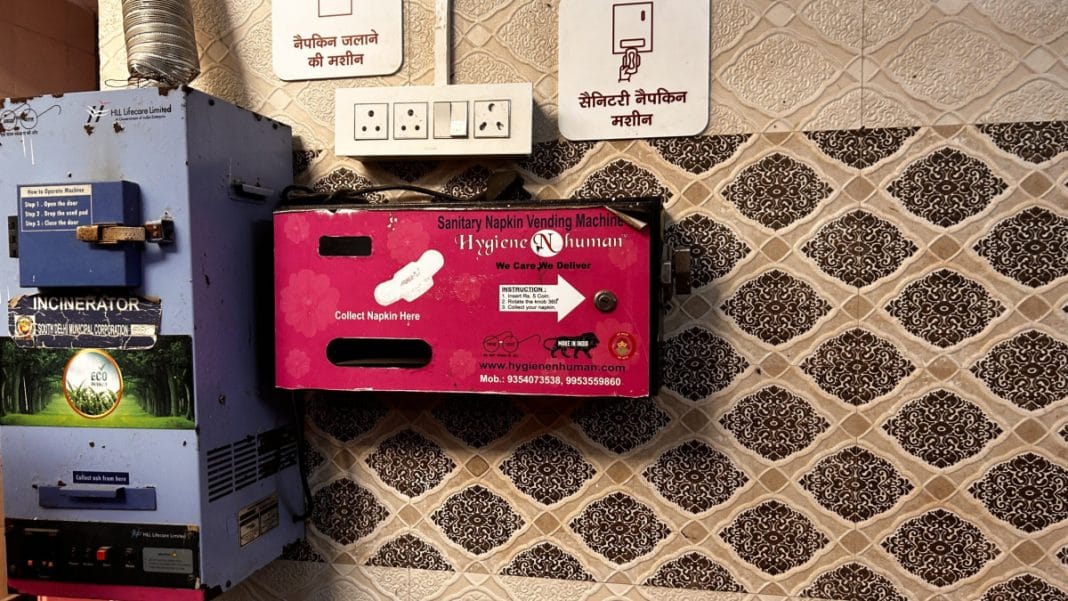
The worst part is that all of these outcomes are easily preventable as long as there are stocked dispensers with sanitary pads. It is important to see pads as a necessity and not something that can be hushed up or ignored.
The logic behind having soap in every washroom should also be used for stocked dispensers as there are enough people whose lives are getting impacted because of lack of one.
It will take time to have fully stocked dispensers as it requires work like machines will have to be installed, stocked, and maintained and then someone will have to push a school or an institution to actually commit to it.
But the work should be logistical, not persuasive. The goal isn’t another campaign explaining why menstruation matters. The goal is to ensure that there are enough installations which are done quietly and consistently so that the next school does not need convincing at all, and it just follows the standard set by the previous school and orders the machine the way it orders soap dispensers.
Institutions that treat mensuration as a basic necessity are the ones that are getting it right. The ones still treating it as an add on are the ones that set up the stigma that women’s basic needs are “optional”.
Soap needed the same argument once which was made with such a force that it stopped needing to be made again and again. Pads deserve the same trajectory, and the sooner that argument gets made and settled, the sooner the need for pads becomes a basic necessity.
Ayana Vardhan is a student of DPS Vasant Kunj, Delhi. Views are personal.
Also Read: The missing word in India’s development story