




New Delhi: Wholesale dog meat vendors and traders in Nagaland are switching to mushroom farming and pickle making. Three major wholesalers permanently left the trade between May and June this year, after having supplied dogs for slaughter and consumption for more than 20 years.
While the state government banned dog trade on 3 July 2020, vendors continued to sell dogs through illegal trading and trafficking networks.
With support from Pro Rural, a grassroots development NGO, and Humane World For Animals India, an animal protection organisation, 30 dog meat vendors—all of them women—have opted for different livelihoods. Another 30 are set to join them over the coming months.
Also read: Amit Rai goes from Oh My God 2 to Ohh My Dog. Humans are second fiddle
The people caught in the trade
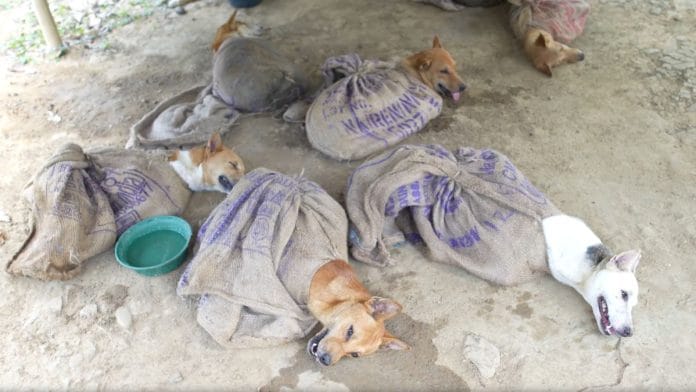
Dogs are routinely stolen or caught from communities and brought to Nagaland, Mizoram, and Manipur. Videos show dogs with metal chains around their necks, and others kept in sacks.
The three wholesalers were key distributors in the region, who supplied dogs for over two decades to Dimapur and Mokokchung districts in the state as well as to Manipur.
In 2025, Pro Rural and Humane World started Models for Change—a livelihood transition programme—in the state. It offered the women vendors an alternative source of income to feed their families.
The wholesalers have voluntarily surrendered 18 captured dogs, the last ones they captured before leaving the trade permanently. Their exit from the large network will likely disrupt the flow of dogs into markets across Nagaland.
After thorough examination, vaccination, and microchipping, the rescued dogs were either adopted by people in Nagaland or sent to Humane World’s shelter.
One of the wholesalers, who was trained in making pickles, had a message for others in the trade.
“The decision was not sudden, as I had been thinking about making the switch for a long time. Apart from making pickles, I have also started a small shop, and I will also be learning mushroom cultivation and baking. To others who are already part of the trade, I would like to tell them that there are more humane businesses out there,” she said.
Keren Nazareth, senior director of companion animals and engagement at Humane World, told ThePrint that the dog meat trade exploits underprivileged people.
“Women under this project have been able to provide a better quality of life for their families. The programme shows such alternative, humane, sustainable, profitable livelihoods are possible for people working in such unsafe livelihoods,” she said. “We will make it stronger”.
Pro Rural and Humane World plan to extend this programme in more districts of Nagaland.
“More women have been reaching out to join the programme,” said Wangshikokla Jamir, project coordinator at Pro Rural. “When we hear about the dog meat trade, it often focuses on animal suffering, but that tells only half the story. The other half is about the people caught up in this trade. Our programme exists to change that equation entirely.”
( Edited by Prasanna Bachchav)