







Winston Churchill’s reservations about the substantiality of India in his jibe, “…no more a reality than the Equator”, has certainly not aged the way it was intended.
The trajectory of India’s democratic footprint has dazzled political pundits and theorists throughout its journey—from an underdog country waking from a long slumber to making its tryst with destiny, to the world’s largest democracy resounding the will of one-sixth of all humanity.
The story of Indian democracy is one of hits and trials from its very conception. Civil servants such as Sukumar Sen, as opposed to his formal training and experience as revenue collector under the colonial regime, became the first election commissioner of India.
India has proven itself to be the pinnacle of democratic refinement through the toughest of times, when most democratic experiments in the sub-continent didn’t last too long.
Indira vis-à-vis Modi: The entanglement of democracy and dissent
The tenure of Indira Gandhi bears an uncanny resemblance with that of Prime Minister Narendra Modi, marked by déjà vu moments, more in domestic spheres, but also internationally—events like the Gulf war and oil shock, border issues and troubles with the US cozying up to Pakistan’s among them. Another striking parallel is what legendary cartoonist R.K. Laxman referred to as the “the elimination of humour from the administration”.
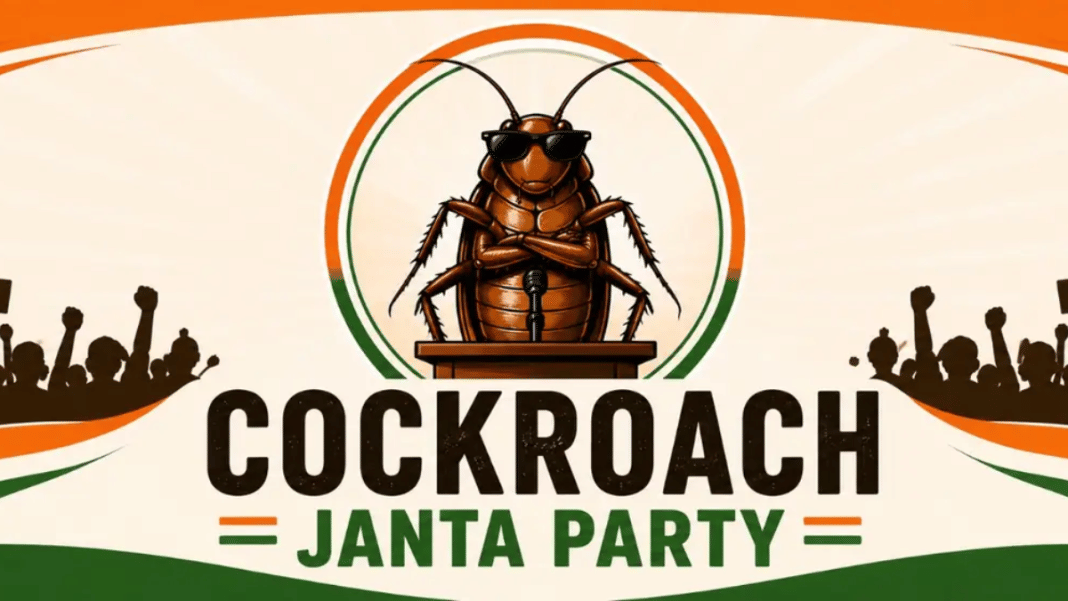
The Cockroach Janta Party (CJP) started off as a satirical platform and quickly morphed into a political movement joined by millions before being withheld “by the government”, as its founder alleges on his X account. The Centre salvaged the move by clearly stating they were acting on the inputs given by Intelligence Bureau (IB) relating to national security concerns. CJP portrays itself as a Gen-Z movement, (un)surprisingly sends shockwaves up to Raisina Hills following the recent developments in India’s neighbourhood.
The government’s crackdown and suspension of CJP’s social media accounts to disband the popular engagement and spread of dissent is akin to the pre-emptive crackdown on the freedom of association during Indira Gandhi’s tenure.
However, it would be unjust to account the feats of the Cockroach Janta Party at par or even on the same page as the JP movement by merely considering its online support base, which hardly accounts for any substantial changes on the ground.
Democratic catharsis: A spark in a powder keg?
PM Modi’s ascent to the office and stay has not been without turbulence and marked by anomic movements and upheavals from the civil society over a number of issues. The farmers’ agitation, anti-Citizenship Amendment Act-National Registry of Citizens, the anti-UGC norms on social discrimination, and the NEET paper leak protests make up a long list of protests that unfurled over the years in and around the national capital. Most of them were accompanied by social media outrage.
In Ideology and Utopia (1929), Karl Mannheim argued that people cannot directly participate in government, but they can make their aspirations felt at certain intervals, and that is sufficient for a democracy.
In a democracy the governed can always act to remove their leaders or force them to take
decisions in the interests of the many. Mannheim insists on shortening this distance between the ruler and the masses to ensure compatibility between the elite rule and a democratic government.
The trend capturing on the Internet has become a regular phenomenon in India and a definitive characteristic of the Modi regime for the years to remember. There are an estimated 23 million to 27 million monthly active users on X, formerly twitter, and 413.85 million users on Instagram (Statista.com 2025) – a figure, when combined, is almost equal to the sum of all active users from the next three countries in the list put together: U.S’s 171.7 million, Brazil’s 140.7 million and Indonesia’s 103.4 million.
This makes social media the most important non-nuclear political artifact of the twenty-first century and circles Mannheim’s utopia on the map of democracy.
The Gen Z protest in the guise of social media uproar and allegory, however, fails to capture the political imagination of the majority-voting population in manufacturing consent and barely budged beyond the tag of a short-lived sensational trend. Still, it managed to dramatically resound what Thomas Jefferson wrote in America’s Declaration of Independence: “…Governments are instituted among Men, deriving their just powers from the consent of the governed.”
The virtual support amassed by the Cockroach Janta Party is indicative of a deepening trend in an era of deliberative democracy and active political participation. The movement itself highlights mass dissatisfaction, among other things belonging to a cohort substantiating class interests of a considerable majority.
Himanshu Tripathi is a PhD scholar at Dr Harisingh Gour Central University in Sagar, Madhya Pradesh. Views expressed are personal.
Also Read: 2026 NEET leak not a one-off incident. It’s part of a larger institutional failure