



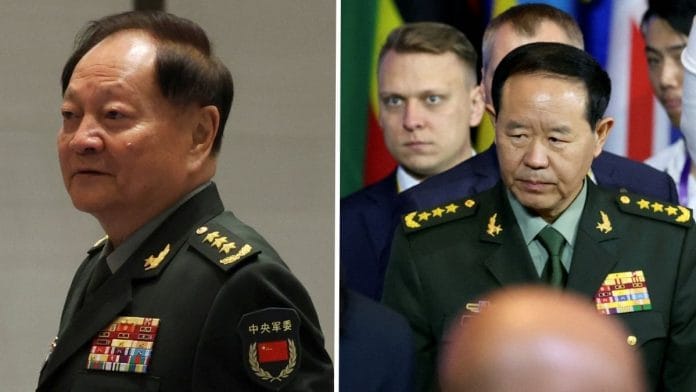
New Delhi: China has removed two of its seniormost military officers, Zhang Youxia and Liu Zhenli, from the Central Military Commission (CMC). The move follows investigations initiated against them in January over alleged violations of discipline and law.
Zhang had been the highest-ranked uniformed officer in the Chinese military, serving as vice chairman of the CMC chaired by President Xi Jinping. He is also a member of the Chinese Communist Party’s Politburo. Liu was a CMC member and chief of staff of its Joint Staff Department.
In January, Xi had abruptly removed Zhang and Liu from the seven-member CMC. Zhang, who stood second only to Xi within the military hierarchy, was seen as one of the president’s closest confidants.
China parallelly maintains the Communist Party and state Central Military Commission structures. Neither Zhang nor Lii have been formally or publicly stripped of their positions on the Central Military Commission of the Chinese Communist Party.
A statement by the Chinese defence ministry statement accused the Zhang of “grave violations of discipline and the law.”
His removal marks the exit of the last of the senior CMC members who were part of the apex military body before Xi’s latest round of appointments. All six commanders appointed by him to the Central Military Commission in 2022 are now away from public eye.
The state Central Military Commission was established under China’s 1982 Constitution as the principal governmental body responsible for “directing the armed forces”. While the Chinese Communist Party’s Central Military Commission provides political direction over military policymaking, the state CMC oversees key military personnel appointments, manages the financial and material resources of the People’s Liberation Army (PLA), develops regulations and implements statutes—intended to give the military a more rational and professional organisational structure.
The chairman of the state Central Military Commission is also designated commander in chief of the armed forces, a departure from earlier arrangements in which either the state president or the party chairman held military command.
In practice, however, the Communist Party’s military commission remains a key institution through which political control over the armed forces is exercised.
The removal of Zhang and Liu is the latest in a campaign under Xi. In 2025, Chinese Communist Party opened more than one million formal investigations into corruption charges, nearly seven times the number recorded when Xi first came to power. That year, the party expelled nine top generals in what became one of the largest public crackdowns within the Chinese military in decades.
With Zhang and Liu under investigation, the state commission was left with only one member besides Xi himself: General Zhang Shengmin, who oversees military discipline and Xi’s anti-corruption campaign. Zhang was elevated to the commission only last year.
In April 2026, Ma Xingrui, the Communist Party secretary of Xinjiang, was placed under investigation. His removal marked the first time since the era of Mao Zedong that three sitting Politburo members had been removed during a single five-year party term.
“What began as an anticorruption push has evolved into an extensive apparatus for managing cadres, enforcing political priorities, and supervising policy implementation,” a May 2026 article in Foreign Affairs noted. “Xi’s discipline campaign should thus be understood as a sweeping effort to transform the CCP itself.”
Many of those removed were members of the party’s powerful Central Committee and among the highest-ranking officers in the Chinese military establishment.
One of the most prominent removals was He Weidong, who was removed from his position as vice chairman of the Central Military Commission in March 2025. He had been the second-highest-ranking officer in China after Xi. He has not appeared in public since March. His removal made him the first sitting member of the Politburo, the Communist Party’s top decision-making body, to be purged in years.
Miao Hua, who oversaw ideological and political control within the military; He Hongjun, executive deputy director of the Central Military Commission’s Political Work Department; and Wang Xiubin, executive deputy director of the Central Military Commission’s Joint Operations Command Centre were all expelled.
Lin Xiangyang, the commander of the Eastern Theatre Command, was removed too. So were Qin Shutong, the Army’s political commissar; Yuan Huazhi, the Navy’s political commissar; Wang Houbin, commander of the Rocket Forces; and Wang Chunning, commander of the Armed Police Force were expelled too.
Separately, on Wednesday, China’s top political advisory body, the Chinese People’s Political Consultative Conference (CPPCC), also removed Zhao Zongqi, the former commander of the Western Theatre Command during the 2020 Galwan clashes, from its membership.
(Edited by Nivedita Patil)
Also Read: India-China agree to push for ‘early harvest’ deal on boundary question after Doval-Wang talks
President Xi has been in office since March 2013. More than one third of a military officer’s career span. At each level of promotion, there is serious evaluation. Also rigorous background checks for integrity, because an officer could be seduced by a foreign power. China has world class surveillance facilities. It is truly remarkable that officers who have risen to such high levels are now being weeded out.