



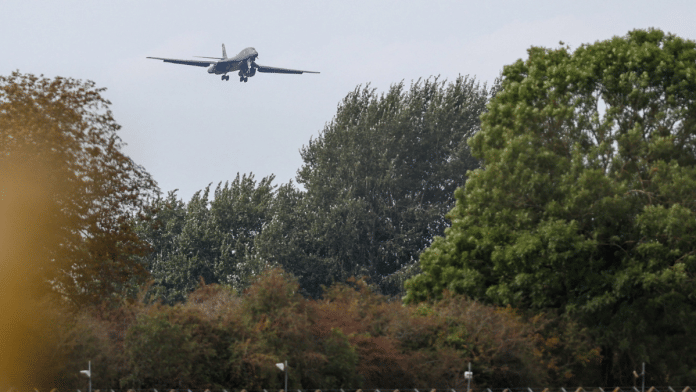
New Delhi: The United States abruptly withdrew all of its 12 B-1 bombers this Sunday from a British airbase in southern England after receiving intelligence about a potential drone attack allegedly ordered by Iran’s Islamic Revolutionary Guard Corps (IRGC), according to a New York Times report.
This came days after British counterterrorism police arrested five men near the base, RAF Fairford, according to the report.
The report says the bombers were moved from the base after US commanders received new information suggesting the aircraft and the hundreds of American personnel stationed at the Gloucestershire air base could be targeted. The base has been used by American bombers in its war against Iran, said the report.
British and US Officials told the NYT the suspected attacks might be part of a wider, multipronged Iranian plot to strike aircraft and potentially kill US personnel at the base.
Iran has denied the allegations and rejected suggestions of its involvement.
The imminent danger at base forced an immediate retreat of the bombers, according to the report. Some bombers and their crews left while aerial refuelling aircraft were still deploying to support their flights back to the US, according to American officials quoted in the report.
Vice President JD Vance said the Pentagon moved the aircraft “out of an abundance of caution” to protect American personnel.
President Donald Trump confirmed that Washington had received information about a threat to the bombers and decided to remove them.
“We had an idea that there might be a threat, and why would I leave them there?” Trump told reporters Monday. Asked whether those behind the threat were linked to Iran, he said they “would be linked to Iran.”
The withdrawal has put the RAF Fairford base at the centre of renewed security concerns, coming days after British counterterrorism police arrested five men near the base and authorities launched an investigation into suspicious activity in the area, according to the report.
The five men were arrested on 27 September after police stopped and searched three vehicles near Fairford. A sixth suspect, a British-Iranian dual national, was arrested in London on 1 October in connection with the same investigation.
The suspects have since been released on bail, but remain under investigation. Counter Terrorism Policing has described the investigation as “hugely complex”, saying officers were examining multiple lines of inquiry, including possible foreign state involvement. Searches of the vehicles found a quantity of petrol but no explosive devices, said the report.
British authorities have indicated that Iran may have played a role in the events surrounding the arrests.
But the US administration has been careful not to publicly establish a direct connection between the arrests and the withdrawal of the bombers.
US Secretary of State Marco Rubio said there was no direct link between the B-1s leaving Fairford and last week’s incident near the base. He said the United States was “constantly reallocating resources” according to its operational requirements.
The distinction is important. While US officials have said new intelligence about a potential Iranian attack prompted the bomber withdrawal, British authorities have not publicly established that the suspects arrested near Fairford were involved in the alleged drone plot.
The Wall Street Journal earlier reported the drone threat as the reason for the withdrawal.
The two developments have nevertheless drawn attention to the vulnerability of a major US military facility in Britain at a time of heightened tensions with Tehran.
Also read: Strait talk with satire? All about Iran speaker Ghalibaf & his cryptic maths taunts for US
Why RAF Fairford matters
Located in Gloucestershire, RAF Fairford is one of the US’ main forward operating locations for long-range bombers in Europe. Unlike a permanent bomber base, the US deploys its aircraft and personnel here for training, exercises, deterrence missions and military operations when required.
Its long runway (about 3,046 meters long) and infrastructure allow it to accommodate large aircraft, including US strategic bombers. The base has supported American and NATO operations in conflicts including the Gulf War, Kosovo and Iraq.
Fairford first opened on 18 January 1944, during the Second World War. It was used in support of Allied operations, including the D-Day landings in Normandy and Operation Market Garden.
During the Cold War, the airfield became part of the US military presence in Britain and acquired a strategic role in American bomber operations in Europe.
The base has remained important to US military planning because of its location and ability to support heavy, long-range aircraft. B-52 bombers have previously operated from Fairford during US deployments to the Middle East, while the airfield has also hosted major military exercises.
Its significance has increased amid the latest confrontation between Washington and Tehran. The base has recently been used to support US military operations involving Iran, making it a potential target for Iranian retaliation.
Iran’s Revolutionary Guards have previously warned countries against allowing the US to use their territory for attacks against Iran. In July, the Guards said any base used to launch attacks on Iranian territory would be a legitimate target for Iranian forces.
The latest threat, therefore, comes at a particularly sensitive moment for the US military presence in Europe.
The B-1 bombers have now returned to their home stations in the United States. The Pentagon has indicated that moving the aircraft out of Fairford does not remove Washington’s ability to conduct long-range strike operations.
For Britain, however, the withdrawal has once again brought RAF Fairford into focus, this time at the intersection of an alleged Iranian threat, a continuing counter-terrorism investigation and the wider US military confrontation with Tehran.
(Edited by Ajeet Tiwari)
Also read: US blockade bottles up dozens of Iranian tankers