



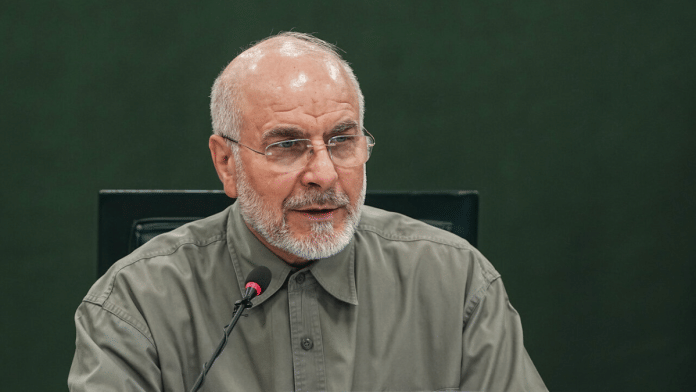
New Delhi: Iranian speaker Mohammad Bagher Ghalibaf is fluent in satire. The 64-year-old, who has emerged as a key interlocutor in the US-Iran war, often uses non-existent equations and formulae, and metaphors to mock the Trump administration.
Take his latest X post, for example. Ghalibaf Wednesday responded to US Treasury Secretary Scott Bessent’s reported claim that Iran “could have nothing left to trade” within two weeks.
“Trajectory of Stress on the House: Ω(t)=Weight/Capacity+Iran Levers Weight↑=(MaturityWall↑+PileOnDebt↑)×Yields↑+YieldVelocity!.Capacity↓=FedRoom↓×(FedParkingLot↓ +Growth?+ForeignBuyers↓+DealersCapacity↓) Iran Levers↑=Energy↑+Bonds↑+OnFed↑Ω(t0)<Ω(Nov)<Ω(2027).”
Trajectory of Stress on the House:
Ω(t)=Weight/Capacity+Iran Levers
Weight↑=(MaturityWall↑+PileOnDebt↑)×Yields↑+YieldVelocity↑
Capacity↓=FedRoom↓×(FedParkingLot↓+Growth?+ForeignBuyers↓+DealersCapacity↓)
Iran Levers↑=Energy↑+Bonds↑+OnFed↑
Ω(t0)<Ω(Nov)<Ω(2027) https://t.co/9sL4pIpXKn pic.twitter.com/NYUnsRRBnG
— محمدباقر قالیباف | MB Ghalibaf (@mb_ghalibaf) September 30, 2026
What looks like gibberish in plain English translates to a rebuff. Ghalibaf, using a fake formula and Looney Tunes (a famous American animated cartoon series created by Warner Bros) characters, claims that US financial stress—driven by heavy debt, rising yields, and a boxed-in Federal Reserve—will “keep growing” through November and into 2027, and that Iran can make it worse by pushing up energy prices and bond pressure.
It is a taunt written in the shorthand of a rates desk, according to analysts who attempted to decode it.
Ghalibaf for dummies
Iran’s parliament speaker, Mohammad Bagher Ghalibaf, quote-tweeted Sean Hannity on U.S. Treasury Secretary Scott Bessent. Bessent said Iran would have “nothing left to trade” in two weeks once its last oil cargoes to China land.
Ghalibaf’s reply: the… https://t.co/2Q4eg5IBud
— Mark (@Mark4XX) September 30, 2026
One of the cartoon characters, Wile E. Coyote, makes the point more bluntly. The cartoon looks at a watch marked “FOLLOW THE WATCH”, gets hypnotised by it, and walks straight off a cliff. The Road Runner—another Looney Tunes character—holds up a sign reading “WALK”.
The implied message is that Washington is so absorbed in the countdown to Iran’s supposed end that it has failed to notice the ground disappearing beneath its own feet.
The jibe lands because the two sides are watching different clocks. Bessent’s clock measures Iran’s remaining economic options. Ghalibaf measures the accumulating costs of forcing those options shut. And Wile E. Coyote, the Looney Tunes character mesmerised by the first clock, has already stepped off the cliff.
Also read: Trump hails ‘very good’ talks with Iran after annihilation threat
Satire as weapon
Using equations as satire is a distinctive feature of Ghalibaf’s style. Last month, he rewrote one of the most famous formulae in central banking.
When the US Federal Reserve, the world’s most powerful central bank, made one of its biggest rate decisions in three years, raising interest rates by 25 basis points last month, Iran’s Parliament speaker took the Taylor Rule, the framework economists use to study where interest rates should be, and inserted two geopolitical variables: the Strait of Hormuz and the Bab el-Mandeb. He called his version the “Straits Taylor Rule“.
The message, delivered from Tehran, was as much a geopolitical taunt as economic argument: the Federal Reserve can raise rates as much as it likes, but it cannot hike its way through a shipping lane.
Back home, however, the quirky negotiator seems to be tackling dissent. A week back, hardline Iranian lawmaker Hamid Rasaei became the first sitting member of Parliament to be jailed, triggering a sharp backlash from ultraconservative figures against Ghalibaf and Chief Justice Gholam-Hossein Mohseni-Ejei.
According to local reports, Rasaei was sentenced to 10 months by the Special Clerical Court over a 2024 newspaper article that accused Ghalibaf of “manipulating parliamentary documents”.
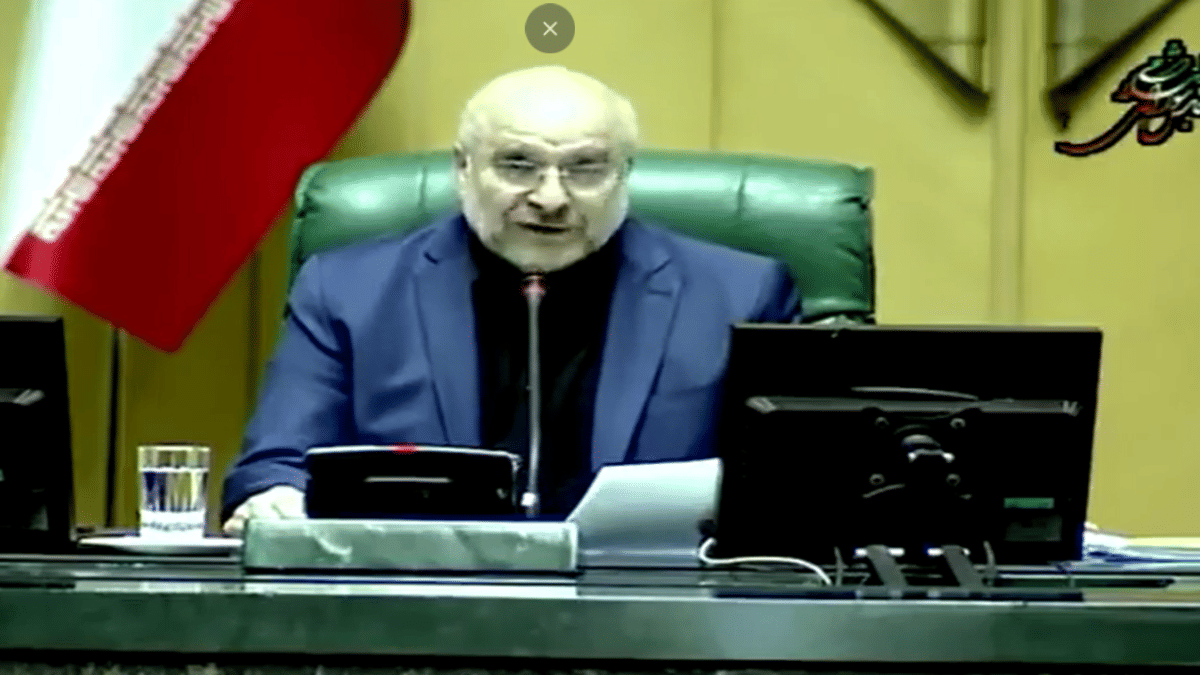
The complaint against Rasaei dates to before he was elected to parliament and concerns a case brought by Ghalibaf against the weekly 9 Dey, where Rasaei was managing director. The complaint followed an article published in January 2024 under the headline “Ghalibaf’s Manipulation of Parliamentary Documents”.
Beyond criticism from ultraconservative politicians, Rasaei’s imprisonment also reportedly drew a strong backlash from media outlets affiliated with the ultra-hardline Paydari Party, or Front of Islamic Revolution Stability, and from former nuclear negotiator Saeed Jalili, a prominent figure in Iran’s principlist and hardline political camp that champions the core ideology of the 1979 Islamic Revolution.
Jalili’s supporters have accused Ghalibaf of “silencing the voices of critics” and allowing a personal dispute over governance to take precedence over Iran’s broader economic and security challenges.
Mohammad Manan Raeisi, a lawmaker who led Jalili’s presidential campaign in the city two years ago, went further, warning that the controversy could provoke a public backlash against Ghalibaf and other senior officials.
“I doubt that under these circumstances people will allow you to appear in any mosque, gathering, public square or religious ceremony. And you may face a popular backlash,” he wrote.
The outsider who is now in the centre
The speaker, meanwhile, has lived multiple lives. The Guardian describes him as “the outsider who survived”. Arab outlets have labelled him the “ambitious public face of post Khamanei Iran”.
He is, among other things, a former Revolutionary Guard commander, a trained pilot, a professor of political geography, a former police chief, a former longtime mayor of Tehran, an unsuccessful presidential candidate and, since 2020, the speaker of Iran’s parliament.
Much like the current set of IRGC hardliners, he entered IRGC during the Iran-Iraq war. His brother Hassan was killed in the conflict.
At 21, in 1982, Ghalibaf became commander of the IRGC’s Imam Reza Brigade, and later commanded the Fifth Nasr Division, formed during the Iraq war.
In 1994, Ali Khamenei appointed him as head of Khatam al-Anbia Construction, the Guard’s engineering arm. Three years later, Khamenei named him commander of the IRGC Aerospace Force. In 2000, he became Iran’s police chief.
Ghalibaf, who holds a PhD from Tarbiat Modares University on the evolution of local institutions in Iran and serves as a teacher at the University of Tehran, became mayor in 2005 and remained in office until 2017. His political ambitions were always visible. He ran for president thrice but could never win. He came fourth in 2005, and second to Hassan Rouhani in 2013.
In 2024, he ran for the presidency again but this time a corruption case came his way. By 2020, he had become speaker of Parliament. His political identity has been described as centre-conservative. His importance changed after the outbreak of war.
The Guardian compared his emergence to the 1967 Grand National, when a horse moved forward after a pile-up near the finish. “Just as in 1967 when a rank outsider won the Grand National due to a massive pile-up of other horses at one of the final fences, Mohammad Bagher Ghalibaf, the speaker of Iran’s parliament and Donald Trump’s putative interlocutor, appears to have come to the front as the field around him rapidly thinned.”
But the same article cautioned against imagining him as Iran’s new sovereign. “In the pantheon of Iran’s leaders, ruthlessly reduced by targeted assassinations, Ghalibaf stands out as a survivor, but if the US president hopes he has finally located the Delcy Rodríguez of Iran—a pragmatic leader from within the regime willing to do business with America—he may need to think again.”
However, during the Islamabad talks in April, The Washington Post reported that Ghalibaf had impressed the American delegation as a“refined and professional bargainer—and potential leader of a new Iran”.
But how much power does he hold? That remains the essential question.
Farzan Sabet, a managing researcher at the research university Geneva Graduate Institute, said in an Al-Monitor article, “Following (former security chief Ali) Larijani’s assassination, Ghalibaf has emerged as the new public face of the Islamic republic’s war effort and diplomacy, but we shouldn’t overstate the extent to which he’s in the driver’s seat: He still answers to higher powers in Tehran.”
(Edited by Ajeet Tiwari)
Also read: One side just overplayed its hand in Iran, writes Marc Champion