



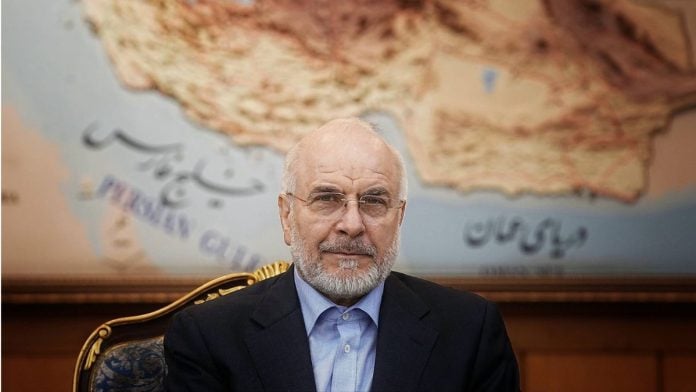
New Delhi: Hours before the US Federal Reserve, the world’s most powerful central bank, made one of its biggest calls in three years and raised interest rates by 25 basis points, the Speaker of Iran’s Parliament pulled up a decades-old economic formula that every central banker on the planet swears by, and quietly rewrote it, introducing terms for the Strait of Hormuz and Bab el-Mandeb.
Essentially, Mohammad Bagher Ghalibaf’s message from halfway across the world was: you can hike rates all you want, but you cannot hike your way through a shipping lane. Does the economics behind the Ghalibaf joke hold up? ThePrint unpacks what the Iranian leader actually did.
On Wednesday, the Federal Reserve raised its benchmark interest rate by 25 basis points, to a target range of 3.75 to 4 percent, its first hike in three years, approved unanimously, under new Fed Chair Kevin Warsh. The move came as inflation stayed stubbornly elevated, driven in large part by rising energy prices.
Hours before that decision, Ghalibaf posted something economists don’t usually expect from a politician—a rewritten version of one of the most famous formulas in central banking, what the Iran Speaker called the ‘Straits Taylor Rule’.
Straits Taylor Rule:
i = r* + π* + 1.5(π−π*) + 0.5(y−y*) + α(SOH−SOH*) + β(BEM−BEM*), α,β > 0
Let’s see if a hike could open SOH or produce a single barrel 🙂
You can’t 25bp a chokepoint and r* isn’t neutral. It’s SOH risk premium, and We set it.
Stay unanchored !
— محمدباقر قالیباف | MB Ghalibaf (@mb_ghalibaf) September 16, 2026
The real Taylor rule
The Taylor Rule was proposed in 1992 by American economist John B. Taylor, and it’s the formula central banks use as a rough guide for setting interest rates.
Simply put, it says: the interest rate a central bank sets should depend on two things. First, how far inflation is from its target. Second, how far the economy’s output is from its full potential. If inflation runs hot, raise rates. If the economy is running below potential, cut rates.
Buried inside the formula is something called r-star (or r*)—the ‘neutral rate of interest’. This is the interest rate that neither speeds up nor slows down the economy—its balance point. Central bankers spend a lot of time trying to estimate where r-star actually sits, because everything else in the formula is built atop it.
Also Read: Op Epic Fury cost US $33.4 billion. 7 killed in action, 417 wounded, 52 aircraft & drones lost
We’ve seen this before
To understand why Ghalibaf’s joke actually lands, we need to go back to the 1970s.
In October 1973, the Organisation of Petroleum Exporting Countries (OPEC)—led by Arab oil producers—imposed an oil embargo on the US as retaliation for American support to Israel during the Yom Kippur War. Oil prices quadrupled in a matter of months. The US Fed, then led by Arthur Burns, faced exactly the dilemma Ghalibaf is describing today.
Inflation was surging. But it wasn’t because Americans were spending too freely—it was because the price of oil itself had exploded, virtually overnight, for reasons that had nothing to do with US monetary policy.
The Fed at the time tried to fight this with interest rates anyway. The result was stagflation —a toxic mix of high inflation and high unemployment that plagued the American economy for the rest of the decade. It took until the early 1980s, under Fed Chair Paul Volcker, and a much more aggressive, sustained campaign of rate hikes, to finally bring inflation back under control — but at an enormous cost, including a deep recession.
Economists have studied this episode extensively. Nobel laureate Milton Friedman famously argued that inflation is, in his words, “always and everywhere a monetary phenomenon”, a position that shaped decades of central banking.
But economists like Robert Barro, and later Olivier Blanchard, pushed back specifically on oil shocks, showing that supply-driven price spikes behave very differently from demand-driven inflation, and that traditional monetary tools are blunt, costly instruments against them.
That’s the exact debate Ghalibaf dropped into.
The Iranian rewrite
What Ghalibaf actually did was bolting two new terms on the Taylor Rule—one for the Strait of Hormuz, one for the Bab el-Mandeb Strait, two of the most critical oil shipping chokepoints on the planet.
His argument, in plain language: inflation right now isn’t a demand problem. It’s a supply problem. Oil is expensive not because Americans are spending too much, but because two of the world’s most important energy shipping lanes are under threat.
And a 25-basis-point rate hike—a quarter of one percent—does nothing to fix that. Ghalibaf was blunt: “You can’t 25bp a chokepoint.” You cannot raise interest rates and magically reopen a strait, or produce a barrel of oil out of thin air.
Strait talk
It’s worth pausing here on just how much leverage that chokepoint actually represents. The Strait of Hormuz, at its narrowest point, is only about 33 km wide, yet roughly a fifth of the world’s total oil consumption passes through it. It is, by a wide margin, the single most important oil transit point on Earth. The Bab el-Mandeb Strait, connecting the Red Sea to the Gulf of Aden, is smaller in volume but strategically just as sensitive, since it’s the gateway for shipping trying to avoid a much longer, costlier route around Africa.
When either of these chokepoints is threatened, the effect isn’t abstract — it shows up directly in freight costs, insurance premiums for tankers, and ultimately, the price at the pump. That’s precisely the transmission mechanism Ghalibaf is pointing to with his alpha and beta terms in the formula—the idea that geopolitical risk around these waterways gets priced directly into what should, in theory, be a ‘neutral’ interest rate.
Is Ghalibaf right?
Is the underlying economics sound? Largely, yes. Ghalibaf is tapping into a real, well-established idea—the difference between demand-side inflation and supply-side inflation.
Interest rates are a demand tool. They work by making borrowing more expensive, cooling off spending and investment. That’s very effective when inflation is caused by an overheating economy.
But when inflation is caused by a supply shock—a war, a blocked shipping lane, an oil embargo—raising interest rates doesn’t fix the shortage. It just adds the pain of higher rates on top of the shortage, precisely the lesson from the 1970s.
Ghalibaf saying the Fed’s ‘neutral rate’ isn’t really neutral—that part of it is just a hidden risk premium tied to the Strait of Hormuz—is a real, defensible economic point, even while using it to score a geopolitical jab at Washington.
And that’s really the cleverness of his post. He signs off by saying, “We set it”—meaning, Iran controls that risk premium, because Iran effectively controls access through Hormuz.
His closing line was “Stay unanchored”—a pun on one of the most important phrases in central banking: ‘anchoring inflation expectations’. That’s the Fed’s job—convincing markets and the public that inflation will return to target, so nobody panics and prices don’t spiral. Ghalibaf is saying, essentially: good luck anchoring expectations, when we control the chokepoint.
Is this a joke? Yes. But it’s built on a genuinely sound piece of economic theory—one the world already learned the hard way once, in the 1970s. Monetary policy is the wrong tool for a supply-side, geopolitical inflation problem.
And Ghalibaf’s meme is really just a modern, sharper-edged version of the same lesson Arthur Burns and Paul Volcker learned 50 years ago: when energy chokepoints are contested, central bankers can raise rates all they like—but they are fighting a battle interest rates alone were never designed to win.
(Edited by Nardeep Singh Dahiya)
Also Read: Iran war-risk pushes tanker freight higher for India. Even alternative crude routes not immune