



New Delhi: Damages of nearly $184 million to diplomatic facilities, 14 military casualties, including 7 killed in action, and 417 wounded—the Operation Epic Fury (OEF) resulted in substantial losses to the US that is still in conflict with Iran.
The findings, according to a report released by the Pentagon’s Inspector General and presented to the US Congress on 15 September, also mentions that 52 military aircraft and drones were either damaged or destroyed during the 38-day operation that concluded 5 May. The operation, carried out by the US and Israel, was done with the objective of dismantling the Iranian regime’s security apparatus.
Giving details of the human losses, the Department of War (DoW) mentioned that six personnel were killed in Kuwait’s Port Shuaiba on 1 March. The seventh service member was lost on the same date in Saudi Arabia.
Four additional service members—3 in Jordan and 1 in Iraq—were killed in action in July, it added.
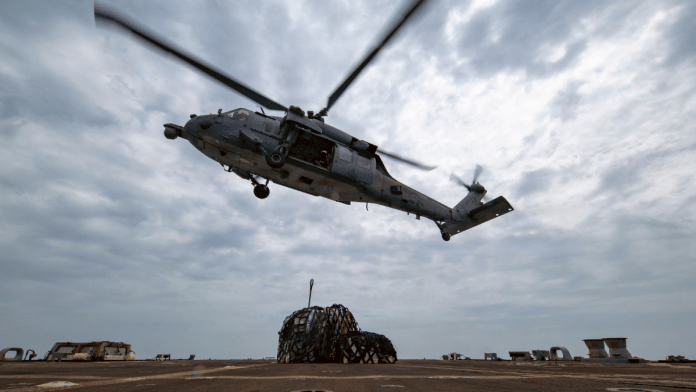
As for the non-hostile deaths, six perished in a KC-135 crash in Iraq on 12 March and 1 other in a MH-60S helicopter crash in the Arabian Sea on 1 July, according to the report.
Under the Defense Casualty Analysis System, all casualties before 7 July were listed as part of OEF, while those later were identified as having occurred during ‘overseas operations’.
The US Central Command (CENTCOM) gave details of 52 aerial assets, including 30 MQ-9 Reapers, lost in various theatres. Four F-15E fighters were destroyed, out of which 3 were due to friendly fire and 1 from enemy fire. A F-35A fighter was lost due to enemy fire over Iran.
An A-10 attack aircraft was destroyed and jettisoned due to damage on return from a Combat Search and Rescue (CSAR) mission. Five KC-135 refuelling aircraft were damaged or destroyed on the ground in Saudi Arabia by Iranian munitions while one was damaged and another destroyed in a collision over Iraq.
An E-3 airborne early warning and control (AEW&C) system was damaged on the ground in Saudi Arabia by Iranian strikes.
Seven helicopters were either damaged, destroyed, or crashed in the same period. A HH-60W helicopter was damaged during CSAR operations, 4 AH-6 copters destroyed during CSAR operations as they were deemed unrecoverable, and another AH-6 shot down over the Strait of Hormuz. A MH-60 copter crashed over the Arabian Sea.
Apart from 30 MQ-9 Reapers destroyed in various circumstances, one MQ-4C high-altitude long-endurance uncrewed aircraft was reported to have crashed.
In the report, the cost calculated for the operation by the DoW was $33.4 billion, including $22.3 billion on munitions, as of 29 June.
Also Read: Iran war: Pentagon separates July casualties from Op Epic Fury toll as wounded count jumps to 624
Damages to diplomatic facilities
Additionally, the document states that American diplomatic facilities in Iraq, Kuwait, Saudi Arabia and the UAE suffered physical damage from Iranian strikes, with an estimated cost of about $184 million. Iraq alone suffered $157 million in damages.
Mission Iraq, a non-combat advisory and capacity-building mission, experienced more than 600 attacks. The U.S. Consulate General in Erbil’s new consulate compound suffered damage to multiple buildings. The embassy in Baghdad also suffered damage but to a lesser extent. The Baghdad Diplomatic Support Compound, located near Baghdad International Airport, was also extensively damaged.
In Kuwait City, the embassy suspended operations on 5 March due to ‘regional tensions,’ strikes, and damage to embassy facilities. Attacks forced its immediate closure and departures of personnel.
Although Secretary of State Marco Rubio traveled to Kuwait on 30 June and reopened the embassy that resumed providing limited emergency services for U.S. citizens as well as consular support, the majority of embassy staff remained on ordered departure as of 30 June, according to the Department of State.
Two Iranian drones struck the US Embassy in Riyadh, causing material damage. After the incident, the embassy issued an order of “shelter-in-place” to staff in Jeddah, Riyadh, and Dhahran and warned the public to “avoid the embassy until further notice due to an attack on the facility.”
The US Consulate General in Dubai sustained damage to a utility building.
Between 23 February and 3 March, 12 US missions in West Asia and Europe initiated requests on behalf of staff to go on authorized departure or ordered departure, according to the report.
By 30 June, 9 missions remained on ordered departure, with personnel and families returning to post only in the U.S. Consulate General in Adana, Türkiye, and the U.S. Embassy in Nicosia, Cyprus. The embassy in Kuwait City reopened in June. However, most of the embassy staff remained on ordered departure.
At the peak of the 23 February-30 June period, nearly 3,500 diplomatic personnel were at maximum either on authorized or ordered departure, or already out of the host countries.
According to the Department of State, all embassy services in the region were affected during OEF, depending on the severity of hostility directed toward particular posts.
(Edited by Tony Rai)
Also Read: 42 American aircraft lost during war against Iran in Operation Epic Fury, reveals CRS report