







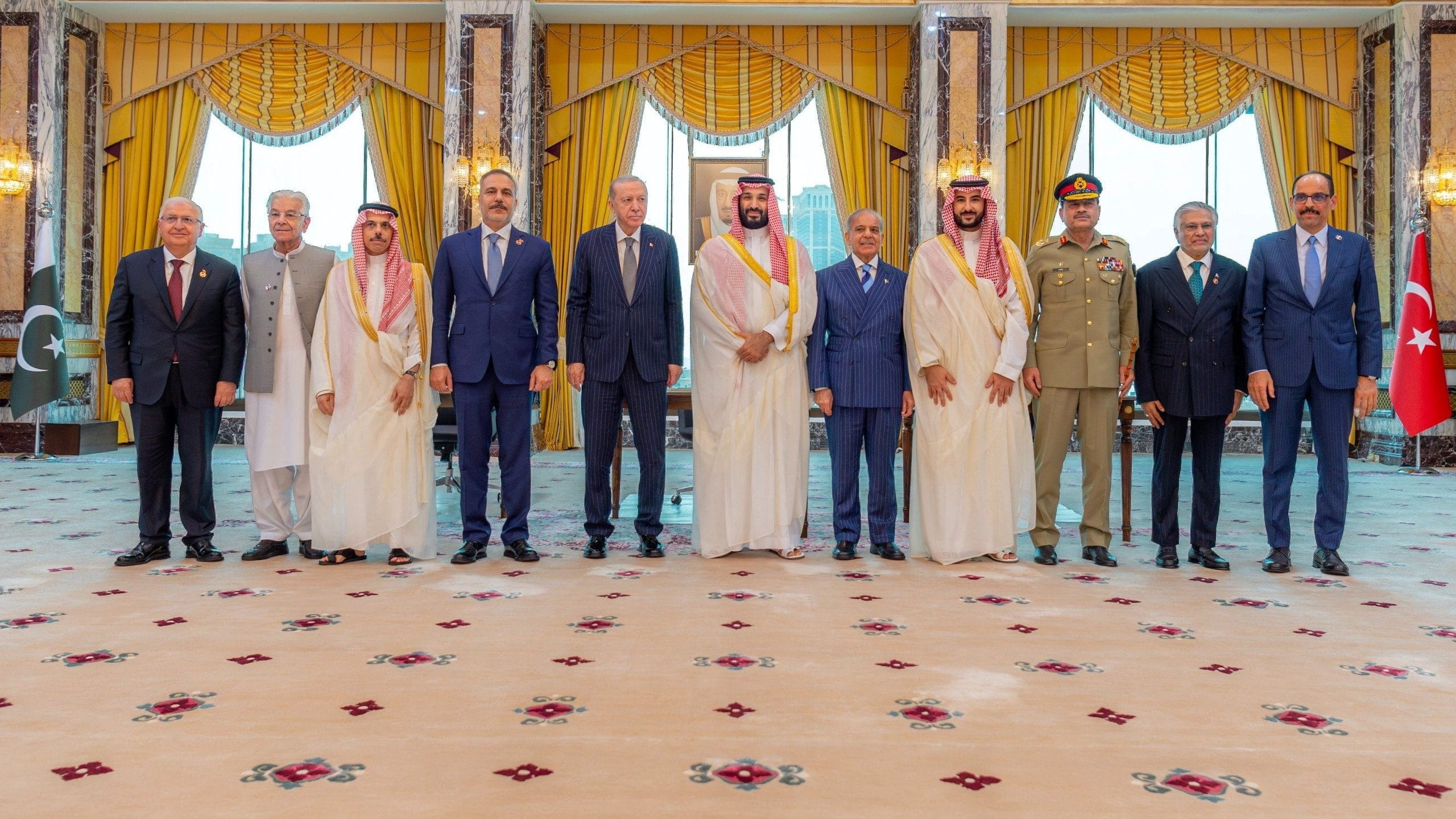
New Delhi: The tripartite defence agreement between Pakistan, Saudi Arabia to its west, and Turkey to the northwest of the kingdom—includes three sizable Islamic countries, two of them quite populous as well. Pakistan has the second-highest Muslim population, after Indonesia, and Turkey is among more populous nations in the Islamic crescent, from the Gulf region all the way to Europe.
These three countries signed what they called the Makkah Accords— formally the Makkah Joint Defence Agreement—last Friday. It’s been almost five days, but I’m still not sure what’s new in the agreement. Because there was already a mutual defence agreement between Pakistan and Saudi Arabia. There was an old agreement; they keep dusting up that old agreement every now and then and adding new elements to it, which is what they did last year. Now they’ve added one more country. What it means is the question that we need to examine.
Mix it up: Now, how to describe this? I don’t want to say old wine in a new bottle, because these are three Islamic countries. Let’s be politically correct. So we can call it the same thandai or lassi or chaas or buttermilk or Kool-Aid in the same bottle. What has changed now? What has changed now is that so far, because Pakistan and Saudi Arabia had it, maybe this drink was coloured green. Now they’ve got Turkey in, so they’ve added a dash of red to it. So you can imagine what that colour will be.
The reason I’m using the colour imagery also is the way the Pakistanis celebrated it. This Monday, for example, the Pakistani authorities instructed or ordered their restaurants, clubs, etc., at least in Lahore if not elsewhere, to light up their buildings in red and green. What that indicates, metaphorically, is that this is not a monochromatic Islamic alliance, because the Turkish flag has the crescent moon and star but on a red base. That’s how Turkey comes in.
Also Read: Three countries, no common enemy—why the Mecca defence pact is weaker than it looks
Enmity, insecurity: Now, what does an agreement like this mean? The first question that will arise is: who’s the enemy this is about? The North Atlantic Treaty Organisation (NATO) came into being as an agreement to protect Europe and American interests from the Soviet Union. This may have been handy in some other situations, say, when the Americans claimed a threat in Afghanistan. Then there’s Article 5 of the NATO charter, which means an attack on one is an attack on all, and all come to the aid of one. But generally, NATO’s enemy was the Soviet Union. That’s why it remained a cohesive alliance. And the fact also is that ever since the Soviet Union declined, this alliance was losing energy. NATO was losing energy. There were debates later about why NATO was needed because the Soviet Union was gone. There was a time, in fact, when there was talk of Russia joining NATO as well. All that’s now over. That equation reversed with the Russian invasion of Ukraine four years back. Once again, there was a common enemy.
In this case, there is a very fine article that Dr Swasti Rao, our consulting editor for strategic and foreign affairs. She says, and I steal this line from her, that for any such agreement to work, it needs three E’s. The first is the enemy. Second is the economy. And third is efficiency. So she’s described these in detail. I’ve just stolen the basic idea from her. And then I will go off a couple of tangents as I always do, and give you the picture as I see it.
So the enemy is the key thing. Let’s not look at the enemies first; let’s think of insecurities. Which of the three is the most insecure? Which is number two in insecurities? And which is number three? Let’s grade them on a scale of 10.
On a scale of 10 on insecurity level, Saudi Arabia, I say it with a straight face, gets 10 out of 10. And I will explain that.

Pure mischief: Pakistan gets 5 out of 10 as long as they decide to stay out of India’s hair. But if they decide to continue investing in more Pulwamas or more Pahalgams, they will face retaliation from India, and each time the retaliation will get bigger, and there will be a risk of greater escalation. If they are taking pangas with India, then their insecurity is 10 out of 10. If they, or rather their army, are not taking pangas with India—which they will not if they are sensible, but with the Pakistanis you can never say that—their insecurity level is 5 out of 10.
Why even 5? That’s because all of their western frontier has come alight. They have Tehreek-e-Taliban Pakistan, which mainly involves a Pashtun population. Then they have the Balochistan Liberation Army and other Baloch groups. And then they have tensions with Afghanistan. Their borders with Iran are more or less open and porous. They’ve got a real problem there. They’ve also got lots and lots of empty spaces, particularly in Balochistan. They’ve also got some mineral wealth in Balochistan, so they want peace there. They’ve got all of these problems, plus they’ve got sectarian issues within their own society. Right now they are a bit suppressed, but they come up anytime. So I would say Pakistani insecurity is 5 out of 10; all of it comes from within. But if they decide to provoke India, or if they decide that adventurism vis-à-vis India is so vital for their national security or their national interests or the army’s own tribal interests that they must do it, then it goes to 10 out of 10.
Also Read: Chinese commentary frames the Mecca pact as a ‘money, gun and nuclear’ combination
Talking Turkey: Then we come to Turkey. I am inclined to say 0 out of 10 because Turkey has no enemies. But I will still put it at 1 out of 10 because Turkey worries a great deal about Kurds in its north and a couple of other small groups, and Erdogan also worries about some groups that might threaten his presidency. But all of those are internal issues and very small. Turkey has a very large defence machinery, very large and modern armed forces. Turkey has zero external insecurity because, remember, Turkey is a member of NATO. An attack on Turkey by another country is an attack on all NATO countries. So Turkey has that security. Turkey even has a bunch of American bombs, I think about 60, stored on its territory at the Incirlik airbase. So Turkey is very secure because of the Kurds and because they want to take on Israel for control or some mischief in Syria.
Is Israel Turkey’s enemy? First of all, Turkey is too large, too powerful—and it is a NATO member—for Israel to take on. Second, Turkey was the first Muslim-majority country to recognise Israel in 1949. They don’t have active diplomatic relations now, but that relationship exists. And in some ways Turkey is in the same box as Egypt, because Egypt is dependent on America for its security and much else. Similarly, Turkey is a member of NATO. So Turkey really has no enemies. So what is Turkey searching for?
Oil’s not well: Saudi Arabia right now has a very active threat from Iran. Iran, whenever it chooses, sends a few missiles or a few drones at Saudi Arabia. It has also affected Saudi Arabia’s defence network or defensive shield, because Saudi Arabia’s defensive shield was the American bases in Saudi Arabia. Now, as long as the bases are there and active, Iran says they can keep on attacking those bases, and they can keep on attacking Saudi Arabia.
Saudi Arabia doesn’t want that. It’s a very soft state. It has a large military, lots of spending. Saudi Arabia has no stomach for any combat — least of all for any combat or any destruction or any attrition on its own soil. That is the reason it also stopped the Americans from using their airbases on its soil during Donald Trump’s Operation Freedom when he wanted to reopen the Strait of Hormuz. And since then, Americans have not been so active from bases in Saudi Arabia. So Saudi Arabia now feels sort of denuded and fully exposed to a much bigger power: Iran.
Besides having a much larger population and being a large nation, Iran also has an ideological issue with Saudi Arabia. Saudi rulers are the custodians of the holy mosques. They also represent Sunni Islam in its most conservative form. Iran, on the other hand, is Shia. But every Muslim has an equal right to the holy places in Saudi Arabia. And that contest continues. Saudis are very scared of Iran, and they do not want hostilities to begin at any point of time. They would rather go and make a deal with Iran of any kind if the Americans would permit them. So that is their one big insecurity. In fact, out of the 10, I would say at this point that will be about 4.
Where does the rest of Saudi insecurity come from? The Saudi defence budget for this year is about $72.7 billion. India with its borders, nearly 1.4 million soldiers under arms has a defence budget of only $82.34 billion. Saudi Arabia’s is $72.5 billion, and that despite the fact that for the past couple of years it’s been lower than before. Back in 2015, Saudi Arabia spent a great deal on defence, one-and-a-half times India’s spend. For many years, it has been the largest defence arms importer in the world, bigger than even India whose defence budget in 2015 was $51.3 billion.
Once again, the Saudi defence budget usually follows crude prices. If crude rises, they spend more. In 2015, crude had fallen, but in the years preceding 2015, it was red hot, reaching $140 a barrel at one point. All that surplus money was spent on Saudi defence. So they’ve been averaging $80 billion-plus for a decade. That is much more than the Indian defence budget every year. This amounts to 6.5 to 7.5 per cent of their economic output in different years. And yet they’ve proven incapable of even fighting the Houthis successfully.
Also Read: The Mecca pact repeats America’s failed Cold War bet on Pakistan
The Houthi horror: The Houthis are very well organised, but they don’t have a country. They have half a country, and are a proxy of the Iranians. The Saudis, even though they launched a multinational assault on the Houthis in 2015 were not been able to control the Houthis. In fact, as we speak, over the last couple of days, Houthis have launched fresh missile and drone attacks on Saudi Arabia, including one of their critical refineries and one of their ports as well.
Why are the Saudis so scared of the Houthis? Because earlier, originally, the scare was that the south of Saudi Arabia was very empty. It’s impossible to police that area, to build defence, to police that border. They were afraid that Houthis would come in and occupy their territory without anybody figuring it out. Then the Houthis expanded the threat to Bab-el-Mandeb. Bab-el-Mandeb connects the Red Sea with the Indian Ocean. That is the other chokepoint in the oil-shipping zones of West Asia. The Red Sea is also where shipping from Europe comes in through Suez. So when the Houthis started attacking that shipping, that was seen as an attack on global shipping, Western shipping, etc. It wasn’t seen particularly as an attack on Saudi shipping because Saudi oil was coming out through the Strait of Hormuz.
Now that the Strait of Hormuz has problems, Saudis are pumping oil at extra speed through the pipelines that they built to their Red Sea ports. The idea is that this oil will come through the pipelines and tankers will fill up at the Red Sea ports. Then some will go to Europe through the Suez Canal. The others coming into Asia will come through Bab-el-Mandeb. Now the Houthis have said that they will attack these ships also, and some ships have been attacked. And alongside this, the Houthis are attacking these ports on the Red Sea. Now if these attacks continue and the Red Sea ports are blockaded, and the Strait of Hormuz, on the other hand, remains unstable as it is right now, then the Saudis are in deep trouble, Trump or not. So that is their other big insecurity: that they started a fracas with the Houthis, and they have not been able to close it. If anything, Houthis now have the power of sea denial also and port denial over Saudi Arabia as well. So the Houthi situation, I’d say, is another 3 on that scale of 10. So 5 for Iran, 3 for the Houthis.
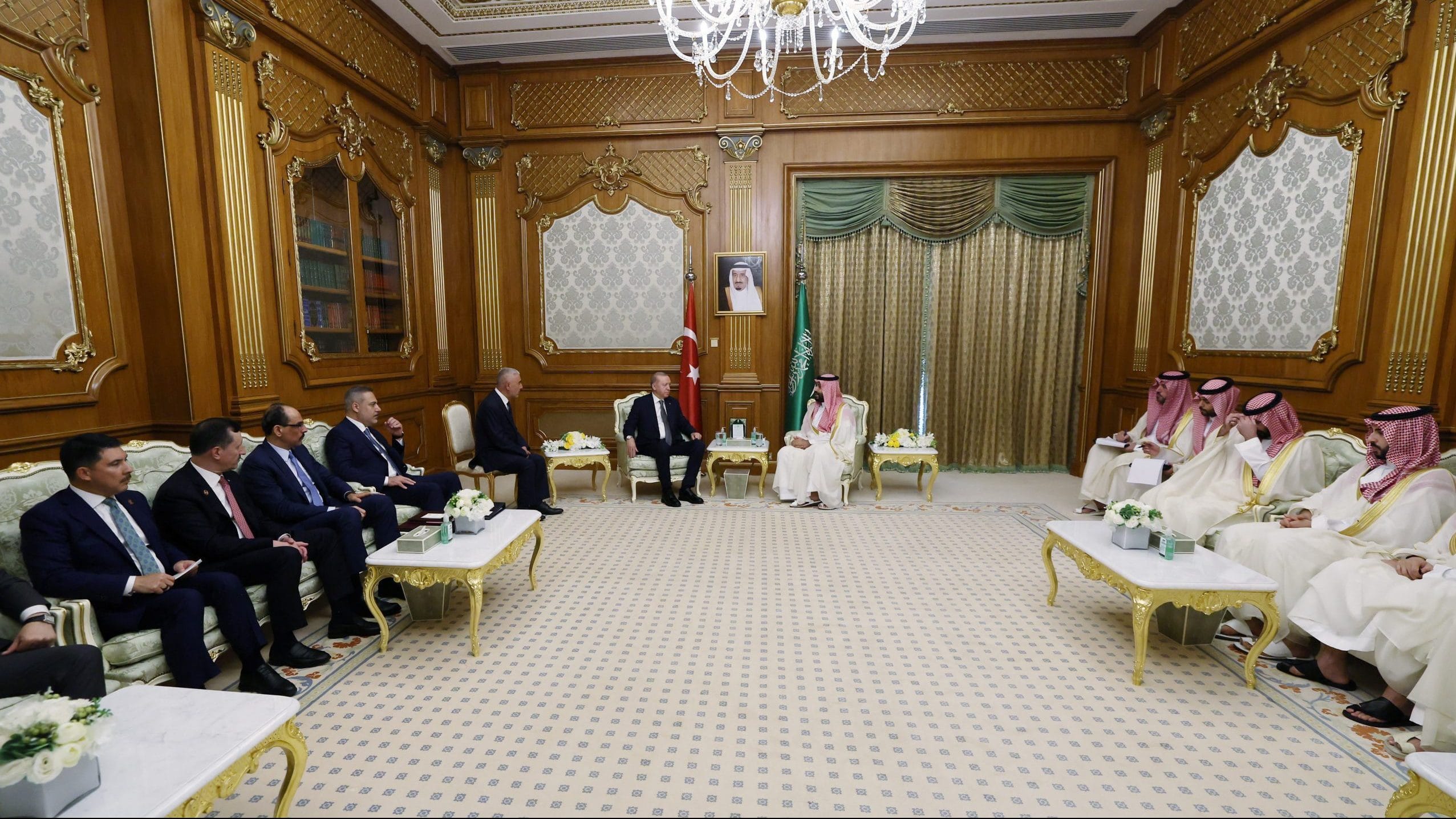
Continental drift: Where does the remaining come from? The 2 comes from plain hubris. Saudi Arabia thought that now they had the money, they had the military muscle, and they could also gift a lot of military equipment. And if you have a colonial mindset, you want to fight a war in Africa. So Saudi Arabia got involved in Sudan on one side — that is the Sudanese National Forces (SNF), whereas Emirates started supporting the other faction, the RSF of the Rapid Support Forces. (Link to full episode on Sudan in description)
In Yemen, until an agreement came about lately, Saudi Arabia and the United Arab Emirates (UAE) were on opposite sides. Saudi Arabia wanted the country to stay together and would have supported the original government there, whereas the UAE seemed happy with the division of the country. If a division of the country takes place, then Houthis take the north, and that exposes all of Saudi Arabia’s underbelly to them. They didn’t want it. So right now there seems to be a truce. Similarly in Libya. In Libya, we know there are two factions. (Link to full episode on Libya in description). There are two factions. One is the third serving Field Marshal in the world, except that he’s got no nation. Field Marshal Haftar, whose forces control the Benghazi area, says about half of Libya, their capital. The real capital of Libya, Tripoli, is with the other group, that is the GNU or Government of National Unity. So Saudi Arabia has been supporting the Government of National Unity. UAE is backing Haftar. Haftar is one to whom Pakistanis thought they could sell some weapons, including JF-17s, and that is something the Reuters Bureau from Pakistan has been talking about for more than a year now.
Never mind the fact that Libya is under a UN arms supply embargo. You know, countries keep giving them arms; even Turkey gives them arms, but all of that is against the embargo. Can Pakistan go against that embargo and sell fighter planes? It’s impossible. It’s not going to happen. Even for that to happen, somebody will have to underwrite it. Similarly, there were several claims about Pakistan selling fighter planes to Sudan. Once again, that’s an impossibility unless one of these two countries, Sudan or the UAE, depending on which faction Pakistan sells those planes to, underwrites that. That’s also not going to happen because the Chinese are also going to have a say in where those planes are sold because these are not countries where other nations want their weapons or their armies or their diplomatic interests to clash with anybody. Now each of these—Yemen, Sudan and Libya—is one point each on that scale of 10 of insecurity for Saudi Arabia. The 10th comes from the Horn of Africa.
Brittle big Horn: It’s a fascinating story there. In Somalia, UAE and Israel have recognised the US Republic of Somalia, whereas Saudi Arabia, Pakistan, Turkey, they support Somalia. In fact, it’s just last week that Pakistan signed some kind of an agreement with the government of Somalia. Now, I told you how much Saud Arabia spends on defence and how much they have bought for it. Then we’ll think about why they still feel insecure. How come all this investment has bought them no sense of security? Look at the size of their armed forces: it’s about 250,000. Turkey is at about 4.8 lakh.
Also Read: Pakistan orders Islamabad restaurants to go red and green to celebrate Saudi-Turkiye pact
Missing josh: The Saudis have over 200 F-15 E strike aircraft, 59 F-15C air superiority aircraft—a top-of-the-line world class aircraft—72 Eurofighter Typhoons, then Tornadoes, I think 30 or 40 of those, then they have 22 refueller aircraft, including six Airbus 330 MRTs Those are the ones that the Indian Air Force has been eyeing for a long time, but these just cost so much that the rethink has always been there. There are 707 and C130 refuellers, and five E-3 Sentry AWACS aircraft. That is Saudi air power. And yet they cannot counter Iran. Why? Because they simply have no inclination to fight anybody. They are combat shy. They are contact shy, and they are attrition shy. That’s why they’ve been renting the Pakistan Army for many decades now.
Now we come to Turkey’s defence budget of $30 billion. They have 240 F-16 aircraft. That’s relevant because those could be loaned to Pakistan without pilots in case of a war with India. Remember, in 1971 some Islamic nations lent their aircraft. Jordan lent a squadron of F104s famously in 1971: the Starfighters. The Iranians also offered their bases for parking Pakistani aircraft away from Indian Air Force attacks.
Will Turkey do this? I don’t know, but that’s a relevant fact. And Turkey only has internal issues. It does face economic challenges. The inflation rate in Turkey has really fallen. It has really fallen to what? 31.75 per cent, which means every month prices are going up in Turkey by 1.78 per cent. The Turkish Lira used to be 7.43 to the dollar in 2021; it’s at 47.7 now. So if you look at the calculation over the last five years under Erdogan, the Turkish Lira has declined by 540 per cent.
Turkey has problems of its own. Turkey is not a country that can gift stuff to anybody. Turkey has a very flourishing military industry. They’d like to sell. They’d love to sell to Saudi Arabia. They’d love to sell to Pakistan, but either of them has to find the money. Pakistan has got no money. They’ll be hoping the Saudis give them money. But the Saudis are not in such good shape as well, because they have launched so many huge projects, because they have got into sibling rivalry with the UAE, and because they thought they would convert Saudi Arabia into a liberal, new, modern, Westernised investment zone and compete with UAE because they’ve got a lot more land and two sea fronts. In the process, they’ve invested and planned a lot. At this point, Saudi Arabia’s total debt is $445 billion. The debt-to-GDP ratio is 34.4 per cent. Their external debt net is $200 billion. Their overall debt is $445 billion. So for Saudi Arabia now to give away $5 billion here, $10 billion there is not going to be easy.
Where’s the fight? Now what does this do if there is no common enemy? Then who are you uniting against, and what is this celebration of the three countries? Only one has held these celebrations, but I can understand that celebration because Field Marshal Asim Munir wants to tell people that he’s doing great things and not to worry about what’s happening within the country. He’s saying, I will address it later. Right now I’m fixing the world for Pakistan. This is serving Kool-Aid to his own people that will work for some time, and it well may because nationalism is a very strong intoxicant.
That said, in the absence of a common enemy, what will happen? Will the Pakistanis join the Saudis in fighting the Houthis? They haven’t done so in the past. They are most unlikely. In fact, I can be sure they are not going to do so now because they don’t want to annoy the Iranians. In 2015, when Saudi Arabia put together a coalition for what was called Operation Decisive Storm that is, Egypt, Morocco, Jordan, Sudan, UAE, Bahrain they all joined Saudi Arabia. But Pakistan and Turkey refused to do so. So Pakistan is not about to go fighting the Houthis. Nor would the Turks do that even for money. Will Pakistan fight Iran? Retaliate against Iran if they attack Saudi Arabia? I can bet this pen, and I can bet my glasses that that’s not going to happen. And if Pakistan does go to war with Iran, maybe I’ll be quite happy to lose my glasses and my pen.
Once again, if you go with the list of the countries that joined Saudi Arabia in Operation Decisive Storm—Egypt, Morocco, Jordan, Sudan, UAE, Bahrain—all six recognise Israel; some are even part of the Abraham Accords. Only two of these, Qatar and Kuwait, do not recognise Israel. Saudi Arabia doesn’t, but you know what? It’s a snarky thing to say, but Saudi airspace is really vital to the Israelis, who have their planes flying over Saudi airspace to go and attack Iran. Also, the Saudis have been intercepting Iranian missiles headed for Israel.
So in West Asia everybody is busy double-crossing each other. And if anybody thinks that Pakistan will offer its nuclear umbrella to Turkey or Saudi Arabia or any other country, Islamic or otherwise, perish the thought. It’s not going to happen. For the simple reason, first of all, because these countries do not have a nuclear threat from anywhere. Pakistan will not nuke Iran if they attack Saudi Arabia. And definitely there’s no point anybody nuking the Houthis because nobody knows where they are. And the Pakistani nuclear bombs? I guarantee you that each one of their bombs and missiles has the name of an Indian city written on it.
That said, if Pakistan goes to war with India, if there is one more terror incident, and India carries out a retaliatory strike, will these two countries come to Pakistan’s aid? Turkey might offer to loan them some planes if a fight with India goes on for some time. There will be statements issued by Turkey. I think Saudi Arabia is going to be very, very careful because Saudi Arabia also has a very strong and deep-rooted interest in India. So once again this will not matter so much. Yes, India has to think about it because there is some sense of a Sunni Islamic unity and a security alliance, which is a new thing.
Also Read: Saudi, Turkey & Pakistan sign defence pact, committing to ‘treat attack on one as attack on all’
All shook up: Look at the flip side. What does it do? One, it makes the Organisation of Islamic Cooperation an irrelevant body. It’s never been a particularly relevant body. It irritates India when periodically they issue a statement on Kashmir. But it’s also true that Sushma Swaraj, when she was external affairs minister, did attend one of the OIC sessions. So OIC now, with this, becomes completely irrelevant because this is a completely different Islamic grouping. Second, this completely marginalises the Gulf Cooperation Council (GCC) because one key member, in fact the biggest member, has now broken away from Saudi Arabia, leaving all the others out in this milieu. See what else has come up. What else has come up in West Asia is the Abraham Accords grouping, that is, UAE, Bahrain and then across the Red Sea, Morocco and Sudan, all of which recognise Israel and are signatories to the Abraham Accords. So that becomes one more grouping. What does it do? It leaves the GCC, the West Asian Arab countries completely divided.
Does India have to worry because we don’t know how this will go, because Pakistan will try whatever it can to squeeze something out of it? If nothing else, then a few billion dollars out of the Saudis as protection money; and we know how that money will be used apart from whatever goes into the generals’ pockets or the politicians’ pockets and their family’s pockets; some will be invested in the military, and that will add to the threat against India. But the country happiest with this is Iran because what’s happened there: one, the Gulf countries have decided that they cannot rely on American security because the US security umbrella cannot guarantee that not even one Iranian missile or drone either sent by Iran or by the Houthis or maybe some of the Iranian proxies in Iraq will not come and hit one of these Gulf Arab countries. They are scared as hell. So they are saying to the US, look, since you can’t fully guarantee it. We’ve got no stomach for any damage. So go away. We’ll make our peace with Iran. And that is something that Iranians are celebrating.
In fact, the Iranians have said formally that this is the Gulf Arab countries’ signal to the US. We’ve seen statements coming out from Iran formally saying the best thing is that you Gulf Arabs have realised that you cannot rely on the American security umbrella and you have to deal with us. So this really strengthens Iran. Whichever way you look at it, Turkey is not going to fight Iran. Pakistan is most certainly not going to fight Iran. And Saudi Arabia, for heaven’s sake, cannot even think of fighting Iran. So this way, if they push America away, relatively, America will not fully go away. The only country that will get stronger is Iran. The Pakistanis can celebrate anything.
Also Read: Pakistan Army’s media wing has a song on Mecca defence pact. Be afraid of god, journalist says