






Prime Minister Lawrence Wong’s latest family support package is a familiar strategy for Singapore: make parenthood cheaper and easier in the hope that people will have more children. The record shows there are limits to how much that can actually achieve.
The 53-year-old premier drew applause, and even some oohs and aahs, from the audience Sunday night during his National Day Rally speech, as he unveiled one of the world’s most generous attempts to reverse a record decline in Singapore’s birth rate. The package includes thousands of dollars in direct assistance in addition to a S$10,000 ($7,879) “baby gift” and more full-day childcare subsidies.
For Jason Gan, a 28-year-old business development manager expecting his first child in November, the extra help is welcome. “It’s given me a financial sigh of relief,” said Gan, the first among his friends to become a parent.
The funds could go toward groceries and enrichment classes, and mean fewer trips across the border to Malaysia for cheaper essentials, but he’s less convinced it will persuade others. It’s good for those “like me that are about to be parents, but I don’t think that’s really the long-term solution here.”
Wong has couched the latest push as a shift away from a traditional reliance on baby incentives, saying in June that the government would focus instead on making family life easier. It’s unclear yet if that can surmount the growing concerns among younger Singaporeans about the rising pressures and perceived constraints of raising children.
Parents often weigh children against the quality of life and freedom they would otherwise enjoy, said Sam Yam, an associate dean at the National University of Singapore’s business school and a professor of psychology and bioethics.
“They don’t mean money in their pocket,” Yam said. He likened the new support for people who already have or are planning children to giving someone a discount for a movie after they already bought the ticket. “In effect, the government is giving everyone at the cinema already a $5 rebate that they never asked for,” he said.
That trade-off resonates with Huang Ying Yi, 24, who said the pressure of Singapore’s education and work culture makes parenthood less appealing.
“Some of us have no desire to birth a child just for it to go through the motions and join the rat race, becoming a cog in the machine,” she said. “You always have to keep up with other people.”
A YouGov survey published days before Wong’s speech found nearly one-third of Singaporeans aged 18 to 44 said no government policy would make them more willing to have children, while lower-cost preschool and childcare ranked highest among measures that could encourage parenthood.
With declining birth rates threatening to compound over generations, the latest measures may be “Singapore’s last opportunity to get it right,” said Eugene Tan, an associate professor of law at the Singapore Management University. “Whether they will work will depend on social norms and mindsets being accommodative of marriage and parenthood,” he said.
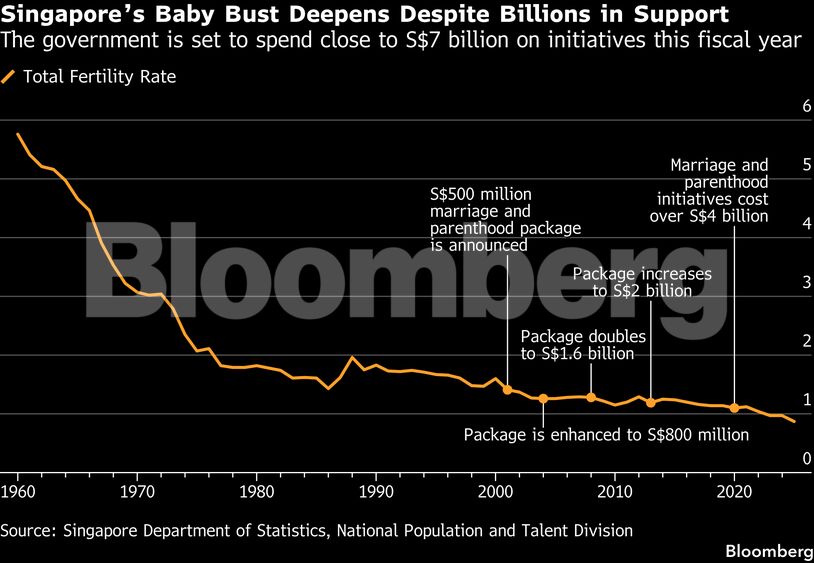
For a small but wealthy nation where citizens make up just 60% of the 6.1 million population, a total fertility rate that fell to a record low 0.87 last year represents an existential concern, especially as it’s on course to be a “super-aged” society. The problem is hardly unique to Singapore.
China’s birth rate dropped to its lowest on record last year, while Japan’s fertility rate also fell to a fresh low. In May, Taiwan announced plans to launch government-subsidized investment accounts for people between six and 18 years old to reverse its plummeting birth rate.
South Korea’s fertility rate has inched up for a second year — yet only to 0.8 — as marriages show signs of recovery after a prolonged slump, supported by incentives designed to ease the financial burden of raising children.
To help incentivize more children, Singapore is now aiming to underwrite almost the entirety of childhood, not just the first moments. Every Singaporean newborn will receive S$2,000 in child credits annually, a S$5,000 “first step” grant and thousands more as the years go on — in addition to the baby gift. The number of parental leave days was expanded as well.
All-in, each child will receive almost S$70,000 in direct assistance through age 17. The biggest pop from the crowd Sunday night came when Wong announced families applying for build-to-order flats will receive an additional ballot for every child they have or are expecting, drastically improving the odds of securing high-demand public housing.
“What we can do is make it easier for Singaporeans who want children to start and raise a family, and we want every family to know: If you choose to have children, the government will stand with you,” he said against a pink backdrop during his remarks at the Institute of Technical Education.
The drive for babies is a far cry from the “Two Is Enough” campaign launched in the early 1970s, when too many children was seen as a drag on the country’s development and resources. Since the city-state reversed course on population policy in 1987, measures have included thousands of dollars in handouts and extended maternity leave.
The government ran matchmaking events for university graduates and a short-lived program that gave children of highly educated mothers priority in primary-school registration if they had three or more children. Then-Prime Minister Lee Kuan Yew remarked at the time that women ought not to work “jobs where they cannot, at the same time, be mothers.”
Yet by 2010 and 2011, the birth rate had fallen to its lowest levels in nearly half a century of independence. With rates continuing to drop, the government set up a workgroup to review marriage and parenthood measures and, in February, announced plans to spend nearly S$7 billion on related initiatives this fiscal year.
Even still, Eugene Godfrey Lee, a 32-year-old executive senior financial consultant, said the latest measures may “kickstart the process” of planning for a family. “At the very least, it will let us feel more supported by the country,” he said.
The prime minister acknowledged the limits, saying on Sunday that Singapore would also have to continue welcoming immigrants while ensuring citizens remain the majority.
“All this means that in the coming years, our overall population will grow more slowly, and our labor force will grow more slowly too,” he said.
Disclaimer: This report is auto generated from the Bloomberg news service. ThePrint holds no responsibility for its content.