


New Delhi: Myanmar has been found guilty of committing genocide against its Rohingya minority by the International Court of Justice (ICJ), marking the first time the UN’s top court has held a state responsible for the crime. In a landmark judgment delivered on 19 November, the court ruled by a 9-6 majority that Myanmar violated its obligations under the Genocide Convention during the 2017 military campaign in northern Rakhine State.
The systematic campaign, described by Myanmar as “clearance operations”, began in August 2017 and resulted in the deaths of at least 10,000 Rohingyas. More than 700,000 fled to neighbouring countries, primarily Bangladesh.
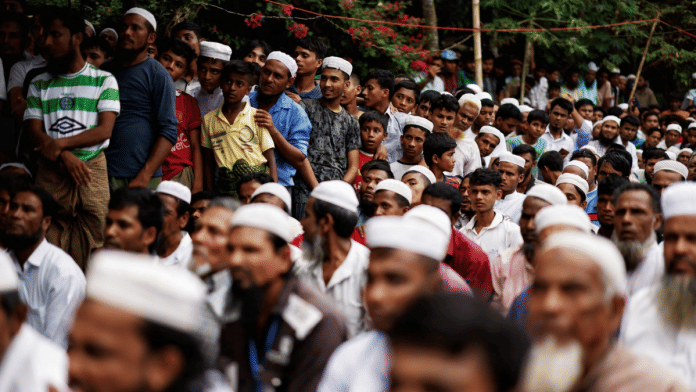
Rohingya refugees in Bangladesh’s Cox’s Bazar watched the live reading of the judgment as the court delivered its verdict in The Hague, Netherlands.
The ICJ held the Myanmar state responsible for genocide committed by its security forces and other state organs. Security forces collectively refers to the country’s armed forces, known as the Tatmadaw, the Border Guard Police and the police.
Reading out the judgment, ICJ President Yuji Iwasawa said the scale of the Rohingya population targeted by Myanmar was “substantial” to establish an inference of genocidal intent. The court noted that northern Rakhine State had a Rohingya population of approximately 815,000 and that the estimated 10,000 deaths represented around 1.2 per cent of this population. It observed that “a comparatively lower percentage of deaths does not, by itself, necessarily preclude a finding of genocidal intent”.
Towards the end of the final hearings, held in January this year, the legal representative of The Gambia, the West African nation that brought the case against Myanmar, invoked Charles Dickens’ Great Expectations: “Take nothing on its looks; take everything on evidence. There’s no better rule.” It was on evidence that the court established Myanmar’s culpability in a judgement running over 600 pages.
Also Read: Rohingya families in Jammu are paying more to leave India than they once paid to enter it
Why does this matter?
The word genocide was coined in 1944 by Polish-Jewish lawyer Raphael Lemkin, combining the Greek word genos (race or tribe) and the Latin suffix -cide (killing) to describe the Nazi atrocities against Jews during the Holocaust. When the Nuremberg Trials took place following World War II, the word did not make its way to the judgement since it was still in its infancy, but Lemkin’s efforts ensured genocide was recognised as a crime by the UN General Assembly (UNGA) in 1946.
On 9 December 1948, the UNGA adopted the Convention on the Prevention and Punishment of the Crime of Genocide, commonly known as the Genocide Convention. Until the ICJ’s latest ruling, the court had never found a state responsible for committing genocide. The verdict, which described Myanmar’s violations as being of “exceptional gravity”, set a 21st-century benchmark for the gravest of all international crimes.
Article II of the convention regards genocide as five acts committed with intent to destroy, in whole or in part, a national, ethnical, racial or religious group: a) Killing members of the group; (b) Causing serious bodily or mental harm to members of the group; (c) Deliberately inflicting on the group conditions of life calculated to bring about its physical destruction in whole or in part; (d) Imposing measures intended to prevent births within the group; and (e) Forcibly transferring children of the group to another group.
In its assessment, the court examined the material elements of the first four acts. It found that the evidence established the actus reus (the physical or material elements of a crime) under all. However, it said the evidence did not conclusively establish the material element under Article II (c), relating to the deliberate imposition of conditions of life calculated to bring about the group’s physical destruction.
Timeline of the case
The case, formally titled Application of the Convention on the Prevention and Punishment of the Crime of Genocide (The Gambia v. Myanmar: 11 States intervening), was filed by The Gambia in November 2019, with the backing of the Organisation of Islamic Cooperation (OIC).
Despite having no direct connection to the crimes, The Gambia was able to bring the case because it had ratified the Genocide Convention in 1978. Article IX of the conventionallows for disputes between parties “relating to the responsibility of a State for genocide” and related acts to be submitted to the ICJ.
In December 2019, the ICJ held hearings on The Gambia’s request for provisional measures to protect the Rohingyas remaining in Myanmar from further genocidal acts. On 23 January 2020, the court ordered Myanmar to prevent acts of genocide against the Rohingyas, ensure that its military and other security forces did not commit such acts, and take steps to preserve evidence relating to the allegations.
The court in its final verdict found that Myanmar had not duly implemented the provisional measures, failing to take effective measures to prevent the destruction and ensure the preservation of evidence. It also noted Myanmar’s non-cooperation and refusal to allow access to evidence and witnesses in its territory and to respond to the requests of the fact-finding bodies established by the United Nations to investigate the matter.
What lies ahead for the Rohingyas?
The verdict, by itself, is unlikely to end the violence and persecution faced by the Rohingya in Myanmar. The court has ordered Myanmar to cease its continuing violations of the convention, and to investigate, prosecute and punish those responsible for genocidal acts under Article III of the Convention. It also asked Myanmar to provide assurances and guarantees of non-repetition, which may include taking appropriate “legal and institutional reform to ensure compliance with relevant international human rights law, international humanitarian law and international criminal law obligations”.
The court also ordered full reparation and restitution, but the ICJ does not have the power to enforce its own rulings, and the UN Security Council (UNSC) would need to uphold the decision.
Speaking to ThePrint, Angshuman Choudhury, an expert on Myanmar and a doctoral candidate affiliated with King’s College London and the National University of Singapore, said that although the court’s directives were unlikely to be enforced anytime soon, the verdict was significant. “The judgment is a critical vindication of the Rohingya community’s position as victims of genocide and the painstaking documentation of countless Rohingya activists around the world who spent a decade to record their own systematic extermination,” he said.
Fiona Raval, a researcher with the South East Asia Research Programme at the Institute of Peace and Conflict Studies (IPCS) who has conducted fieldwork on the Rohingya, told ThePrint that the community continued to face persecution irrespective of which entity controlled the country.
“The genocide of 2017 happened under civilian rule, and the face of Myanmar’s democracy, Aung San Suu Kyi, defended those actions. The primary perpetrators of the violence have been the military who are now running the government,” she said.
Raval added that most of Rakhine State, where the Rohingya primarily reside, was currently under the control of the Arakan Army (AA), an ethnic armed group that does not recognise the Rohingya as native inhabitants of the region and regards them as outsiders. “The AA itself was accused of scorched-earth tactics like burning villages, forcible displacement, and orchestrating mass-killings”, Raval added.
Choudhury similarly noted that although the AA had established a parallel administration in Rakhine State, it was not technically an official authority representing Myanmar as a state party before the ICJ. Consequently, it had no legal obligation to comply with the court’s orders.
“The AA, representing the Rakhine Buddhist majority, shares a complicated relationship with the Rohingya minority and like the military, may not be interested in immediately resettling them in their original areas of residence in northern Rakhine. Further, since 2023, renewed armed conflict between the AA and the military junta in the Rohingya areas has damaged homes and other structures and trapped the minority in the crossfire,” he added.
The crisis, therefore, remains too complex for a single court verdict to resolve. Any lasting solution will require fundamental structural changes to Myanmar’s political and social institutions.
Global response
The ruling marks a significant precedent for international accountability and cooperation in confronting genocide and other mass atrocities. It could also influence other cases pending before the ICJ, particularly the genocide case brought by South Africa against Israel in December 2023 over its military campaign in Gaza.
US Ambassador to the UN, Mike Waltz, criticised the proceedings before the verdict, accusing ad hoc judge Navi Pillay of seeking to lower the legal threshold for proving genocide. In a statement, he warned that a weakened standard could later be “weaponized against American and allied soldiers whenever they raise a finger against terrorists that hide behind civilians”. Pillay was awarded the 2026 Nobel Peace Prize for her contributions to peace and international law.
The United Kingdom, which has already imposed sanctions on Myanmar’s military regime, announced plans to expel the country’s defence attaché and called for an urgent UNSC meeting to discuss the ruling. It also summoned Myanmar’s Chargé d’Affaires and said further measures could follow to ensure accountability.
Bangladesh, which hosts more than 1 million Rohingya refugees in overcrowded camps, welcomed the judgment and called on Myanmar to “promptly, fully and effectively” fulfil its obligations under the ruling.
Dhaka reiterated that the repatriation of Rohingyas to their homes in Myanmar remained the “only viable solution to the crisis”. It also expressed hope that the verdict would serve as a “critical catalyst for safe, voluntary and dignified return of the Rohingyas to Myanmar”.
The ruling may not immediately alter how Myanmar’s international partners engage with the military-backed government. However, Choudhury said it could provide them with a “solid incentive to pressure the regime to fix its ways, while bolstering the wider pro-democracy resistance in Myanmar today, which seeks a comprehensive overthrow of the military-backed government”.
At a time when Myanmar’s military-backed government, led by Min Aung Hlaing, who was elected president in April 2026, is seeking diplomatic legitimacy through engagements with regional and international governments, the judgment “may throw a spanner in the works”, Choudhury added.
(Edited by Chingkheinganbi Mayengbam)