



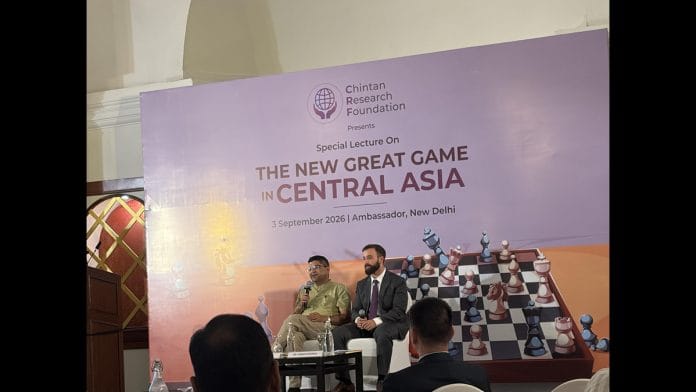
New Delhi: India is emerging as the biggest “loser” in the new “Great Game” unfolding across Central Asia, even as China, Russia and the United States make aggressive inroads into the region, said Joseph Epstein, director of the Turan Research Center in Washington and a senior fellow at the Yorktown Institute, in Delhi on Thursday.
Delivering a lecture at an event hosted by the Chintan Research Foundation, Epstein invoked the 19th century rivalry between the British empire and Russia in the region, saying, “The trick to engaging Central Asia is providing a counterbalance to prevent over-dependence on the other great powers in the region.”
Landlocked and ringed by Russia, China, Afghanistan and Iran, the region’s singular goal is avoiding dependence on any one patron, he said. Chinese investment sits alongside American mineral ventures; Russian security guarantees run parallel to European financing; Turkish drones share runway space with Israeli technology. “They are looking for a portfolio, not a patron,” Epstein said.
In Epstein’s blunt analysis, India is losing that competition. Islamabad blocks the most direct route west. Three decades of Indian corridor diplomacy, Epstein noted, have produced trade in the low single digits of billions of dollars.
But the failure, he argued, is one of framing, not effort. New Delhi has chased physical corridors it cannot control, when its real advantages need no corridor at all: digital public infrastructure like Aadhaar and UPI, already exported to a dozen countries, four decades of expertise keeping Soviet-era military hardware flying, as Russia’s own maintenance capacity erodes, generic pharmaceuticals, agricultural and water technology, and medical training.
Ties between India and Uzbekistan were elevated to a “comprehensive strategic partnership” on Sunday, while the two countries agreed to establish a “long-term arrangement” for the sale of uranium, as Prime Minister Narendra Modi met Uzbekistan President Shavkat Mirziyoyev. Mirziyoyev also conferred the Order of the Highest Friendship (Oliy Darajali Do’stlik) upon Modi in a ceremony in Tashkent on Sunday, recognizing the “enduring” friendship between the two countries.
This was Modi’s fourth visit to Uzbekistan and the second stand-alone bilateral visit. He earlier made visits in 2015, 2016 and 2022. Mirziyoyev is expected to travel to India in a couple of weeks for the BRICS summit.
Also Read: PM Modi’s Central Asia visit is a quest for a new Eurasian highway. Detouring around rivals
The Central Asian game
Central Asia splits into distinct tiers, Epstein said. Kazakhstan and Uzbekistan are the major poles—Kazakhstan through wealth and diplomatic sophistication, Uzbekistan through population and reformist momentum. Kyrgyzstan and Tajikistan lag, dependent on remittances, Tajikistan’s weight is underrated given its Afghan border and the outsized role of Tajik nationals in extremist networks. Turkmenistan stands apart, isolationist and gas-dependent, its pipeline policy leaving it reliant on China, the main builder of its export lines.
In this scenario, there were two events that, more than any grand strategy, reshaped the region’s trajectory. The first was the sudden death of Uzbekistan’s founding president, Islam Karimov, in 2016. His successor, Shavkat Mirziyoyev—a technocratic “administrator”, in Epstein’s words—opened the economy, settled border disputes and turned Tashkent from the biggest obstacle to regional integration into one of its champions.
The second was Russia’s 2022 invasion of Ukraine. With Moscow’s attention consumed, Central Asian and South Caucasus governments found room to maneuver — promoting national languages over Russian, deepening ties with Washington and Brussels, and absorbing Azerbaijan into their annual leaders’ summit. Baku’s 2023 victory over Armenia, and its refusal to be intimidated by Moscow or Tehran, made it something of a role model and indispensable, as gatekeeper of the Middle Corridor, the only Western trade route bypassing both Russia and Iran.
None of this, Epstein cautioned, reflects hostility toward Moscow. According to him, it was more fear of Russia, not defiance, that still shapes regional caution.
China’s money, Central Asian resentment
China is now Central Asia’s biggest trading partner. Trade between China and the region topped $100 billion last year, but resentment runs alongside the investment. “Resentment at the street level is real,” Epstein said, citing protests over land concessions, environmental damage and labour practices. Beijing has answered with vocational schools and Confucius Institutes, but has shown little appetite to provide security, focusing narrowly on Uyghur militancy and an Afghan buffer.
The other big player is Turkey. According to Epstein, the Organisation of Turkic States is real but transactional, undercut by an “older brother” posture the Central Asian region has resisted since the 1990s.
Washington, meanwhile, has abandoned its old ambition of prying the region from Russia or China, which according to him is “never achievable, given geography alone”, in favor of critical-minerals deals, Middle Corridor investment and inclusion in initiatives like the Abraham Accords.
Central Asia, Epstein concluded, therefore rejects exclusivity where even China, its dominant partner, doesn’t pressure states over their ties elsewhere.
Recalling Indian analyst C. Raja Mohan’s ‘Panipat complex’, Epstein said India needs a corrective approach and to act fast. “The region is not asking India for anything. What they want is another option, and that happens to be something that India could supply immediately at relatively low cost and without needing a border. In time, these arrangements will harden, and India will have a much harder time finding its way in.”
(Edited by Nardeep Singh Dahiya)
Also Read: India needs a passage into Central Asia. Uzbekistan can be its anchor