






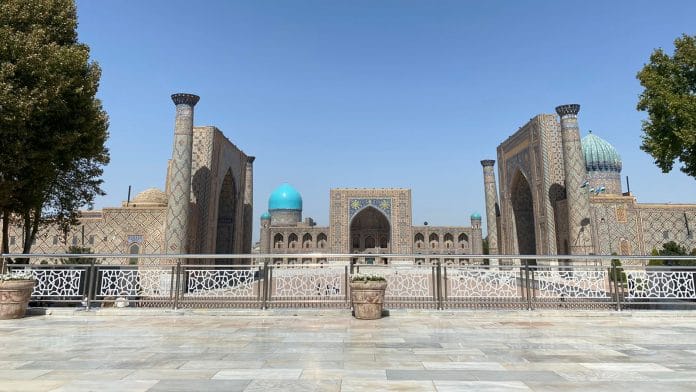

Prime Minister Narendra Modi’s engagement with Central Asia comes at an important moment for a region that has once again assumed a significant place in world geo-politics specially in the context of conflicts in West Asia. India’s participation in the Shanghai Cooperation Organisation, of which Uzbekistan is a member, reflects New Delhi’s sustained commitment to the security, connectivity, economic development and people-to-people ties of the region.
As India looks towards an Asia that is more connected and stable, its relationship with Uzbekistan acquires particular importance—not merely as a contemporary strategic partnership, but as one rooted in centuries of civilisational exchange.
For India, Central Asia has never been a distant geography. The Silk Route connected India with Central Asia via a network of trans Himalayan routes going through passes like the Bolan and the Khyber Pass. The multi-modal International North-South Transport Corridor scheduled to be completed by 2029 represents India’s robust efforts to reclaim the connectivity that the Silk Route once provided. India’s Connect Central Asia policy has aimed to renew the historical depths of relationship with the region encompassing political, economic, educational, cultural and people-to-people cooperation.
Uzbekistan occupies a special place in this story because the ties between the Indian subcontinent and the lands of present-day Uzbekistan stretch back to antiquity.
The Kushan Empire created one of the great connective spaces of the ancient world, linking Central Asia with Afghanistan and northern India. These networks facilitated the movement of merchants, monks, ideas and artistic traditions across vast distances. One of the most compelling physical reminders of this shared past survives in Uzbekistan itself. Kara Tepa and Fayaz Tepa near Termez preserve Buddhist archaeological remains dating to around the first century BCE, while Kara Tepa is home to the only cave monastery in Central Asia. These sites stand as remarkable testimony to the extent to which Buddhist ideas and Indian cultural influences travelled northwards through the ancient routes of Central Asia.
The historical relationship was never one-directional. Between the eighth and eleventh centuries, Central Asia became one of the great intellectual centres of the medieval world. Cities and scholarly networks across the region witnessed an extraordinary efflorescence in mathematics, astronomy, medicine, philosophy and literature. The intellectual achievements of this period has been referred to as an ‘enlightenment’ whose legacy has not often been given the significance it deserves.
The legacy of an ‘enlightenment’
Few figures illustrate this better than Abu Ali Ibn Sina (Avicenna) and Abu Rayhan Al-Biruni. Ibn Sina’s Canon of Medicine became one of the foundational works of medieval medical science; significantly, the work also referred to the Indian system of medicine and healing, including Ayurveda. Al-Biruni went further in building a direct intellectual bridge with India. He travelled to India, studied Sanskrit, Indian philosophy, astronomy and mathematics, and produced Kitab-al-Hind, one of the most important medieval scholarly accounts of Indian civilisation.
Abd-er-Razzak Samarqandi (15th Century), an ambassador and historian from Samarkand, he visited the Vijayanagara Empire in southern India during the 1440s. His detailed travelogue (Mat-a’ sad-dain wa-majma’ al-bahrain) provided valuable historical accounts of the royal court, administration, and urban life in South India
India was thus part of the wider circulation of knowledge that made the region an intellectual hub of the world. Indian mathematical and astronomical traditions travelled through these networks, while scholars from Central Asia engaged deeply with Indian thought. The exchange was sustained by the same routes that carried commerce and culture.
Samarkand and Bukhara, long renowned as centres of learning, scholarship and culture, remained powerful reference points in the intellectual and cultural imagination of the medieval world. The connections extended beyond dynastic history into architecture, language, literature, cuisine and traditions of scholarship. The double dome and the Charbagh layout of gardens evolved out of Uzbek influences. Even today, shared culinary traditions—from naan and non to pulao and pilaf, and from samosa to samsa—echo these centuries of interaction. The Naqshbandi Sufi tradition and other spiritual links provide another dimension to this shared heritage.
The close bonds that were forged with Uzbekistan during the Soviet Era contributed significantly to the vibrant ties that developed in modern times. Hindi has been taught at Tashkent State University of Oriental Studies since 1947, while other Uzbek universities also teach the language. There are currently ICCR Chairs for Hindi and Economics in Uzbekistan, and Indian literature has travelled into Uzbek through translations of works by Rabindranath Tagore, Premchand and Amrita Pritam. The Ramayana, Mahabharata and Mahatma Gandhi’s autobiography have also been translated into Uzbek. A Hindi-Uzbek dictionary released by Prime Minister Modi during his 2015 visit contains more than 23,000 words, while the two languages share thousands of common words.
The affection for Indian culture is equally visible in Uzbekistan’s enduring love for Indian cinema. Raj Kapoor is commemorated with a bust in Tashkent, while the Indo-Uzbek production Ali Baba aur 40 Chor, filmed in Uzbekistan in the 1970s, remains popular. Streets and public spaces named after Mahatma Gandhi and Lal Bahadur Shastri further demonstrate the warmth with which India’s leaders and cultural figures are remembered.
Also read: India cannot be summarised. After living here, I know why: Ecuadorian Ambassador
Ancient bonds to modern partnerships
The contemporary partnership has increasingly acquired a developmental dimension. India’s Jawaharlal Nehru India-Uzbekistan IT Centre, the Mahatma Gandhi Centre, ITEC and ICCR scholarships, and the presence of Indian universities in Tashkent, Andijan, Bukhara and Jizzakh reflect India’s commitment to capacity building and human-resource development. Nearly 2,700 Uzbek nationals have benefited from ITEC scholarships and 426 from ICCR scholarships. Uzbekistan is also an important destination for Indian educational engagement and an increasingly significant source of medical visitors to India.
People-to-people ties are being carried into the next generation. The India–Central Asia Youth Delegation, proposed by Prime Minister Modi at the first India–Central Asia Summit in January 2022, has brought successive groups of young Central Asians to India. By 2026, four editions had been held, with the programme designed to familiarise young Central Asians with India’s culture as well as its contemporary achievements in technology, development and innovation.
Yoga offers another contemporary expression of this civilisational connection. With Indian support, Uzbekistan became the first country in Central Asia to conduct yoga certification examinations under India’s Yoga Certification Board. Hundreds of Uzbek practitioners have received certification, while Tashkent hosted the seventh International Conference on Yoga in 2025—the first such flagship ICCR conference in Central Asia.
The story of India and Uzbekistan is therefore not simply one of shared history. It is a story of shared intellectual curiosity, cultural familiarity and human connection continually renewed across generations. Uzbekistan is a vital strategic and economic anchor for India in Central Asia, serving as a primary gateway to the broader Eurasian continent. It has been a highly reliable supplier of raw uranium and a critical untapped frontier for rare earth elements that anchors India’s long term energy security and needs of cutting-edge technology.
As India deepens its Connect Central Asia policy and works with its regional partners to advance security, connectivity, economic opportunity and human development, Uzbekistan will remain a pivotal partner.
Prime Minister Modi’s continuing engagement with Central Asia provides an opportunity to give this exceptional relationship fresh momentum. India and Uzbekistan can draw upon the depth of their shared past to build a future that contributes to peace and prosperity in Asia and beyond.
Dr. Ashwin Parijat Anshu is an associate professor of History at Delhi University. Views are personal.