



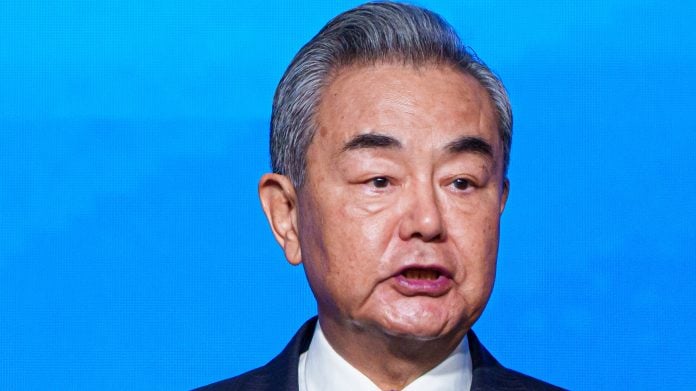
China’s top diplomat suggested relations with Japan had deteriorated to a low point unseen in decades, adding pressure on Japanese Prime Minister Sanae Takaichi to amend her Taiwan remarks.
Foreign Minister Wang Yi made the comment as he received a Japanese delegation led by former Foreign Minister Takeshi Iwaya on Monday, according to a statement from China’s Foreign Ministry.
“Current Sino-Japanese relations are once again facing a severe situation, requiring normalization once more,” he said, noting that 2027 marks the 55th anniversary of the establishment of diplomatic ties.
The language underscores the depth of China’s anger at Takaichi’s remarks last November publicly linking a crisis over Taiwan with the possible deployment of Japanese troops. Wang repeated China’s demand that Takaichi “correct” her remarks, which it sees as an affront to Beijing’s claims on the self-ruled democracy and a violation of the political foundations of bilateral ties.
Beijing has frozen diplomatic contact with Tokyo over the comments, and sees Iwaya’s visit as an unofficial exchange. Wang described the trade association as a civil-society group and called on the group to help steer Tokyo toward the “right choice.”
Three lawmakers from Japan’s ruling and opposition parties visited Beijing in late August. Iwaya, who served under Takaichi’s predecessor Shigeru Ishiba and is regarded as a moderate on China, took over the Association for the Promotion of International Trade after former Foreign Minister Yohei Kono died in June.
Chief Cabinet Secretary Minoru Kihara on Tuesday declined to comment on the meeting, while saying Japan should maintain communication with China at various levels. Japanese Trade Minister Ryosei Akazawa also refrained from commenting, noting Iwaya is not part of the administration, while reiterating he’s open to dialogue with his counterpart.
The meeting came days after President Xi Jinping pressed Beijing’s positions on Taiwan and Japan during a summit with Donald Trump in the US. Xi urged the US to oppose Taiwan independence and invoked the two countries’ shared fight against Imperial Japan in an effort to portray changes in Tokyo’s security policy as part of a revival of militarism. The White House acknowledged that the leaders recalled the allyship during Xi’s state visit in a factsheet.
Beijing claims the self-governed democracy as part of its territory and opposes moves it sees as supporting Taiwan’s formal independence. Taipei has rejected that claim, asserting the island is already a de facto independent nation.
China has protested the Japanese government’s efforts to raise defense spending, revise its pacifist constitution and three non-nuclear principles, calling them signs of return to “militarism” that led to Japan’s World War II history of aggression in Asia. Tokyo has dismissed such criticisms as “hypocritical.”
In his meeting with Iwaya, Wang again referred to wartime history, praising Kono for confronting Japan’s past and warning that Tokyo would be unable to “face the world” if it erased its history of aggression or glorified convicted war criminals.
Disclaimer: This report is auto generated from the Bloomberg news service. ThePrint holds no responsibility for its content.