





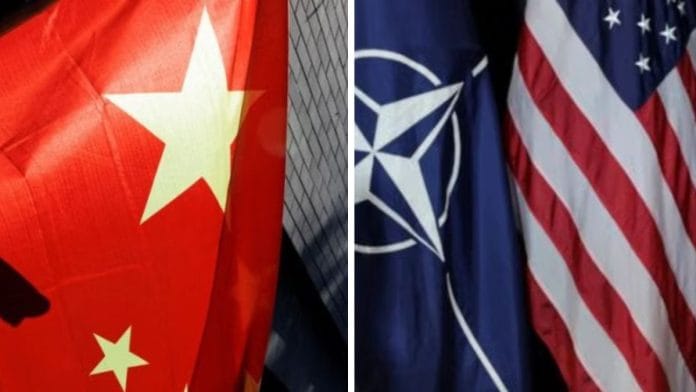


New Delhi: China called on the US to halt “armed attacks” on civilian nuclear facilities in non-nuclear weapon states while NATO accused Beijing of “rapidly” expanding its arsenal without transparency, as countries finalise their positions ahead of the 11th review conference of the Non-Proliferation of Nuclear Weapons (NPT) treaty.
Guo Jiakun, spokesperson for China’s Ministry of Foreign Affairs, said at a press briefing Monday that Beijing was “highly concerned over the challenges the NPT faces”.
The review conference, which opens in New York next week, “should urge the US to fulfill its special and primary responsibility for nuclear disarmament and stop armed attacks on nuclear facilities for peaceful purposes in non-nuclear-weapon party states,” Guo said.
He added: “[The US should] stop building nuclear alliances based on nuclear sharing arrangements, take measures to hold back the negative moves of countries like Japan to possess nuclear weapons, and properly settle the nuclear proliferation risks brought by nuclear submarine cooperation among the US, the UK and Australia.”
Guo’s statement was referring to the American and Israeli strikes on Iranian nuclear facilities in June 2025 and the ongoing conflict between Washington, Tel Aviv and Tehran.
China also named AUKUS—the trilateral security pact between the US, the UK and Australia, under which Canberra is to acquire nuclear-powered submarines within the next decade—as a mechanism for the spread of sensitive technologies.
The partnership was conceived as a counterweight to China’s naval build-up in the Pacific.
On the other side, the North Atlantic Treaty Organization (NATO), in a statement Tuesday, offered a contrasting account of who is driving proliferation.
“Today’s deteriorating security environment poses challenges relevant to the NPT, as proliferation crises continue and escalate,” the 32-member alliance of countries primarily from Europe and North America said.
“Russia has violated crucial arms control commitments and employed irresponsibly threatening nuclear rhetoric. China continues to rapidly expand and diversify its nuclear arsenal without transparency. Both have increased ties with states that seek to proliferate nuclear weapons and undermine international arms control,” the alliance said.
On its own nuclear posture, NATO was unequivocal: “As long as nuclear weapons exist, NATO will remain a nuclear alliance. The fundamental purpose of NATO’s nuclear capability is to preserve peace, prevent coercion, and deter aggression. Allies have always adhered to their obligations under the NPT and continue to do so.”
The alliance’s nuclear posture rests principally on the American nuclear umbrella. The UK and France are NATO’s only other nuclear-armed members.
Anxiety over Washington’s long-term commitment to European security has already produced a consequential French shift. Last month, President Emmanuel Macron reversed three decades of French policy on nuclear restraint, scrapping the 300-warhead ceiling first set in 2008 and announcing that Paris would no longer publish its arsenal figures. Macron also outlined a doctrine of “advanced deterrence” that would extend France’s nuclear umbrella over seven European allies.
The competing positions will be staged at the 11th NPT Review Conference, which opens on 27 April at the United Nations headquarters in New York City and concludes on 22 May.
The treaty counts nearly every country in the world among its parties, including Iran.
But India, Pakistan and Israel have never signed the NPT. South Sudan, independent only since 2011, is also not a party.
Also Read: Trump’s Iran war fits an old US pattern. As always, it will shift the global order